
BNB's Strategic Position in Institutional Investment Portfolios
The recent announcement by China Renaissance, a Hong Kong-listed investment bank, to raise $600 million for a Binance Coin (BNB)-targeted fund marks a pivotal moment in the institutional adoption of blockchain assets. This initiative, co-led with YZi Labs (the family office of Binance founder Changpeng Zhao), underscores a strategic shift in how traditional financial institutions view digital assets-not as speculative gambles, but as core components of diversified portfolios. By allocating $200 million of its own capital and partnering with institutional investors to secure an additional $400 million, China Renaissance has positioned BNBBNB-- as a cornerstone of its digital treasury strategy[1]. This move mirrors the corporate treasury model popularized by Bitcoin-focused firms like StrategyMSTR--, where digital assets are held as institutional-grade reserves[4].
BNB's Ecosystem as a Catalyst for Institutional Confidence
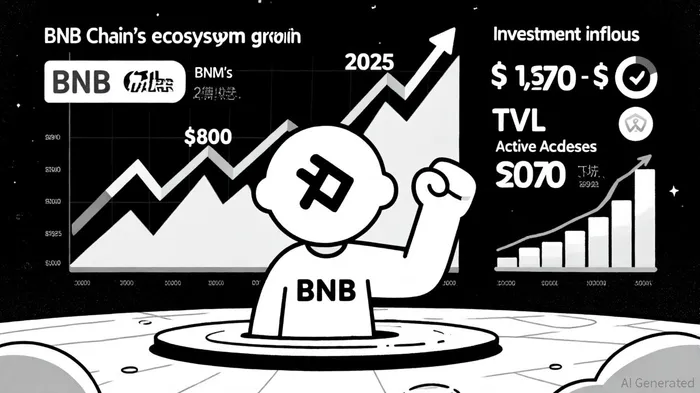
BNB's institutional appeal is rooted in its robust ecosystem and deflationary mechanics. The BNB Chain, which processes over 3.2 million active addresses and $9.06 billion in TVL, has become a high-throughput, low-cost blockchain platform[1]. Its "Yellow Season" roadmap, which includes sub-second block times and gasless transactions, positions it as a scalable infrastructure for both decentralized finance (DeFi) and real-world applications[1]. BNB's utility extends beyond trading fee discounts on Binance; it now facilitates yield-earning opportunities, token sales, and even purchases via Binance Pay, bridging digital and physical economies[3].
The token's deflationary supply model further enhances its value proposition. With 31% of its total supply burned, BNB's scarcity is increasingly aligned with institutional demand. This dynamic has created a flywheel effect: as more institutions allocate to BNB, circulating supply tightens, and price appreciation follows. For example, China Renaissance's initial $100 million investment in August 2025 pushed BNB to an all-time high of $1,370[1]. Analysts note that BNB's Sharpe ratio of 2.5 over five years-outperforming traditional indices and other large-cap cryptocurrencies-highlights its strong risk-reward profile[3].
Institutional Trends and the BNB Chain's Competitive Edge
The China Renaissance fund is part of a broader institutional trend. Over 30 publicly traded companies have collectively allocated $1.2 billion to BNB in 2025, with Binance's founder emphasizing the token's role as a multi-chain asset and institutional bridge[2]. This momentum is amplified by regulatory clarity, such as the U.S. GENIUS and CLARITY Acts, which have legitimized stablecoins and digital asset treasuries (DATs)[3]. BNB's institutional adoption is further reinforced by strategic partnerships, including Kazakhstan's Alem Crypto Fund, which invested in BNB as its first asset[1].
Compared to competitors like EthereumETH-- and SolanaSOL--, BNB Chain's TVL ($17.1 billion) and DEX volume ($108 billion weekly) outpace both, despite Solana's 20% block capacity upgrades[3]. BNB's target of 20,000 TPS by 2026 and 1.875-second block finality positions it as a viable alternative for institutional-grade infrastructure[1].
Implications for the Future of Digital Asset Investing
China Renaissance's $600 million fund signals more than just capital-it reflects a paradigm shift in how institutions evaluate digital assets. By structuring the fund as a U.S.-listed DAT company, the firm is creating a compliant, familiar vehicle for traditional investors to access BNB's growth potential[1]. This approach could catalyze a wave of institutional allocations, particularly in Asia, where regulatory frameworks are increasingly accommodating.
Moreover, BNB's integration into corporate treasuries mirrors Bitcoin's trajectory. As Strategy has demonstrated, holding BitcoinBTC-- as a reserve asset can generate alpha while hedging against macroeconomic volatility. BNB's dual role as a utility token and store of value offers similar advantages, with added benefits from its deflationary model and ecosystem-driven demand[4].
Conclusion
China Renaissance's BNB-targeted fund is a watershed moment for institutional crypto investing. It validates BNB not just as a speculative asset, but as a strategic reserve with tangible utility, scarcity, and scalability. As more institutions follow suit, BNB's position in global portfolios is likely to strengthen, cementing its role as a linchpin in the convergence of traditional finance and blockchain innovation.





Comentarios
Aún no hay comentarios