
BNB's Strategic Position Amid Crypto Market Volatility
In the volatile landscape of 2025, Binance Coin (BNB) has emerged as a resilient asset, leveraging structural upgrades, institutional adoption, and deflationary mechanics to navigate market turbulence. As crypto markets grapple with macroeconomic uncertainty, BNB's strategic positioning—rooted in both near-term catalysts and long-term value retention—offers a compelling case for investors seeking stability amid chaos.
Near-Term Catalysts: Infrastructure and Institutional Momentum
BNB's Q3 2025 upgrades, including the Pascal hard fork, have introduced smart account functionality with gasless transactions and batch processing, significantly enhancing developer efficiency and user experience on the BNBBNB-- Chain [2]. Complementing this, the Lorentz and Maxwell updates have slashed block processing times to 1.5 seconds and 0.75 seconds, respectively, positioning the network to rival Ethereum's scalability while maintaining lower fees [2]. These improvements are not merely technical; they signal a broader effort to attract decentralized application (dApp) developers and institutional capital.
Institutional adoption has further accelerated, with VanEck's filing for a spot BNB ETF marking a pivotal moment for mainstream acceptance [2]. This development, coupled with the BNB Treasury Company's initiatives to bridge institutional investors to the ecosystem, underscores a structural shift toward regulated market participation. Analysts note that such moves could stabilize BNB's price by reducing speculative trading and fostering long-term accumulation [1].
Long-Term Value Retention: Deflationary Mechanics and Ecosystem Expansion
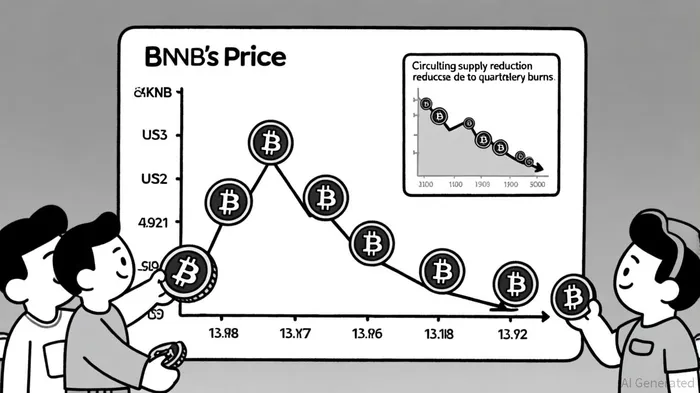
BNB's deflationary strategy remains a cornerstone of its value proposition. The 31st quarterly token burn in April 2025 eliminated 1.57 million BNB, valued at nearly $1 billion, reducing the circulating supply and enhancing scarcity [2]. This automated process, now transparently governed by community input, has evolved into a decentralized mechanism that aligns with investor confidence [3]. By Q3 2025, the BNB Foundation executed another major burn of 1,595,599.78 BNB, further tightening supply [1].
Beyond tokenomics, BNB's ecosystem expansion into real-world assets (RWAs) and corporate treasuries has diversified its utility. The tokenization of U.S. equities via xStocks and infrastructure upgrades like a Rust-based client and Super Instructions—aiming to process 5,000 decentralized exchange swaps per second—highlight BNB Chain's ambition to become a global financial infrastructure layer [4]. These innovations, combined with a growing total value locked (TVL) driven by platforms like Four.meme, suggest a self-sustaining network effect [2].
Navigating Bear Markets: A Dual-Pronged Strategy
While crypto markets remain prone to volatility, BNB's dual focus on technical innovation and institutional integration provides a buffer against downturns. The deflationary model ensures that even in bear markets, reduced supply can counterbalance demand shocks. Meanwhile, institutional-grade products like tokenized stocks and 24/7 trading access for non-U.S. investors create a flywheel of adoption that transcends traditional market cycles [3].
Critically, BNB's roadmap includes further block gas limit increases and AI-powered dApps, which could drive utility in both bull and bear phases [1]. Analysts project a conservative $800 to bullish $1,200 price range for 2025, with the token's scarcity and utility acting as tailwinds [1].
Conclusion
BNB's strategic position in 2025 is defined by its ability to balance immediate catalysts—such as network upgrades and ETF filings—with long-term value retention through deflationary mechanics and ecosystem diversification. As markets oscillate between optimism and pessimism, BNB's structural advantages position it as a potential safe-haven asset within the crypto space. For investors, the key takeaway is clear: BNB's resilience lies not in speculative hype but in its capacity to adapt, innovate, and integrate with global financial systems.






Comentarios
Aún no hay comentarios