
BNB's Rapid Market Cap Growth and Its Implications for Crypto Investment Strategy
The cryptocurrency landscape in 2025 is marked by a seismic shift in market dynamics, with Binance Coin (BNB) emerging as a pivotal asset in both speculative and institutional portfolios. As of October 2025, BNB's market capitalization has surged to over $180 billion, securing its position as the third-largest cryptocurrency globally, trailing only BitcoinBTC-- and EthereumETH--, according to a BNB $100M institutional backing report. This growth is notNOT-- merely a function of speculative fervor but is underpinned by structural developments in the BNBBNB-- Chain ecosystem, institutional adoption, and a diversification of use cases that align with broader macroeconomic trends. For forward-looking investors, understanding BNB's trajectory offers critical insights into how to strategically allocate capital in an increasingly fragmented digital asset market.
Structural Catalysts for BNB's Growth
BNB's ascent is driven by its role as the linchpin of the Binance Smart Chain (BSC), which has evolved into a robust infrastructure for decentralized finance (DeFi), non-fungible tokens (NFTs), and cross-chain solutions. The BNB Chain processes 12–17 million daily transactions, with gas fees as low as 0.15 Gwei and sub-second block times, making it one of the most scalable blockchains in the industry, as detailed in the BNB Chain ecosystem report. This technical efficiency has attracted developers and users, with the ecosystem's Total Value Locked (TVL) reaching $17.1 billion in 2025, led by platforms like PancakeSwapCAKE-- and AsterASTER-- Protocol, according to the same report.
Moreover, BNB's deflationary mechanics-quarterly token burns that have removed over 31% of its total supply-have reinforced its scarcity narrative, a feature that resonates with both retail and institutional investors, per The Currency Analytics. According to a report by The Currency Analytics, this supply reduction has been a key driver of BNB's price appreciation, with the token hitting an all-time high of $1,236.74 in October 2025, as covered in a Cointelegraph article. Such fundamentals distinguish BNB from many of its peers, which often lack clear utility or governance frameworks.
Institutional Adoption and Mainstream Legitimacy
Institutional interest in BNB has surged, signaling a new phase of mainstream adoption. Publicly traded firms, including China Renaissance, Nano Labs, and Windtree Therapeutics, have collectively invested over $1.2 billion in BNB, reflecting confidence in its long-term value proposition, per The Currency Analytics. This trend is further amplified by a VanEck proposal for the first U.S. BNB ETF, which, if approved, could unlock billions in institutional capital.
The BNB Chain's strategic partnerships with traditional financial infrastructure providers have also bridged the gap between decentralized and centralized systems. For instance, cross-chain bridges developed in collaboration with Celer and Stargate FinanceSTG-- enable seamless asset transfers between BNB Chain and Ethereum, enhancing liquidity and interoperability, as described in the Cointelegraph article. These integrations position BNB as a critical node in the broader blockchain ecosystem, reducing its exposure to the volatility of niche markets.
Diversification and Risk Mitigation
For investors seeking to diversify their digital asset portfolios, BNB's multifaceted utility offers a compelling case. Unlike speculative assets that derive value from fleeting trends, BNB's role in transaction fees, smart contracts, and cross-chain protocols ensures a recurring demand. As noted in the BNB Chain ecosystem report, the token's integration into DeFi platforms like AaveAAVE-- and VenusXVS-- via wrapped BNB (wBNB) has expanded its use cases beyond its native chain. This cross-chain liquidity not only enhances BNB's utility but also mitigates risks associated with single-chain exposure.
Furthermore, BNB's alignment with real-world asset (RWA) tokenization and cross-border payment solutions underscores its potential to serve as a bridge between traditional and digital finance, a point also highlighted by Cointelegraph. For instance, BNB Greenfield-a decentralized storage layer-facilitates cross-chain data sharing, enabling NFT platforms and DeFi protocols to operate with greater efficiency, as noted in the BNB Chain ecosystem report. Such innovations position BNB as a versatile asset capable of adapting to evolving market demands.
Strategic Allocation in a Volatile Market
While BNB's growth is impressive, investors must balance optimism with caution. The token's rapid appreciation has outpaced many altcoins, but its success is contingent on the continued expansion of the Binance ecosystem and regulatory clarity. A strategic allocation in BNB should, therefore, be part of a broader portfolio that includes Bitcoin, Ethereum, and other high-conviction assets.
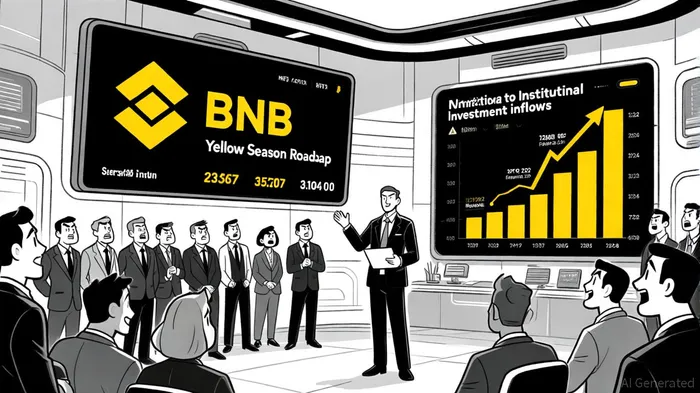
Data from Gate.com suggests that BNB's market capitalization growth is supported by a 1.34% graduation rate in memecoinMEME-- projects like Four.meme, indicating strong user engagement and liquidity, according to the BNB Chain ecosystem report. However, investors should monitor macroeconomic indicators, such as interest rate cycles and regulatory developments, which could impact risk-on sentiment. For those with a medium-term horizon, BNB's technical upgrades-such as the Yellow Season roadmap aiming for 20,000 TPS by 2026-provide a compelling long-term thesis, as detailed in the BNB Chain ecosystem report.
Conclusion
BNB's rapid market capitalization growth is a testament to its evolving role in the crypto ecosystem. From institutional adoption to cross-chain innovation, the token has demonstrated resilience and adaptability in a highly competitive market. For investors, the key lies in recognizing BNB's unique position as a utility-driven asset with defensible fundamentals. While no investment is without risk, a strategic allocation in BNB can enhance portfolio diversification and capitalize on the ongoing convergence of decentralized and traditional finance.






Comentarios
Aún no hay comentarios