
BNB's Price Momentum and Future Trajectory After Breaking All-Time Highs
Binance Coin (BNB) has recently shattered all-time highs, trading above $1,112 in September 2025, driven by a confluence of factors that underscore its evolving role in the crypto ecosystem. This surge is not merely speculative but rooted in structural improvements to the BNBBNB-- Chain, robust staking demand, and aggressive token-burning mechanisms. To assess BNB's future trajectory, it is critical to dissect these three pillars of value creation and their interplay with market dynamics.
Network Usage: A Foundation for Sustained Demand
The BNB Chain's network metrics in September 2025 reveal a thriving ecosystem. Active addresses surged to 73.24 million, a record high, while transaction volume hit 4.34 million, the second-highest monthly total in its history, according to a Cryptonomist article. These figures reflect not just transactional activity but also growing adoption of decentralized applications (dApps) and cross-chain interactions. Total Locked Value (TLV) on the chain rose to $8.23 billion, a 2.5% 24-hour increase, signaling renewed confidence in DeFi protocols and staking platforms, as reported by Cryptonomist.
Such metrics are pivotal for BNB's price momentum. Increased network usage directly correlates with higher demand for BNB, as users pay gas fees, stake tokens, or participate in governance. For instance, the rise in TLV indicates that more capital is being locked into BNB-based protocols, which in turn drives token utility and scarcity. As stated by CryptoPotato, "The BNB Chain's ability to sustain high active addresses and TLV is a testament to its role as a foundational layer for Web3 innovation."
Staking Demand: Balancing Yield and Supply Dynamics
Staking has emerged as a double-edged sword for BNB's price. Platforms like Binance Simple Earn offer flexible staking with no lock-up periods and APYs as low as 1%, while DeFi platforms such as PancakeSwapCAKE-- provide higher returns (up to 15%) for longer-term commitments, according to a HedgeWithCrypto guide. This diversity attracts a broad user base, from retail investors seeking passive income to institutional players optimizing liquidity.
However, staking's impact on price is nuanced. When APYs are high, more BNB is staked, reducing circulating supply and potentially pushing prices upward. Conversely, lower APYs can lead to selling pressure as investors liquidate positions. For example, Binance's dual investment model saw APYs spike to 129.39% in certain periods, incentivizing mass staking and temporarily tightening supply, a trend reported by Cryptonomist. Yet, platforms like KuCoin and Trust Wallet, with APYs ranging from 8.25% to over 30%, introduce volatility by competing for liquidity, as noted by CryptoPotato. This dynamic creates a feedback loop: higher staking demand reduces supply, which could drive prices up, but also risks over-concentration in platforms with security vulnerabilities, according to the HedgeWithCrypto guide.
Token Burns: A Deflationary Tailwind
BNB's quarterly token-burning mechanism remains a cornerstone of its value proposition. In September 2025, the 31st burn removed 1.58 million BNB tokens, valued at $916 million, reducing the total supply to 139.31 million from an initial 150 million, as reported by CryptoPotato. Since 2022, cumulative burns have exceeded $14.2 billion, eroding supply by over 30%, according to an IcoinMarket article.
While the immediate price impact of the September burn was muted-BNB traded around $580.23 post-burn-historical data suggests a longer-term correlation between burn magnitude and price appreciation. For instance, a $1 billion burn in early 2024 coincided with BNB's price doubling from $300 to $600, a pattern noted by IcoinMarket. Analysts at CryptoPotato argue that "the deflationary narrative is gaining institutional traction, with BNB's supply reduction now comparable to Bitcoin's halving events in terms of market psychology."
However, the relationship is not linear. In late 2024 and 2025, larger burns failed to trigger proportional price jumps, indicating that other factors-such as decentralized exchange (DEX) volume and macroeconomic conditions-now play a more significant role, IcoinMarket observed. This underscores the importance of viewing burns as part of a broader ecosystem strategy rather than a standalone driver.
Future Trajectory: Optimism Amid Risks
Looking ahead, BNB's trajectory hinges on its ability to maintain network growth, optimize staking incentives, and sustain burn rates. Projections suggest BNB could reach $1,521 by 2026 and $17,085 by 2030, driven by Binance's ecosystem expansion, the Maxwell hard fork's efficiency gains, and the token's deflationary mechanics, according to CoinPedia's prediction. Institutional adoption, such as VanEck's proposed BNB ETF, further bolsters bullish sentiment, CoinPedia notes.
Yet, risks persist. Regulatory scrutiny, particularly in markets like the U.S. and EU, could disrupt BNB's adoption. Geopolitical tensions and macroeconomic headwinds, such as rising interest rates, may also dampen investor appetite. As noted by CoinPedia, "BNB's success will depend on its ability to navigate regulatory complexity while scaling its utility beyond trading fees."
Conclusion
BNB's recent price surge is a product of its ecosystem's resilience and strategic innovation. The interplay of network usage, staking demand, and token burns creates a self-reinforcing cycle of value creation. While challenges remain, the token's deflationary structure and expanding utility position it as a compelling long-term investment. Investors should monitor quarterly burns, staking APY trends, and regulatory developments to gauge its trajectory in the coming years.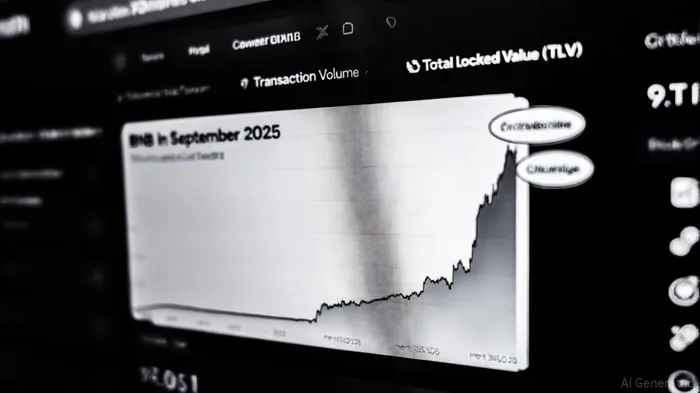






Comentarios
Aún no hay comentarios