
BNB Chain Surpasses Solana in Stablecoin Inflows: A Turning Point or a Transient Reversal?
The stablecoin market in Q4 2025 witnessed a seismic shift as BNBBNB-- Chain and SolanaSOL-- vied for dominance in capital flows. While Solana's ecosystem has long been celebrated for its speed and DeFi innovation, BNB Chain's strategic focus on low-cost infrastructure and utility agreements has sparked a critical question: Is this a structural realignment in blockchain adoption, or a temporary blip in a fragmented market?
Solana's Stumble and BNB Chain's Surge
Solana's Q4 2025 performance was a mixed bag. The chain reported $1.02 billion in net inflows from newly launched ETFs and $1.4 billion in network revenue-a 48-fold increase over two years. However, its stablecoin supply reached $14.8 billion by year-end, which was overshadowed by a 97% drop in active traders and a 58% decline in SOL's price during the memecoinMEME-- slump according to market data. This volatility exposed Solana's reliance on speculative activity, particularly in its memecoin-driven DEX volume of $1.5 trillion.
BNB Chain, meanwhile, leveraged its "0 Fee Carnival" initiative to subsidize stablecoin transfers, driving weekly stablecoin volumes to $30 billion. By Q4, its stablecoin supply had doubled to $14 billion, with daily stablecoin volumes exceeding $124 billion according to trading data. This growth was underpinned by BNB Chain's focus on retail and peer-to-peer commerce, attracting projects like a major platform that migrated from Solana in 2025, citing lower fees and a larger user base.
Capital Flow Dynamics: Speed vs. Scale
The divergence in capital flows between the two chains reflects their distinct value propositions. Solana's appeal lies in its blistering transaction speeds and DeFi ecosystem, which attracted institutional interest and USDC dominance (70% of its stablecoin supply). However, its Q4 network activity collapse-despite $782 billion in SOL-stablecoin trading volume-highlighted vulnerabilities in liquidity concentration and user retention.
BNB Chain, conversely, prioritized scalability and cost efficiency. Its Parallel Execution upgrades reduced block times and boosted transaction throughput, while its TVL of $3.89 billion underscored its role as a stablecoin infrastructure hub. The chain's ability to attract projects from Solana, such as a major platform in 2025, illustrates its competitive edge in balancing low fees with a mature user base.
Regulatory Clarity and Institutional Tailwinds
The broader stablecoin market's $290 billion market cap in Q4 2025 was fueled by clearer U.S. regulatory signals and institutional adoption. EthereumETH-- remained the dominant network, but Solana and BNB Chain capitalized on fragmented liquidity. Solana's DeFi ecosystem and BNB Chain's utility-driven approach both benefited from this environment, though their trajectories diverged.
Solana's institutional appeal- bolstered by its $1.4 billion in network revenue-was offset by its Q4 user exodus. BNB Chain, however, leveraged its TVL and stablecoin infrastructure to secure long-term partnerships, positioning itself as a reliable backbone for cross-chain commerce.
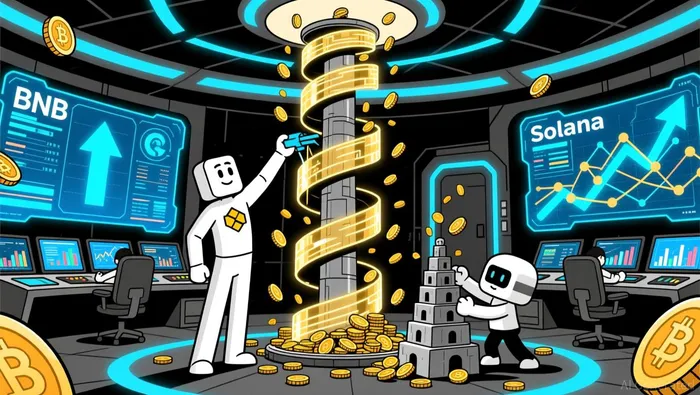
A Turning Point or a Transient Reversal?
The question of whether BNB Chain's surpassing of Solana in stablecoin inflows is a turning point hinges on sustainability. Solana's technical advantages and DeFi momentum suggest a potential rebound, particularly if institutional interest in its ecosystem stabilizes. However, BNB Chain's focus on low-cost, high-volume use cases-such as retail payments and cross-border commerce- aligns with macroeconomic trends favoring stablecoin utility over speculation.
For investors, the key lies in monitoring network activity metrics. Solana's Q4 collapse in active traders raises red flags, while BNB Chain's consistent TVL growth and strategic initiatives like the "0 Fee Carnival" indicate resilience. The stablecoin market's 54% year-over-year transaction growth also suggests that both chains will remain relevant, but their roles may evolve: Solana as a high-speed DeFi hub and BNB Chain as a utility-driven infrastructure layer.
Conclusion
The Q4 2025 data paints a nuanced picture. While BNB Chain's stablecoin inflows outpaced Solana's in the short term, the broader blockchain landscape remains fragmented. Solana's technical prowess and institutional backing could yet reclaim its position, but BNB Chain's strategic focus on cost efficiency and utility has created a durable foundation. For now, this appears to be a structural shift-driven by regulatory clarity and institutional adoption-rather than a transient reversal. Investors should watch for further migrations, TVL trends, and regulatory developments to gauge the longevity of this realignment.






Comentarios
Aún no hay comentarios