
Why BNB Chain (BNB) and Ethereum (ETH) Dominate Altcoin Adoption Metrics in 2026
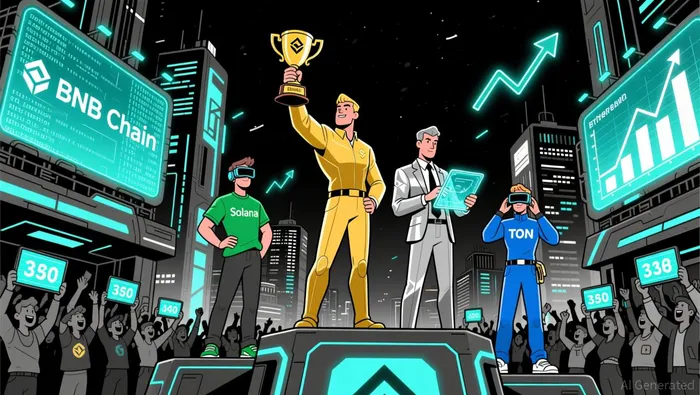
The blockchain landscape in 2026 is defined by two dominant forces: BNB Chain (BNB) and Ethereum (ETH). While altcoins like SolanaSOL-- and TONTON-- have shown flashes of innovation, their underperformance in critical metrics-wallet growth, DeFi utility, and institutional adoption-highlights the enduring strength of BNBBNB-- and ETHETH--. This analysis unpacks why these two chains remain the bedrock of altcoin adoption, and what this means for investors seeking exposure to utility-driven blockchains.
User Base Growth: BNB and ETH's Unstoppable Momentum
BNB Chain's Scalability Edge
BNB Chain's dominance in daily active wallets is a testament to its strategic focus on scalability and affordability. By Q4 2025, BNB Chain averaged 4.32 million daily active wallets, outpacing Solana's 3.23 million and Ethereum's weaker retail engagement. This growth was fueled by the Lorentz and Maxwell upgrades, which slashed block times and fees, making BNB Chain a go-to platform for high-volume use cases like decentralized exchanges (DEXs) and cross-chain bridges.
Ethereum's Institutional Resilience
While EthereumETH-- lagged in retail metrics, its institutional strength anchored its relevance. Ethereum's EIP-4844 upgrade in early 2025 reduced Layer 2 data costs, enabling throughput of over 5,600 transactions per second (TPS) and daily peaks of 1.74 million transactions. Meanwhile, Ethereum's DeFi Total Value Locked (TVL) hit $99 billion by year-end 2025, driven by institutional confidence in its composability and security. Over 3.5 million ETH units were held in ETFs by early 2025, signaling a shift toward institutional-grade adoption.
Solana and TON's Stumbles
Solana, despite its 65,000 TPS throughput and memecoin-driven hype, faced volatility in user retention. Its daily active wallets plateaued at 3.2 million, while TON's active wallets dropped from 9.2 million to 6.8 million in a single month. TON's integration with Telegram's wallet ecosystem initially drove 21 million activated wallets by September 2024, but its lack of robust DeFi infrastructure and developer tools limited long-term utility.
Network Utility: DeFi, Developer Activity, and Enterprise Partnerships
Ethereum's DeFi Supremacy
Ethereum's TVL dominance ($99 billion) and 88 million deployed smart contracts underscore its role as the "world computer" for decentralized finance. Its L2 ecosystem-anchored by rollups like ArbitrumARB-- and Optimism- processed $1.74 billion in daily transactions, cementing its position as the backbone of DeFi. Institutional demand for Ethereum-based ETFs ($35 billion in ETH held) further reinforced its financial infrastructure appeal.
BNB Chain's Enterprise Play
BNB Chain carved out a niche in enterprise blockchain adoption, particularly in fintech and payments. By 2025, it handled 30% more enterprise RPC requests than Ethereum, thanks to sub-1-second block times and $0.01 gas fees. Binance's ecosystem incentives and EVM compatibility attracted Ethereum-based projects to migrate, boosting BNB Chain's TVL to $58 billion. Its 2026 roadmap aims to scale throughput to 20,000 TPS while maintaining low costs, positioning it as a high-performance trading chain.
Solana's Speed vs. Utility Gap
Solana's $23 billion DeFi TVL in 2025 (peaking at $13.22 billion in September) highlighted its appeal for high-frequency trading and AI agents. However, its TVL declined to $8.86 billion by January 2026, reflecting volatility in user trust after network outages. While Solana's 725 million new wallets and $1.5 trillion DEX volume showcased activity, its ecosystem lacked the composability and institutional safeguards of Ethereum.
TON's Niche Appeal
TON's integration with Telegram's 700 million users drove explosive adoption of USDt-TON (36.2 million new wallets and $39.6 billion in transaction volume). However, its TVL and developer activity remained underreported, with no direct data on dApp counts or institutional partnerships. This lack of transparency and utility depth left TON as a speculative play rather than a foundational blockchain.
Investment Implications: BNB and ETH as Core Holdings
For investors, the contrast between BNB/ETH and altcoins like Solana and TON is stark. BNB Chain's enterprise-grade scalability and Ethereum's institutional-grade DeFi infrastructure create flywheels of adoption that are hard to replicate. Both chains benefit from:
- Network Effects: Ethereum's composability and BNB Chain's EVM compatibility attract developers and enterprises.
- Institutional Backing: ETF inflows and corporate partnerships validate their utility beyond speculation.
- Technical Roadmaps: Ethereum's EIP-4844 and BNB Chain's 2026 upgrades ensure long-term relevance.
Altcoins like Solana and TON, while innovative, face headwinds. Solana's TVL volatility and TON's underdeveloped DeFi ecosystem make them high-risk, high-reward bets. Investors seeking utility-driven exposure should prioritize BNB and ETH, whose fundamentals are underpinned by real-world adoption and institutional trust.






Comentarios
Aún no hay comentarios