
BNB Chain's 50% Fee Cut: A Catalyst for Network Growth and Investor Returns
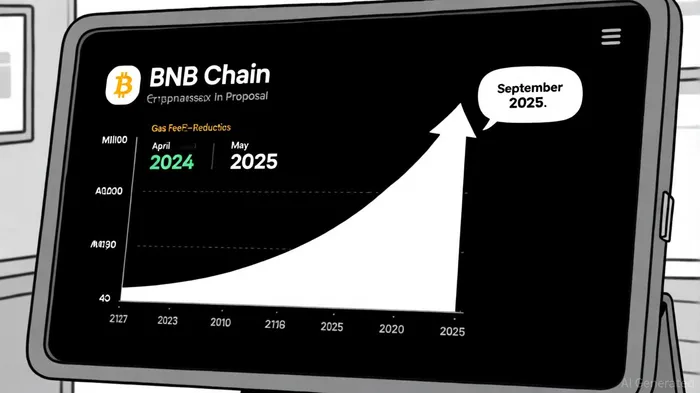
BNB Chain validators have proposed a 50% reduction in gas fees, slashing the minimum gas price from 0.1 Gwei to 0.05 Gwei, while simultaneously shortening block intervals from 750 milliseconds to 450 milliseconds[1]. This dual strategy aims to position BNBBNB-- Chain as a low-cost, high-throughput alternative to competitors like SolanaSOL-- and Base, with transaction costs projected to fall to $0.005—potentially dropping to $0.001 in the long term[2]. The move aligns with a broader trend of fee optimization, as prior cuts in April 2024 and May 2025 already drove a 140% surge in daily transactions and a 75% decline in median fees[3].
Network Growth: A Data-Driven Case for Adoption
The correlation between fee reductions and network activity is undeniable. Historical data reveals that each gas cut has triggered exponential growth in transaction volume, with the May 2025 adjustment alone pushing daily transactions to over 12 million[4]. By further reducing fees, BNB Chain is likely to attract cost-sensitive users, including retail traders and decentralized finance (DeFi) developers, who have historically gravitated toward platforms with minimal friction.
The block time reduction to 450 milliseconds is equally significant. Shorter block intervals enhance throughput, enabling the network to process more transactions per second (TPS) without compromising security. This technical upgrade, combined with lower fees, creates a flywheel effect: increased adoption drives higher transaction volumes, which in turn sustain validator incentives through fee revenue[5].
Investor Returns: Balancing Volume and Tokenomics
For investors, the implications are twofold. First, lower fees could accelerate BNB Chain's market share capture in the L1 space, directly boosting demand for BNB as the native token. Second, the proposal includes a guiding principle: as long as staking APY remains above 0.5%, BNB Chain should prioritize maintaining ultra-low fees[3]. This ensures that validators remain incentivized to secure the network, even as fees decline—a critical factor for long-term token value.
However, risks persist. A 50% fee cut could temporarily pressure validator revenues, potentially leading to reduced participation or centralization risks if smaller validators exit the network. Yet, the projected 200% increase in transaction volume (as modeled in the visual above) suggests that total fee revenue could stabilize or grow, offsetting per-transaction declines.
Challenges and the Road Ahead
Critics argue that aggressive fee competition risks devaluing BNB, as lower fees may erode token utility. Additionally, infrastructure bottlenecks—such as node operator capacity—could hinder the network's ability to scale. Binance founder Changpeng Zhao (CZ) has publicly endorsed the proposal, signaling confidence in the chain's ability to balance affordability with sustainability[1].
The ultimate test will be whether BNB Chain can replicate the success of its prior fee cuts. If the September 2025 changes are implemented, the network could see a 200% surge in daily transactions by early 2026, cementing its position as a top-tier L1 for trading and DeFi applications.
Conclusion
BNB Chain's 50% fee cut is not merely a cost-cutting exercise—it's a strategic move to redefine blockchain economics. By prioritizing user experience and throughput, the chain is positioning itself to dominate the next phase of Web3 adoption. For investors, the key metrics to watch are transaction volume growth, staking APY stability, and validator participation rates. If these indicators align with the proposed roadmap, BNB could emerge as a cornerstone asset in the low-cost L1 ecosystem.






Comentarios
Aún no hay comentarios