
BNB's $1,200 Surge: Network Utility and Strategic Partnerships Power a New Bull Run, While Paydax Emerges as a Stronger Contender Than Aster
In October 2025, Binance Coin (BNB) shattered expectations by surging past $1,200 for the first time, marking a historic milestone for exchange tokens and altcoins, as reported in a FinancialContent article. This rally was not driven by speculative hype alone but by a confluence of robust network utility expansion, strategic partnerships, and favorable macroeconomic conditions. As the BNBBNB-- Chain's ecosystem matures, it has become a critical battleground for projects like Paydax (PDP) and AsterASTER-- (ASTER), both vying to capitalize on the bull run. However, Paydax's superior transactional scalability and institutional-grade adoption metrics position it to outperform Aster in the long term.
Network Utility Expansion: BNB Chain's Infrastructure as a Catalyst
The BNB Chain's utility growth has been nothing short of explosive. By late September 2025, the network recorded over 15 million active addresses-surpassing Solana-and daily transaction volumes oscillating between 12 to 17 million, according to a CoinDesk report. Gas fees were slashed to 0.05 Gwei, reducing costs to approximately $0.005 per transaction, according to a Yahoo Finance report. These improvements, coupled with the BNB Chain's "Yellow Season" roadmap, aim to scale transactions per second (TPS) to 20,000 by 2026, making it one of the most competitive blockchains for decentralized finance (DeFi) and enterprise applications, according to Dropstab research.
Decentralized trading volume on the BNB Chain has also surged, with platforms like PancakeSwapCAKE-- and Aster DEX driving decentralized exchange (DEX) fees to record highs in a CoinDesk article. For instance, Aster's Total Value Locked (TVL) reached $2.34 billion in late 2025, fueled by its decentralized perpetual exchange model, per OKX data. However, while Aster's niche focus on derivatives trading has attracted liquidity, its scalability remains constrained compared to the broader utility of projects like Paydax.
Strategic Partnerships and Institutional Adoption: BNB's Ecosystem Gains Momentum
BNB's price surge coincided with a wave of institutional adoption and strategic partnerships. Franklin Templeton's collaboration with Binance in late 2025, for example, propelled BNB to an all-time high of $904.37 in September, according to a CoinLineup report. Binance's ecosystem initiatives-such as cross-chain bridges to EthereumETH-- and Polygon, DeFi integrations, and partnerships with global payment providers-have further solidified BNB's role as a foundational asset in the crypto space, as detailed in a Cryip overview.
Institutional investors are increasingly allocating to BNB Chain-based assets, drawn by its low fees, EVM compatibility, and regulatory advancements. Jiuzi Holdings and Alem Crypto Fund added BNB to their treasuries in 2025, according to an Analytics Insight article, while decentralized platforms like Aster DEX have attracted over $29 billion in 24-hour trading volume, per a CryptoPotato report. These developments underscore BNB Chain's appeal as a scalable infrastructure for both retail and institutional participants.
Paydax vs. Aster: Why Paydax's Scalability and Institutional Adoption Edge Matter
While Aster has carved a niche in decentralized derivatives, Paydax (PDP) is emerging as a more versatile and institutionally robust contender. Paydax's projected $500 million liquidity injection through its presale has positioned it to surpass both Aster and BNB in growth potential, according to a BlockchainReporter report. This liquidity boost enables Paydax to offer collateralized lending against real-world assets (RWAs)-such as gold and luxury goods-while providing high-yield opportunities like 15.2% APY for lenders and 20% APY for Redemption Pool stakers, per a CoinPedia release.
In terms of scalability, Paydax emphasizes real-time cross-border payments and settlements in seconds, according to a BTCC article, though specific TPS metrics remain undisclosed. By contrast, Aster's TPS is estimated at 191, according to Dropstab research, significantly lower than BNB Chain's 20,000 TPS target. Paydax's institutional-grade security-backed by partnerships with Sotheby's, Brinks, and Onfido-also enhances its credibility, as noted in a CoinPedia roundup. These factors create a more holistic demand cycle for Paydax compared to Aster's derivatives-focused model.
Conclusion: BNB's Bull Run and the Rise of Paydax
BNB's surge above $1,200 is a testament to the BNB Chain's expanding utility and institutional adoption. However, the ecosystem's future may hinge on projects like Paydax, which combines DeFi innovation with real-world asset integration and institutional-grade infrastructure. While Aster has demonstrated explosive growth, Paydax's broader utility, superior scalability, and strategic partnerships make it a stronger long-term bet in this bull cycle. As BNB Chain continues its "Yellow Season" upgrades, investors should closely monitor how these dynamics shape the next phase of the altcoin market.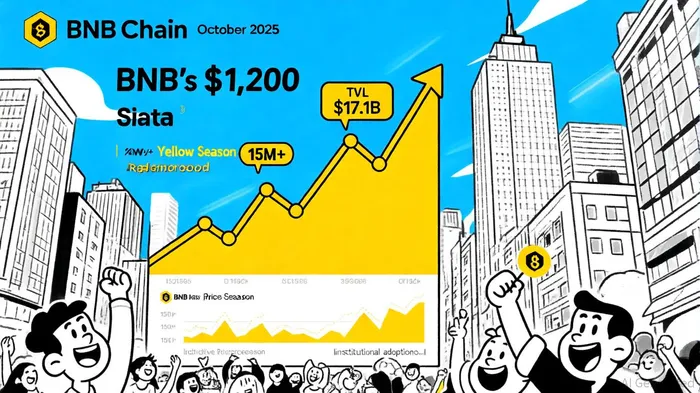






Comentarios
Aún no hay comentarios