
BNB's $1,000 Milestone: A Macro-Driven Revaluation and Institutional Inflow Catalyst
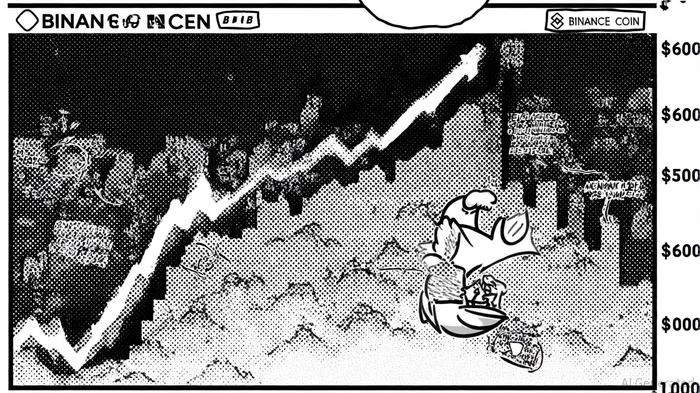
Binance Coin (BNB) has shattered expectations in late September 2025, surging past $1,000 for the first time in its history. This milestone, driven by a confluence of technical momentum, institutional adoption, and macroeconomic tailwinds, signals a paradigm shift in how digital assets are perceived by both retail and institutional markets.
Technical Catalysts and Market Dynamics
BNB's price trajectory has been underpinned by robust technical indicators. A short squeeze in late September 2025 forced bearish traders out of positions, creating a self-reinforcing upward spiral [1]. The token is now trading within an ascending channel, with Fibonacci retracement levels projecting key resistance at $1,080, $1,186, and $1,292 [1]. Analysts at CoinCodex and Standard Chartered have flagged $920–$1,275 as near-term targets, citing a neutral RSI of 61.23 and a bullish MACD crossover [1].
Historical backtesting of MACD Golden Cross signals reveals mixed outcomes. A strategy buying BNBBNB-- on MACD Golden Cross events and holding for 30 trading days from 2022 to 2025 yielded a total return of -30.9%, with an average trade gain/loss of +0.35% (wins ≈ +15.6%, losses ≈ -12.0%) and a maximum drawdown of 62%[6]. These results underscore the volatility of relying solely on technical signals, even as the current MACD crossover aligns with broader bullish momentum.
On-chain activity further validates this optimism. Binance Smart Chain processed 11.44 million daily transactions in early September 2025, reflecting sustained utility in decentralized finance (DeFi) and cross-border payments [5]. Meanwhile, BNB's deflationary mechanics—$1 billion in token burns and real-time gas fee burns—have reduced circulating supply, amplifying scarcity [5].
Institutional Adoption: From Treasuries to ETFs
Institutional demand for BNB has surged, with corporate treasuries emerging as a key driver. In July 2025, Nano LabsNA--, Windtree Therapeutics, and CEA IndustriesBNC-- collectively allocated $610 million to BNB, treating it as a strategic reserve asset [1]. This mirrors Bitcoin's adoption by traditional firms but with a critical difference: BNB's utility in Binance's ecosystem (e.g., staking, gas fees) creates structural demand.
Binance's institutional user base has grown 97% year-on-year, with 250 million registered users and a 116% increase in VIP accounts [3]. The exchange's partnership with Franklin Templeton to launch institutional digital asset solutions has further legitimized BNB as a blue-chip token [1]. While specific BNB ETF data remains scarce, the token's market capitalization—$112 billion as of September 2025—now rivals that of major financial institutions like UBSUBS-- [1].
Macro-Driven Revaluation: Regulatory Clarity and Inflation Hedges
The macroeconomic backdrop has amplified BNB's appeal. The U.S. GENIUS Act, enacted in July 2025, provided regulatory clarity for stablecoins and digital assets, spurring institutional inflows [1]. Binance's proximity to a DOJ compliance deal and speculation about Changpeng Zhao's return have also reduced regulatory uncertainty, making BNB a safer bet for institutional capital [2].
Inflationary pressures and central bank policies have positioned BNB as an alternative hedge. With global CPI remaining elevated, BNB's 3.64% 24-hour gain and 9.4% weekly rise outperform traditional assets [1]. Unlike Bitcoin's “store-of-value” narrative, BNB's utility in high-throughput transactions and DeFi protocols offers a dual-income stream—capital appreciation and yield generation—appealing to macro-aware investors [5].
Comparative Analysis: BNB vs. Bitcoin and Ethereum
While BitcoinBTC-- ETFs dominate with $153.18 billion in assets under management (AUM) as of September 2025, EthereumETH-- ETFs have grown faster, attracting $30.35 billion in inflows [4]. BNB, though lacking a dedicated ETF, has outperformed both in institutional adoption velocity. Its Sharpe ratio of 2.5—superior to Bitcoin and Ethereum—highlights its risk-adjusted returns [1].
Ethereum's proof-of-stake model and staking yields (3–4%) have made it a yield-focused asset, but BNB's deflationary burns and Binance's ecosystem upgrades (e.g., Maxwell, Lorentz) offer a more aggressive value proposition [5]. As Binance eyes a U.S.-listed BNB Treasury company to raise $1 billion [5], the token's institutional profile is set to expand further.
Risks and Outlook
Despite the bullish case, risks persist. Regulatory shifts, particularly in the U.S. and Europe, could disrupt Binance's operations. Competition from SolanaSOL-- and Ethereum's DeFi ecosystem remains a challenge. However, BNB's strategic positioning—bridging traditional finance and crypto—suggests a resilient trajectory. Analysts project $1,200 by late 2026, with long-term targets reaching $2,292 by year-end 2025 [1].
Conclusion
BNB's $1,000 milestone is not an anomaly but a symptom of broader macro-driven revaluation. As institutional capital increasingly views digital assets as a strategic asset class, BNB's unique blend of utility, scarcity, and regulatory progress positions it as a top-tier contender. For investors, the confluence of technical strength, institutional adoption, and macroeconomic tailwinds presents a compelling case for long-term exposure.






Comentarios
Aún no hay comentarios