
BMW's Share Price Pressure: Strategic Misalignment and Sector Headwinds in the Premium EV Transition
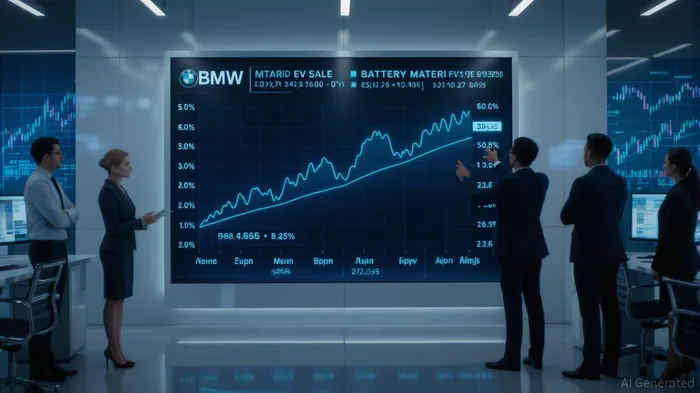
BMW's recent share price pressure, marked by a 5.05% single-session decline and a 3.58% four-week drop[2], reflects growing investor concerns over near-term strategic misalignment and sector-specific headwinds in its premium EV transition. While the company remains committed to its 2030 target of 50% electric vehicle (EV) sales[3], Q2 2025 results revealed a 21.2% year-over-year decline in North American EV sales[2], underscoring regional disconnects between strategic ambition and market realities.
Strategic Misalignment: Ambition vs. Execution
BMW's multi-drivetrain strategy—blending EVs, hybrids, and combustion engines—has positioned it as a flexible player compared to rivals like Mercedes-Benz, which has openly questioned Europe's 2035 ICE ban[1]. However, this approach has exposed vulnerabilities in execution. The Neue Klasse platform, a cornerstone of BMW's EV roadmap, promises 497-mile range and 400-kW charging capabilities[4], yet Q2 2025 saw U.S. sales of key models like the i5 and iX plummet due to waning federal tax incentives and aging platforms[6]. This misalignment between product readiness and consumer demand has eroded confidence, particularly in markets where EV adoption lags behind regulatory timelines.
Meanwhile, the company's 10% share buyback program, contingent on free cash flow[3], offers a short-term buffer but does little to address structural challenges. For instance, production halts linked to the Integrated Braking System (IBS) and weak China demand reduced overall vehicle deliveries by 4.5% in the first nine months of 2024[2], even as BEV sales rose 19.1% YoY. This duality highlights the tension between electrification goals and profitability, with Q3 2024 auto margins at 5%—a figure CEO Oliver Zipse described as “temporary” but one that has spooked investors[3].
Sector-Specific Headwinds: Supply Chains and Competitive Pressures
The premium EV segment faces unique headwinds, including raw material volatility and geopolitical bottlenecks. Lithium and cobalt prices, though stabilized post-2022, remain sensitive to China's dominance in processing[5]. BMW's reliance on Chinese supply chains—85% of its vehicles are sold there—exposes it to regulatory risks and ethical scrutiny over cobalt mining practices[5]. Additionally, U.S. tariffs on EV components and logistical bottlenecks have forced BMW to pause shipments to dealerships[2], exacerbating inventory shortages and delaying revenue recognition.
Competitive pressures further amplify these challenges. Tesla's Q2 2025 deliveries fell 13% YoY[6], yet its software-driven innovation and vertical integration continue to set industry benchmarks. Meanwhile, Chinese EV rivals like BYD and NIONIO-- are capturing market share with cost-effective LFP batteries and localized production[5], forcing BMW to balance premium pricing with affordability—a delicate act in price-sensitive markets.
Investor Implications and Outlook
Despite these headwinds, BMW's long-term prospects remain anchored in its Neue Klasse platform and 2030 decarbonization goals[4]. The company's 15.7% YoY EV sales growth in H1 2025[2] and 50% China EV sales target[3] suggest resilience in key markets. However, near-term share price volatility is likely to persist until the company resolves U.S. demand gaps, stabilizes supply chains, and demonstrates consistent profitability in its EV segment. Analysts project a rebound to 87.75 EUR by Q4 2025[2], but this hinges on successful Neue Klasse launches and improved cost management.
For investors, the current valuation offers a cautious entry point, provided BMW can navigate its strategic and operational crosscurrents. The premium EV transition is fraught with risks, but with its multi-drivetrain flexibility and focus on software innovation[4], BMW retains a unique position to recalibrate and thrive in a fragmented market.





Comentarios
Aún no hay comentarios