
BMW's Revised FY25 Guidance and Strategic Implications for the EV Transition
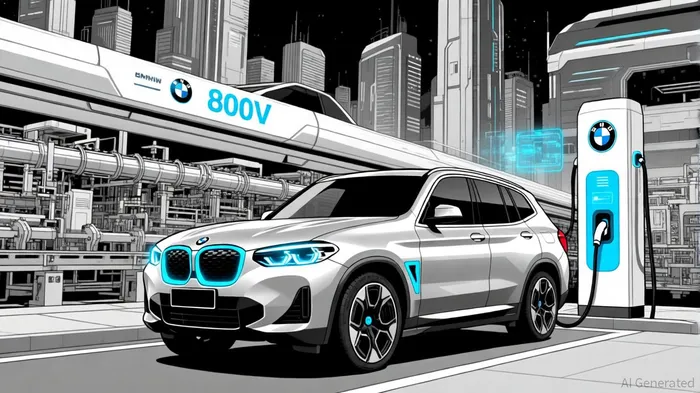
The automotive industry's transition to electrification and digitalization has reached a critical inflection point in 2025. For legacy automakers like BMW, the stakes are high: balancing innovation with profitability while navigating supply chain volatility, regulatory pressures, and intensifying competition from Chinese EV startups and TeslaTSLA--. BMW's revised FY25 guidance underscores its commitment to a dual-track strategy-accelerating electrification while leveraging digital tools to optimize production and reduce costs. However, this path is fraught with risks that investors must weigh against potential rewards.
Electrification: A Premium Play with Ambitious Targets
BMW's Neue Klasse platform, set to debut with the all-electric iX3 SUV in late 2025, represents a technological leap. The platform's 800V architecture enables 30% faster charging and a 30% range improvement over previous models, while integrating the battery as a structural component to reduce weight and enhance rigidity, as described in an AutoTimes piece (an AutoTimes piece). By 2025, the company aims for 25% of its sales to be battery-electric vehicles (BEVs), with a long-term goal of 50% by 2030, per The EV Report (The EV Report). This premium-focused approach contrasts with rivals like Ford, which has pivoted to smaller, more affordable EVs after reporting $2.5 billion in EV losses in early 2024, according to a CIO article (a CIO article).
However, BMW's strategy faces headwinds. Chinese EV giants like BYD have captured significant market share through vertical integration and cost advantages, forcing BMW to defend its premium positioning in a rapidly democratizing EV market, as highlighted in a DealershipGuy report (a DealershipGuy report). Meanwhile, General Motors (GM) and Volkswagen (VW) are pursuing broader electrification roadmaps. GM aims for EV profitability by late 2024, backed by U.S. battery cell production, while VW plans to launch 25 BEVs in North America by 2030 under its $131 billion "NEW AUTO" strategy, according to a 1xMarketing overview (a 1xMarketing overview).
Digital Transformation: The iFactory Advantage
BMW's digital transformation, centered on its iFactory concept, offers a strategic edge. By integrating AI, digital twins, and virtualization, the company has slashed production planning times-from 12 weeks to one or two for body-paint line simulations, as detailed in a CIO article. The BMW Virtual Factory, part of an industrial metaverse initiative, enables real-time collaboration with partners, while the FactoryViewer tool allows employees to navigate production facilities via 3D scans and drones, also described in that CIO article. These innovations align with broader industry trends: Ford, for instance, allocated $11.1 billion to ICT in 2024, focusing on cloud computing and robotics, according to a Ford From the Road article (a Ford From the Road article).
Yet, digital investments come at a cost. BMW's R&D spending hit €4.17 billion in H1 2024, up from €3.4 billion in 2023, as it develops Neue Klasse models and next-gen X5 variants, according to a BMWBlog article (a BMWBlog article). While the company expects R&D and capital expenditures to peak in 2024, rivals like VW are doubling down. VW's $131 billion electrification and digitalization plan by 2030 dwarfs BMW's current outlays, raising questions about long-term competitiveness (the 1xMarketing overview cited above).
Financials and Risks: Navigating Tariffs and Supply Chain Woes
BMW's FY25 guidance projects stable EBT levels and stronger free cash flow, driven by reduced R&D spending and operational efficiencies (per The EV Report). However, external risks loom large. A 25% U.S. tariff on imported vehicles could cut earnings by over €1 billion, prompting BMW to offer temporary price protection for dealers and consider production relocations, according to a Tradlinx post (a Tradlinx post). Global semiconductor shortages and high interest rates further complicate EV adoption, which grew to 9.3% of new vehicle sales in March 2025-up from 8.4% in 2024 but still below Tesla's historical dominance, as reported by DealershipGuy.
In contrast, GM's focus on large EVs like the Cadillac Escalade IQ and Ford's pivot to cost-effective models highlight divergent risk profiles. While GM aims for profitability by late 2024, Ford's EV business remains unprofitable, underscoring the sector's volatility (see the CIO article cited earlier).
Strategic Implications for Investors
BMW's balanced approach-combining premium electrification with cutting-edge digital tools-positions it as a leader in innovation. However, its reliance on high-margin markets and exposure to tariffs and supply chain bottlenecks pose risks. Investors must assess whether BMW's focus on premium EVs and flexible powertrain options (including hydrogen fuel-cell vehicles by 2028, noted in an AutoTimes piece) can offset competition from Chinese EVs and cost-sensitive consumers.
In comparison, VW's aggressive scale and GM's U.S. battery investments suggest higher growth potential but also greater financial exposure. Ford's struggles highlight the perils of misjudging market demand. For BMW, the key will be executing its Neue Klasse rollout smoothly while maintaining profitability amid rising costs.
Conclusion
The EV transition is reshaping the automotive landscape, and BMW's FY25 guidance reflects both ambition and pragmatism. While its digital and electrification strategies offer a compelling value proposition, investors must remain vigilant about supply chain risks, regulatory shifts, and the rapid pace of innovation by rivals. For now, BMW's technology-open approach and premium brand strength provide a strong foundation-but the road ahead remains bumpy.





Comentarios
Aún no hay comentarios