
BMW's Revised Earnings Forecast and Implications for the Global Auto Sector
The automotive industry's transition to electric vehicles (EVs) has entered a critical phase, and BMW's recent earnings forecast revision underscores both the challenges and strategic recalibrations required to navigate this shift. According to Reuters, the German automaker now anticipates a slight decline in group earnings before tax for 2025, down from earlier expectations of stability, citing "slow growth in China and U.S. import tariffs" as key factors. This adjustment, coupled with a reduced return on capital employed (ROCE) for its automotive business (now 8–10%, down from 9–13%), highlights the fragility of profit margins in an era of rapid technological and regulatory change, as the Reuters report explains.
The Earnings Dilemma: A Microcosm of EV Transition Struggles
BMW's Q3 2025 results further illustrate the tension between traditional strengths and emerging EV challenges. While total vehicle deliveries in North America surged 24% year-over-year to 96,886 units, electrified sales (BEV + PHEV) dipped by 2.8%, with the iX model experiencing a 33% year-over-year decline, according to Bimmerfile. This divergence signals a broader industry trend: even as automakers scale production, EV adoption is being tempered by supply bottlenecks, shifting incentives, and intensifying competition. For BMW, the drop in EV momentum raises questions about its ability to balance profitability with its ambitious 50% EV sales target by 2030, the Reuters report added.
The root causes are multifaceted. In China, the world's largest EV market, BMW faces stiff competition from local rivals like BYD and Xpeng, which offer cost-competitive models with advanced software features, according to a CNBC report. Meanwhile, U.S. tariffs and policy uncertainty have disrupted production planning, forcing BMW to pause EV manufacturing in the U.S. for May 2025, as Electrek reported. These headwinds are not unique to BMW but exemplify the systemic risks of an unsteady global EV transition.
Strategic Resilience: Neue Klasse and the Triple-Platform Gambit
To counter these pressures, BMW is doubling down on its "Neue Klasse" platform, a cornerstone of its 2025 strategy. This platform, set to debut with the iX3 SUV, integrates 800V technology for 30% faster charging and a structural battery design that reduces weight and enhances rigidity, Autotimesnews reports. Autotimesnews adds that the Neue Klasse also features a "superbrain architecture" with 20 times the computing power of previous models, positioning BMW to compete in the software-defined vehicle arena dominated by TeslaTSLA-- and Chinese automakers.
Complementing this is a triple-platform strategy: dedicated EV, combustion-only, and multi-energy architectures. This approach allows BMW to flexibly allocate resources to markets with varying EV readiness. For instance, the multi-energy platform enables larger vehicles to be configured with internal combustion engines, hybrids, or full EV powertrains on the same assembly lines, reducing costs and complexity, according to a DriveTech analysis. Such agility is critical in markets like India and the Middle East, where EV adoption remains nascent, as DriveTech notes.
BMW is also addressing infrastructure gaps by joining Tesla's Supercharger network via the North American Charging Standard (NACS). While current models require an adapter (available late 2025), future Neue Klasse vehicles will feature NACS ports by default, Bimmerfile explains. This partnership mitigates range anxiety and leverages Tesla's robust charging infrastructure, a strategic move to retain customer confidence during long-distance travel.
Broader Implications: A Global Sector at a Crossroads
BMW's adjustments reflect a broader industry reckoning. The EV transition is reshaping global value chains, with battery manufacturers emerging as key players and traditional suppliers struggling to adapt, according to a ScienceDirect analysis. China's dominance in EV production-where over 50% of 2025 sales are electric-has intensified competition, forcing Western automakers to innovate or risk obsolescence, per BloombergNEF's Electric Vehicle Outlook 2025. Meanwhile, U.S. and EU policies, including tariffs on Chinese EVs and incentives for domestic production, are creating fragmented markets, as detailed in a GlobeNewswire report.
The stakes are high. As BMW CEO Oliver Zipse warned in the CNBC piece, the industry is entering a "selection process," where only the most adaptable firms will thrive. BMW's focus on software, sustainability, and platform flexibility positions it to weather this shakeout. However, its success hinges on execution: the Neue Klasse must deliver on cost and performance promises, and partnerships like the Tesla Supercharger integration must translate into tangible customer benefits.
Conclusion: A Test of Long-Term Resilience
BMW's revised earnings forecast is a stark reminder of the volatility inherent in the EV transition. Yet, its strategic investments in technology, infrastructure, and operational flexibility demonstrate a commitment to long-term resilience. While challenges like U.S. tariffs and Chinese competition persist, the Neue Klasse platform and triple-platform strategy offer a blueprint for navigating a fragmented global market. For investors, the key question is whether these moves will be enough to secure BMW's position in an industry where the rules of the game are still being rewritten.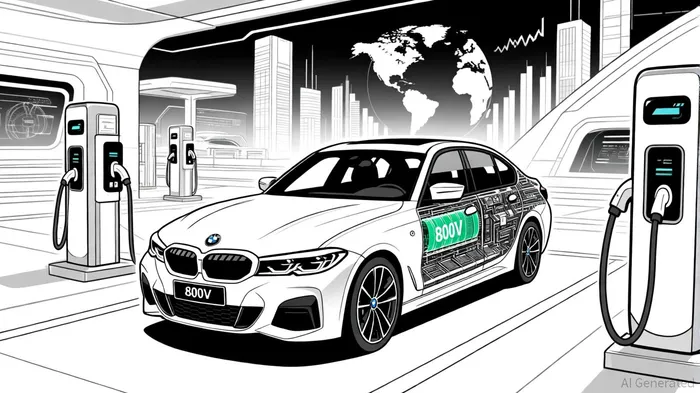





Comentarios
Aún no hay comentarios