
BMW's Resilience in the EV Transition: Strategic Shifts and Financial Outlook for 2025
BMW's Resilience in the EV Transition: Strategic Shifts and Financial Outlook for 2025
The global automotive industry's transition to electric vehicles (EVs) has tested even the most established automakers. Yet, BMW Group's 2025 strategy demonstrates a blend of innovation, financial discipline, and adaptability that positions it as a resilient contender in this high-stakes race. While the company faces headwinds-including margin pressures from tariffs and competitive markets-it has made significant strides in electrification, technological integration, and cost optimization. For investors, the question is whether BMW's strategic recalibration can translate into sustained profitability amid industry-wide turbulence.
Strategic Pillars: Electrification, Technology, and Diversification
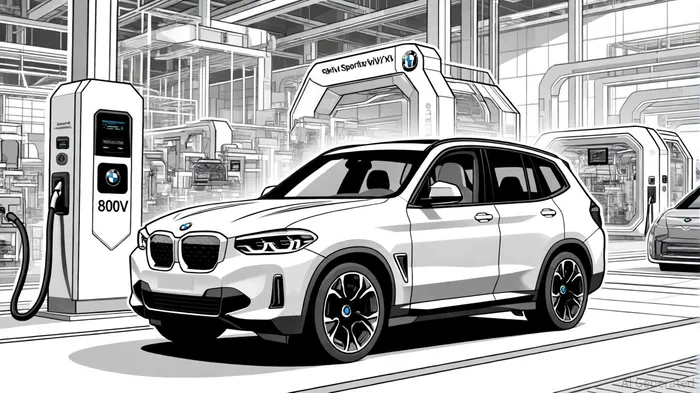
BMW's 2025 strategy hinges on three pillars: accelerating EV adoption, advancing software-defined vehicles, and maintaining a diversified drivetrain portfolio. Central to this is the Neue Klasse platform, which debuted with the iX3 Sports Activity Vehicle in late 2025. This platform introduces 800V technology, enabling 30% faster charging and a 30% range improvement over previous models, according to an Autotimes article. By 2027, BMW plans to launch over 40 new or updated vehicles, including all-electric variants of its popular X5 and 7 Series models.
The company's commitment to electrification is evident in its sales performance. In Q1 2025, fully electric vehicles (BEVs) accounted for 26.9% of total deliveries, a 32.4% year-over-year increase, according to a BMW Group press release. However, Q3 2025 data from North America reveals a slight 2.8% decline in electrified vehicle sales (BEV + PHEV), reflecting challenges in maintaining momentum amid saturated markets and price competition, as noted in a BMW US sales release. Despite this, BEVs still represented 20% of U.S. sales in the first three quarters of 2025, underscoring BMW's growing footprint in the EV segment.
BMW's technological edge lies in its Software-Defined Vehicle initiative, which integrates zonal architecture and four "super-brains" to reduce wiring by 600 meters and enable over-the-air updates. The iDrive X infotainment system and Panoramic Vision head-up display further enhance user experience, aligning with consumer demand for connected, intuitive interfaces. This digital transformation not only differentiates BMW but also creates long-term revenue streams through software subscriptions.
Financial Resilience Amid Challenges
BMW's financial performance in 2025 has been mixed. Group EBIT for Q1 2025 fell by 22%, the lowest since 2020, with a margin contraction of 1.8 points to 9.3%, according to Automotive World. The Automotive Segment's EBIT margin stood at 6.9% in Q1, however, remaining at the upper end of its 5–7% target range. This resilience stems from disciplined cost management and a focus on high-margin EVs. For instance, the company reduced R&D and capital expenditures in 2025 after a record €18 billion investment in 2024, improving free cash flow.
External pressures, such as tariffs, have impacted margins. In Q2 2025, tariffs shaved approximately 2 percentage points off Automotive Segment margins. Yet, BMW's free cash flow rebounded to €1.9 billion in Q2, and the company reaffirmed its full-year target of over €5 billion. This suggests that operational adjustments-such as shifting production to lower-cost regions and optimizing supply chains-are mitigating some of the financial strain.
A critical milestone for BMW is its achievement of 1.5 million fully electric vehicles delivered by mid-2025, with 3 million electrified vehicles on the road. This scale not only strengthens its market position but also accelerates cost reductions through learning curves and economies of scale.
Operational Adjustments and Market Positioning
BMW's strategy to balance electrification with traditional drivetrains is a pragmatic response to diverse market demands. While BEVs dominate its long-term vision, the company continues to offer internal combustion engines (ICEs) and plug-in hybrids (PHEVs) in regions where EV adoption lags. This flexibility is evident in its 2024 results, where electrified vehicles accounted for nearly 25% of sales.
Sustainability is another cornerstone of BMW's strategy. The company's circular economy initiatives-such as recyclable vehicle designs and low-emission manufacturing-align with regulatory trends and consumer preferences. In 2024, CO2 emissions for its new vehicle fleet fell below 100 grams per kilometer (WLTP), a testament to the effectiveness of its technology-open approach.
Outlook: Navigating Uncertainties
For investors, BMW's path to profitability hinges on its ability to scale EV production, manage costs, and differentiate its offerings. While the company's 2025 EBIT margin guidance of 5–7% remains conservative, its focus on high-margin software and premium EVs could drive upside. The launch of hydrogen fuel-cell vehicles by 2028 also positions BMW to capitalize on emerging markets.
However, risks persist. Intensifying competition from TeslaTSLA--, Chinese EV startups, and legacy automakers could erode margins. Additionally, global supply chain disruptions and regulatory shifts may require further capital allocation.
Conclusion
BMW's 2025 strategy reflects a company in transition, balancing the urgency of electrification with the realities of profitability. By leveraging its technological prowess, operational agility, and brand equity, BMW is navigating the EV shift with a mix of caution and ambition. For investors, the key takeaway is that resilience in this sector requires not just capital but also strategic clarity-a trait BMW appears to possess in abundance.





Comentarios
Aún no hay comentarios