
BMW's Leadership Shift and Strategic Resilience Amid China's Premium Market Headwinds
The automotive industry is at a crossroads, and BMW's recent leadership transition underscores the urgency of navigating a rapidly shifting landscape. With Milan Nedeljković set to assume the CEO role in May 2025, the German automaker faces a dual challenge: stabilizing its margins in the face of China's fierce EV competition and executing a high-stakes electrification strategy. As China's premium car market becomes increasingly contested by local rivals like BYD and Xiaomi, BMW's ability to balance manufacturing efficiency with innovation will determine its long-term resilience.
Manufacturing-Led Margin Protection: A Strategic Pivot
BMW's approach to margin protection hinges on cost optimization and production efficiency, particularly in its Neue Klasse platform-a cornerstone of its EV strategy. According to a Bloomberg report, the company has scaled back research and development spending by nearly 11% in the first nine months of 2025, signaling a shift toward operational discipline. This fiscal restraint is complemented by the Neue Klasse platform, which promises to reduce battery manufacturing costs by 20% while improving range and charging efficiency. Such advancements are critical in China, where BMW's profit margins have been squeezed by rising tariffs and aggressive pricing from domestic EV brands.
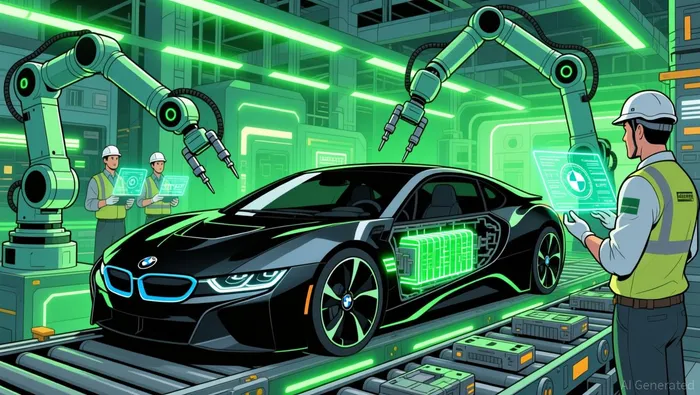 The automaker's focus on localized production further illustrates its commitment to cost control. By tailoring the Neue Klasse lineup to Chinese market demands-such as integrating advanced software features and optimizing battery performance-BMW aims to differentiate itself from rivals offering "tech-laden, affordably priced" alternatives. However, the success of this strategy depends on Nedeljković's ability to streamline production and mitigate supply chain bottlenecks, a task complicated by global tariff policies and regulatory shifts.
EV Execution Risks: Navigating China's Competitive Minefield
Despite these efforts, BMW's EV execution in China remains fraught with risks. The company's third-quarter 2025 sales in the country plummeted by 29.8% to 147,691 units, a stark reflection of the market's transformation. Local EV brands, now accounting for nearly 70% of passenger car sales in China, have outpaced BMW with rapid innovation cycles and lower price points. Compounding these challenges, U.S. and EU import tariffs-particularly the 25% additional tariff imposed in March 2025-threaten to erode profitability further, with BMW estimating a potential 1 billion euro hit in 2025.
The automaker's revised earnings forecast, which narrows its automotive EBIT margin range to 5–6% (down from 5–7%), highlights the fragility of its current position. While the Neue Klasse platform has generated strong pre-order demand for models like the iX3 SUV, this momentum must translate into sustained sales growth to offset declining traditional vehicle deliveries. Analysts caution that BMW's margin pressures could persist unless it accelerates its pivot to EVs and refines its pricing strategy in China (https://www.spglobal.com/ratings/en/regulatory/article/-/view/sourceId/101638244).
Strategic Resilience: Leadership and Long-Term Vision
Nedeljković's appointment brings a seasoned leader with deep expertise in production optimization and EV manufacturing-a critical asset as BMW navigates this inflection point. His 32-year tenure at the company, including leadership roles in production, positions him to oversee the Neue Klasse's 2025 launch with a focus on scalability and cost discipline. However, his success will depend on more than operational efficiency; it will require a nuanced understanding of China's evolving consumer preferences and regulatory environment.
For investors, the key question is whether BMW can replicate its European and North American strengths in China's hyper-competitive EV market. The company's confidence in the Neue Klasse lineup-coupled with its commitment to localized product development-suggests a long-term play to regain market share. Yet, the path forward remains uncertain. As stated by a Reuters report, BMW's CFO has acknowledged that the company will "return to growth in China" with its all-electric offerings, but this optimism must be tempered by the reality of a market where even established players like Mercedes-Benz have seen quarterly sales decline.
Conclusion: A High-Stakes Transition
BMW's leadership shift and strategic recalibration reflect a company in transition, grappling with the dual forces of electrification and globalization. While Nedeljković's focus on manufacturing-led margin protection and the Neue Klasse platform offer a blueprint for resilience, the automaker's ability to execute in China will define its competitiveness in the premium EV segment. For investors, the coming months will test BMW's resolve-and its capacity to adapt in a market where the rules of the game are being rewritten daily.







Comentarios
Aún no hay comentarios