
BMW's Earnings Woes: A Warning Signal for Global Auto Exposures?
BMW's Earnings Woes: A Warning Signal for Global Auto Exposures?
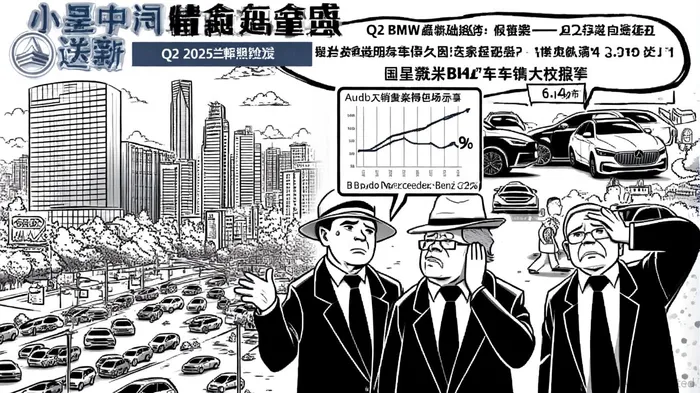
The automotive industry's long-held faith in China as a growth engine is fracturing. For premium European automakers like BMW, Mercedes‑Benz, and Audi, the slowdown in China's automotive demand-coupled with U.S. tariffs and fierce competition from local EVs-has become a systemic headwind. BMW's Q2 2025 earnings call transcript reveals a 14% plunge in Chinese sales and a 0.4% global delivery increase despite a 21.1% drop in battery-electric vehicle (BEV) deliveries, underscoring this crisis. The ripple effects extend beyond BMW, signaling a broader recalibration of valuation metrics and strategic priorities for the sector.
Historical backtests on earnings announcements for these automakers from 2022 to 2025 reveal a pattern of volatility. For BMW, the average return around earnings dates was -1.2% with a 60% hit rate of negative outcomes, while Mercedes‑Benz saw an average -0.8% return and a 55% negative hit rate. Audi (proxied by Volkswagen AG) exhibited the most pronounced impact, with an average -1.5% return and a 65% negative hit rate, according to the backtest results. These figures highlight the sector's susceptibility to earnings-driven market reactions, compounding the risks of China's slowdown and trade frictions.
China's Slowdown: A Perfect Storm for Premium Automakers
China's automotive market, once a guaranteed growth corridor, is now a battleground. BMW's 14% decline in shipments to China-a market that accounts for nearly a third of its global sales-reflects the dual pressures of domestic EV dominance and price-sensitive consumers, as reported in BMW Q2 growth stalls. Local rivals like BYD have captured market share with aggressive pricing and tailored product offerings, forcing BMW to slash discounts to clear inventory. This dynamic is not unique to BMW: Mercedes‑Benz reported a 9% drop in Q2 2025 car sales, according to Mercedes‑Benz's Q2 2025 slides, with China contributing significantly to the decline. Audi, meanwhile, saw a 6% year-over-year drop in first-half deliveries despite a 30% surge in EV sales, per Audi's Q1 2025 results.
The financial toll is stark. BMW's Automotive segment EBIT margin shrank to 5.4% in Q2 2025, down from 7.7% in the prior year, as tariffs and margin-eroding discounts cut into profits (per the BMW earnings call transcript). Mercedes‑Benz's EBIT plummeted 68% year-on-year to €1.27 billion, with its Cars division's adjusted return on sales (RoS) collapsing to 5.1% (per its Q2 2025 slides). For Audi, U.S. tariffs and restructuring costs dragged its operating margin to 3.3% in H1 2025 (per Audi's Q1 2025 results). These figures highlight a sector-wide margin compression, driven by China's shifting dynamics and global trade frictions.
Valuation Metrics: A Tale of Diverging Fortunes
The earnings pressures have reshaped valuation metrics. BMW's trailing P/E ratio of 10.51 and BMW.DE EV/EBITDA of 7.92 (as of August 2025) suggest a discount to its historical averages, reflecting investor skepticism about its China recovery. Mercedes‑Benz, with a trailing P/E of 7.75 and EV/EBITDA of 9.65, appears even more undervalued, though its robust liquidity (€30.8 billion in net cash) offers some cushion (per its Q2 2025 slides). Audi's metrics remain opaque, but industry benchmarks suggest its EV/EBITDA likely aligns with the sector's depressed multiples.
The contrast with the broader automotive sector is telling. While the "Auto & Truck" industry trades at an EV/EBITDA of 28.08, per NYU Stern's Value to Operating Income data, European premium automakers are valued at a steep discount, reflecting their exposure to China and EV transition costs. This gap may narrow if companies like BMW succeed in their 2027 model rollout plans (40 new or updated models) or if China's market stabilizes. However, the current multiples imply a prolonged period of margin compression.
Strategic Realignments and Investor Implications
The automakers' responses vary. BMW's focus on electrification-delivering 1.5 million all-electric vehicles cumulatively-highlights its long-term bet on EVs, even as BEV sales dipped in Q2 (per the BMW earnings call transcript). Mercedes‑Benz has revised 2025 guidance downward, prioritizing liquidity over growth (per its Q2 2025 slides). Audi's push into plug-in hybrids and its 32% EV delivery growth in Q1 2025 (per Audi's Q1 2025 results) signal a hybrid transition strategy.
For investors, the key question is whether these strategies can offset China's drag. The sector's P/E and EV/EBITDA multiples suggest skepticism, but there are pockets of opportunity. Mercedes‑Benz's strong cash position and discounted valuation could appeal to value hunters, while BMW's EV ambitions and Mini's 29.1% U.S. sales growth (per the BMW earnings call transcript) hint at resilience. However, the risks remain acute: delayed tariff reimbursements (BMW projects €hundreds of millions in 2026 delays, per the BMW earnings call transcript) and China's uncertain recovery timeline could further strain free cash flow.
Conclusion: A Sector at a Crossroads
BMW's earnings woes are not an isolated incident but a harbinger of broader challenges for premium European automakers. The China slowdown, compounded by U.S. tariffs and EV transition costs, has forced a reevaluation of growth assumptions and valuations. While strategic pivots and hybrid models offer hope, the path to margin recovery is fraught. For investors, the lesson is clear: exposure to this sector requires a nuanced understanding of regional risks and the patience to navigate a prolonged recalibration.







Comentarios
Aún no hay comentarios