
BMS's $1.5bn Acquisition of Orbital Bio: Strategic Move or Overpay in a Competitive CAR-T Landscape?
Bristol Myers Squibb's (BMS) $1.5 billion acquisition of Orbital Therapeutics has ignited debate about its strategic rationale in the rapidly evolving CAR-T therapy market. While critics question the valuation of a preclinical asset, proponents argue that BMS is positioning itself at the forefront of a transformative shift in immunotherapy. This analysis evaluates the deal's long-term value creation and competitive positioning, drawing on market dynamics, technological potential, and industry trends.
Strategic Rationale: Diversifying into Autoimmune Diseases
BMS's acquisition centers on OTX-201, an investigational in vivo CAR-T therapy designed to reprogram immune cells using circular RNA delivered via lipid nanoparticles. Unlike traditional ex vivo CAR-T therapies, which require complex and costly patient-specific manufacturing, OTX-201 aims to simplify the process by engineering T cells directly within the body. This approach could reduce treatment timelines and costs, addressing a critical limitation of current therapies, according to a BMS press release.
The move into autoimmune diseases marks a strategic pivot for BMS. While the company already dominates hematologic malignancies with Breyanzi and Abecma, autoimmune conditions like systemic lupus erythematosus (SLE) and multiple sclerosis (MS) represent a $100+ billion market with unmet needs. Early-phase data from BMS's CD19-directed CAR-T therapy in SLE patients showed sustained B-cell depletion and improved disease activity scores, suggesting the potential for one-time curative treatments, according to a Fierce Biotech report. By leveraging Orbital's RNA platform-which integrates AI-driven design and advanced lipid nanoparticle (LNP) delivery-BMS aims to expand its footprint into non-oncology indications, a space where competitors like Novartis and Kyverna Therapeutics are also exploring opportunities, per a Towards Healthcare analysis.
Market Potential: In Vivo CAR-T's Growth Trajectory
The in vivo CAR-T therapy market is projected to grow at a compound annual growth rate (CAGR) of 30.4% from 2025 to 2034, outpacing the broader CAR-T market's 29.10% CAGR, according to a NovaOneAdvisor report. This growth is driven by advancements in delivery technologies (e.g., LNPs) and the scalability of in vivo approaches. While hematologic malignancies currently dominate the market, autoimmune diseases are emerging as a key growth area. For instance, the global CAR-T therapy market for autoimmune conditions is expected to expand from $1.2 billion in 2025 to $12.8 billion by 2034, reflecting a 29.8% CAGR, per a Towards Healthcare forecast.
BMS's acquisition aligns with this trajectory. Orbital's platform offers a unique value proposition: programmable RNA therapies that can be tailored to specific autoimmune targets. This flexibility positions BMS to capture a significant share of the autoimmune CAR-T market, which is still in its infancy. For context, Novartis's YTB323 candidate for MS and Kyverna's K-101 for SLE are also in early development, but BMS's first-mover advantage with OTX-201 could provide a competitive edge, according to a Pharmaceutical-Technology article.
Valuation Analysis: Justifying the $1.5 Billion Price Tag
Critics argue that paying $1.5 billion for a preclinical asset with no clinical data is risky. However, the valuation must be contextualized within the broader industry trends. In 2025, in vivo CAR-T platforms are commanding premium valuations due to their potential to disrupt traditional cell therapy economics. For example, AbbVie's $1.1 billion acquisition of Audentes Therapeutics in 2023 and Gilead's $2.1 billion stake in Poseida Therapeutics highlight the sector's appetite for cutting-edge platforms, as noted in a FierceBiotech report.
Orbital's RNA technology, which combines circular RNA engineering with AI-driven design, adds another layer of value. This platform is not only applicable to autoimmune diseases but also to oncology and rare diseases, creating a diversified revenue stream. Furthermore, BMS's existing infrastructure-such as its NEX-T™ manufacturing process and partnerships with Cellares-reduces the risk of scaling OTX-201 into commercial production, as discussed in a ScienceDirect review.
Competitive Positioning: BMS vs. Key Players
BMS faces stiff competition from Novartis, Gilead, and emerging biotechs. Novartis's Kymriah and Gilead's Yescarta dominate the hematologic malignancy space, while allogeneic CAR-T developers like Allogene Therapeutics are pushing off-the-shelf solutions. However, BMS's focus on autoimmune diseases creates a niche where it can differentiate itself.
The company's ACTioN initiative-a cross-disciplinary collaboration with researchers and patient advocates-further strengthens its position. By accelerating clinical trials and leveraging real-world data, BMS aims to shorten the path to regulatory approval for OTX-201. Additionally, its spinout model-contributing autoimmune programs to a new biotech venture while retaining equity and royalties-optimizes risk-sharing and capital efficiency, according to a P05 spinout analysis.
Risks and Challenges
Despite its strategic merits, the acquisition carries risks. OTX-201 is still in IND-enabling studies, and clinical failures could erode value. Manufacturing scalability, while improved by in vivo approaches, remains a challenge for complex autoimmune indications. Regulatory hurdles, including safety concerns around immune modulation, also loom large.
Moreover, the autoimmune CAR-T market is unproven. While the projected $12.8 billion market size by 2034 is optimistic, it assumes rapid adoption and reimbursement for a novel therapy. Payers may resist high prices without robust long-term efficacy data.
Conclusion: A Calculated Bet on the Future
BMS's acquisition of Orbital Bio is neither a reckless overpay nor a guaranteed success-it is a calculated bet on the future of immunotherapy. By acquiring a cutting-edge in vivo platform and entering the autoimmune space, BMS is hedging against the limitations of ex vivo CAR-T and positioning itself for long-term growth. The $1.5 billion price tag reflects the high stakes of innovation in a $128.55 billion market by 2034, according to Precedence Research. For investors, the key question is whether BMS can translate its technological and strategic advantages into clinical and commercial wins. If it succeeds, the acquisition could prove to be a defining move in the CAR-T landscape. 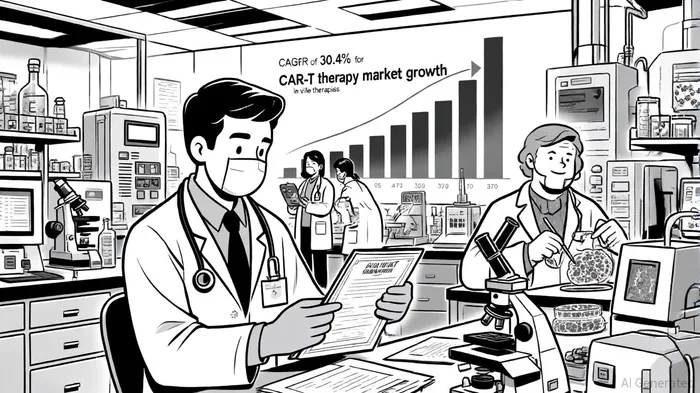





Comentarios
Aún no hay comentarios