
BMO's Dividend Growth and Strategic Expansion: A Blueprint for Long-Term Sustainability in a Low-Yield World
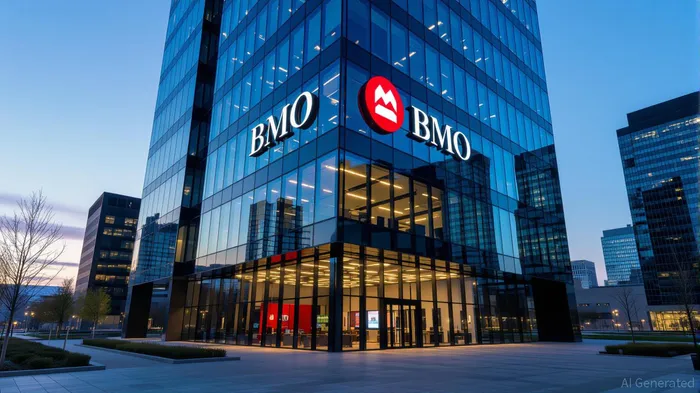
In an era where traditional income investments struggle to outpace inflation, Bank of MontrealBMO-- (BMO) stands out as a rare combination of dividend resilience and strategic ambition. With a payout ratio of 62.84% as of July 2025 and a 7.2% five-year dividend growth rate, BMOBMO-- has demonstrated a disciplined approach to rewarding shareholders while fueling expansion. This article examines how BMO's balanced payout strategy, U.S. market penetration, and capital-efficient growth position it as a top-tier income and growth stock for 2025 and beyond.
Disciplined Payout Ratio: A Sustainable Model in a Low-Yield Environment
BMO's trailing twelve-month (TTM) dividend payout ratio of 62.84% may seem elevated, but it remains well within sustainable bounds when contextualized against its financial metrics. The bank's Common Equity Tier 1 (CET1) ratio of 13.5% as of July 2025 provides a robust capital buffer, ensuring it can maintain dividends even during economic downturns. Historically, BMO's payout ratio has fluctuated between 33% and 63% over the past decade, with the current level reflecting a strategic shift toward higher shareholder returns without compromising reinvestment.
Compared to its Canadian banking peers, BMO's payout ratio is competitive. For instance, Royal Bank of CanadaRY-- (RBC) and Toronto-Dominion BankTD-- (TD) typically maintain payout ratios in the 50–55% range, while BMO's 62.84% suggests a stronger commitment to dividends. However, this higher ratio is offset by BMO's superior earnings growth. In Q3 2025, BMO's adjusted EPS rose 22% year-over-year to $3.23, driven by a 51% surge in U.S. P&C segment net income to $709 million. This performance underscores BMO's ability to generate earnings growth that supports its elevated payout.
Strategic U.S. Expansion: Fueling Earnings and Dividend Growth
BMO's U.S. expansion is a cornerstone of its long-term strategy to diversify revenue streams and enhance profitability. The bank's acquisition of Burgundy Asset Management Ltd. in late 2025, pending regulatory approval, is a prime example. This move will bolster BMO's wealth management capabilities, particularly in high-net-worth segments, and align with its digital transformation goals. The acquisition is expected to add $1.2 billion in assets under management and expand BMO's client base by 15,000 high-net-worth individuals.
The U.S. P&C segment has already delivered impressive results. In Q3 2025, it reported a 51% year-over-year increase in net income to $709 million, driven by higher net interest income, non-interest revenue, and a 42% rise in adjusted net income. BMO's focus on capital efficiency—such as its $30 million share repurchase program—further amplifies returns for shareholders. Analysts project that U.S. operations could contribute up to 30% of BMO's total earnings by 2027, providing a tailwind for dividend growth.
Dividend Sustainability: A Track Record of Resilience
BMO's dividend growth trajectory is a testament to its financial prudence. Over the past five years, the bank has raised its dividend by an average of 7.2% annually, with the most recent hike to $1.63 per share in Q4 2025—a 5% increase from the prior year. This consistency is underpinned by BMO's strong free cash flow (FCF) generation. Despite a 73.17% FCF payout ratio, the bank's TTM net income of $5.663 billion provides ample room for reinvestment and future hikes.
Analysts forecast that BMO's forward payout ratio will stabilize at 51% by 2028, assuming its U.S. expansion continues to deliver earnings growth. This would leave a 49% buffer for reinvestment, ensuring the bank remains agile in a low-yield environment. Moreover, BMO's focus on reducing credit provisions—from $1.1 billion in Q2 2025 to $573 million in Q3—signals improved risk management, further supporting dividend sustainability.
Investment Thesis: A Dual-Engine Growth Story
For income-focused investors, BMO's 4.18% dividend yield (as of August 2025) is attractive in a low-yield world. However, its strategic U.S. expansion adds a growth dimension that sets it apart from peers. The bank's ability to balance high payout ratios with capital-efficient growth—through acquisitions, digital innovation, and market diversification—creates a compelling dual-engine model.
Key risks include macroeconomic volatility and potential credit losses, but BMO's CET1 buffer and disciplined expense management mitigate these concerns. With a forward P/E ratio of 11.9x (as of August 2025), the stock appears undervalued relative to its earnings trajectory.
Conclusion: A Top-Tier Income and Growth Play
Bank of Montreal's strategic blend of disciplined payout ratios, consistent dividend hikes, and aggressive U.S. expansion positions it as a standout in the Canadian banking sector. For investors seeking both income and growth, BMO offers a rare combination of reliability and ambition. As the bank continues to integrate its U.S. operations and leverage digital tools to enhance client experience, its long-term sustainability in a low-yield environment becomes increasingly compelling.
Investment Advice: Investors should consider adding BMO to their portfolios for its attractive dividend yield and growth potential. A core holding in a diversified portfolio, BMO is well-positioned to navigate macroeconomic headwinds while delivering consistent returns.





Comentarios
Aún no hay comentarios