
Bluwhale (BLUAI): A High-Growth AI-Driven Crypto Asset with Dual Exchange Momentum
A Multi-Chain Ecosystem with AI-Driven Utility
Bluwhale's decentralized AI network operates across 37+ blockchains, aggregating data into a unified financial dashboard through its WhaleScore metric, as described in Phemex's BluWhale guide. This system empowers users to monitor cross-chain activity, optimize trading strategies, and access AI-generated recommendations. The BLUAI token, a BEP-20 utility token on Binance Smart Chain, fuels AI queries and node verification, ensuring the network's scalability and security, according to CoinMarketCap. With over 100,000 nodes securing the ecosystem, BLUAI's decentralized architecture mitigates single points of failure while enabling real-time data processing.
The recent Binance listing introduces dual exchange momentum, with spot trading on Binance Alpha and leveraged futures on Binance Futures, per a Coinotag announcement. This dual-listing strategy not only broadens BLUAI's liquidity base but also attracts both retail and institutional traders seeking exposure to AI-driven crypto innovation. Additionally, an airdrop distributing 1,600 BLUAI tokens per eligible user (valued at ~$0.03 each) further incentivizes adoption, according to a LookonChain report, potentially driving short-term demand.
Technical Analysis: Volatility, Indicators, and Strategic Entry Points
BLUAI's price action has historically exhibited significant volatility, with daily fluctuations averaging 4–8% and spikes exceeding 15–20% during major announcements, as detailed in the MEXC volatility guide. For instance, the Nov 2023–Feb 2024 bull cycle saw a 580% surge, driven by quarterly roadmap updates and AI feature launches, a pattern noted in MEXC's analysis. Traders can leverage technical tools like the 14-day Average True Range (ATR), Bollinger Band Width, and Stochastic RSI to navigate this volatility. A 14-day ATR above 0.15 often signals high-opportunity environments, while Bollinger Band contractions (20-period, 2σ) frequently precede sharp price movements, observations consistent with MEXC's coverage.
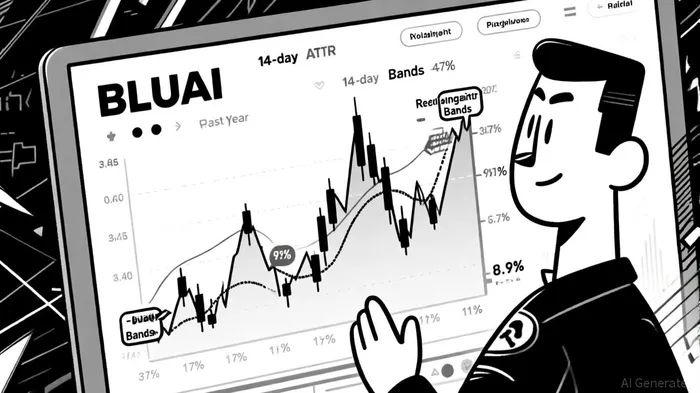
Strategic entry points emerge when combining these indicators with market sentiment. For example, Stochastic RSI (14,3,3) has historically identified local tops and bottoms in BLUAI's price action, particularly when confirmed by bullish or bearish divergences, as previously reported by MEXC. The October 2025 listing on Binance Alpha and Futures creates a unique catalyst: liquidity surges and leverage availability (up to 50x) may amplify short-term momentum, but traders must remain cautious of bid-ask spreads and margin requirements, a risk highlighted in Coinotag's announcement.
Dual Exchange Momentum and Liquidity Dynamics
Binance's dual-listing strategy for BLUAI-spot trading on Binance Alpha and leveraged futures on Binance Futures-creates a feedback loop between spot and derivatives markets, according to a LookonChain announcement. This structure allows traders to hedge positions or scale exposure based on volatility, potentially stabilizing price discovery. For instance, the BLUAIUSDT perpetual contract's 50x leverage could attract speculative capital, increasing trading volume and reducing slippage for large orders, as noted in the Coinotag announcement. However, liquidity dynamics remain critical: during high-volatility periods, bid-ask spreads may widen, impacting entry costs.
Historical data suggests that BLUAI's market cycles align with broader altcoin trends but exhibit distinct amplitude and timing, a relationship observed in MEXC's analysis. The Nov 2023–Feb 2024 bull cycle, for example, outperformed the altcoin market by 200 basis points, driven by AI-driven use cases and institutional adoption. Investors should monitor 50-day and 200-day moving average crossovers, RSI divergences, and MACD histogram reversals to identify cycle transitions.
Strategic Entry Point Framework
To capitalize on BLUAI's dual exchange momentum, investors should adopt a phased entry strategy:
1. Initial Accumulation (October 21–31, 2025): Target pullbacks during the post-listing volatility. Use Stochastic RSI divergences and Bollinger Band contractions to identify oversold conditions.
2. Momentum Scaling (November 2025–January 2026): Add to positions during AI roadmap updates or whale activity spikes. Monitor WhaleScore metrics for real-time demand signals.
3. Risk Management: Set stop-loss orders below key support levels identified by 14-day ATR thresholds. Diversify exposure across spot and futures markets to hedge against liquidity shocks.
Conclusion: A High-Conviction Play in AI-Driven Finance
Bluwhale (BLUAI) represents a compelling intersection of AI, blockchain, and financial infrastructure. Its multi-chain architecture, dual exchange momentum, and utility-driven token model position it to capture growth in the AI-driven crypto sector. While volatility remains a challenge, technical indicators and strategic entry frameworks can mitigate risks while capitalizing on short- and long-term opportunities. As the ecosystem matures, BLUAI's ability to integrate real-time data and AI insights may redefine how users interact with decentralized finance.







Comentarios
Aún no hay comentarios