
Blue Star Helium: A Strategic Play in the Tightening Global Helium Supply Chain
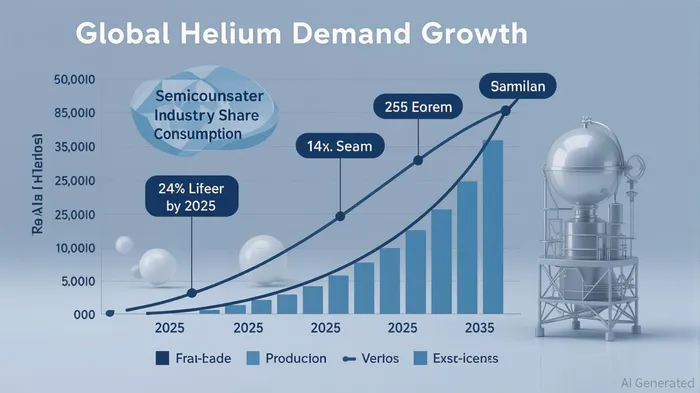
The global helium market is undergoing a seismic shift. As the semiconductor industry surges to meet the demands of artificial intelligence, quantum computing, and advanced manufacturing, its share of helium consumption has skyrocketed to 24% of global demand[2]. With annual production capacity hovering around 175 million cubic meters and demand inching closer to parity, the market is tightening—creating a perfect storm of upward price pressure and strategic opportunities for producers like Blue Star Helium.
Operational Momentum: Galactica's Path to Commercialization
Blue Star Helium's Galactica facility is no longer a speculative project but a near-term production reality. The company has completed its 2025 drilling campaign, with the State 9 well achieving a record gas flow rate of 360,000 cubic feet per day (cfd), alongside helium and CO2 concentrations of 1.52% and 80.48%, respectively[4]. These results validate the high permeability and productivity of the Lyons Formation reservoir, a critical factor for sustained output.
First helium production is now targeted for December 2025[1], with the Pinon Canyon processing plant nearing final installation and commissioning. The phased approach—tying in development wells incrementally—ensures controlled scaling while minimizing operational risks[1]. By Q1 2026, the company aims to integrate six development wells, including the Jackson-27 well (320,000 cfd flow rate, 0.41% helium) and Jackson-31 (250,000 cfd, 2.2% helium)[3], into its gathering system. This strategy not only accelerates revenue generation but also provides a buffer for optimizing full-field development.
Dual-Product Strategy: Monetizing CO2 as a Value Add
While helium remains the primary focus, Blue Star's ability to monetize CO2 is a game-changer. The Pinon Canyon plant will soon integrate CO2 purification and liquefaction capabilities, targeting the food and beverage industry, which demands high-purity CO2 for carbonation and modified atmosphere packaging[3]. With first CO2 production expected in H1 2026[1], the company is diversifying its revenue streams in a market where CO2 prices have surged due to supply chain disruptions and regulatory pressures on industrial emissions.
This dual-product model is a strategic hedge against helium price volatility. For context, the global helium price index has risen by 18% year-to-date, driven by outages at legacy producers and the semiconductor industry's insatiable appetite[2]. By capturing value from both helium and CO2, Blue Star is positioning itself as a resilient, multi-commodity player.
Market Dynamics: A Semiconductor-Driven Gold Rush
The semiconductor industry's dominance in helium demand is not a temporary blip. As stated by the 2025–2035 Helium Market Report, the sector's reliance on high-purity helium for cryogenic cooling and gas chromatography is expected to grow at a compound annual rate of 9.5%[2]. This trend is compounded by geopolitical factors: China's recent restrictions on helium exports and the U.S. Department of Energy's push to deplete its 30-year-old helium reserve have further strained supply.
Blue Star's timing is impeccable. With its Galactica facility set to come online as the market transitions from a supply surplus to a deficit, the company is uniquely positioned to capture a disproportionate share of the value. Its 6–10 identified infill drilling locations[4] also provide a clear path to scale production beyond initial targets, ensuring long-term growth.
Investment Thesis: A Producer Born of Necessity
Blue Star Helium's transition from explorer to producer is a masterclass in strategic execution. By leveraging high-permeability reservoirs, a phased development approach, and dual-product monetization, the company is mitigating the risks that have plagued smaller helium producers. Moreover, its alignment with the semiconductor industry's growth trajectory—coupled with a tightening global supply chain—creates a compelling case for long-term value creation.
For investors, the key question is not whether Blue Star will succeed, but how quickly it can scale. With first production just weeks away and CO2 monetization on the horizon, the company is poised to deliver both near-term cash flow and long-term equity upside in a market where supply constraints are becoming the new normal.







Comentarios
Aún no hay comentarios