
Blue Origin's Mars Mission and the Future of Space Launch Competitiveness
The Economics of Reusability: A Double-Edged Sword
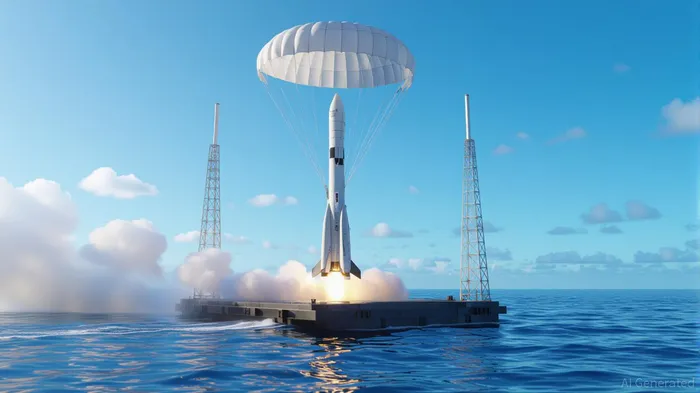
Reusable rocket technology has long been hailed as a game-changer for reducing launch costs. According to analysis, SpaceX's Falcon 9, , has set a benchmark by slashing costs and enabling high-frequency missions like Starlink deployments. However, the economic benefits of reusability are contingent on sustained demand for frequent launches. In contrast, Europe's Ariane 6 remains expendable, as its market lacks the volume to justify the high upfront investment in reusability according to the same analysis.
Blue Origin's New Glenn rocket, with its demonstrated reusability, positions the company to compete in markets where cost efficiency is paramount. Yet, the financial success of such technology hinges on securing long-term contracts and scaling operations. For instance, Rocket Lab's Electron rocket, though smaller, has generated steady revenue by targeting niche markets like small satellite launches, even as its Neutron rocket faces delays. This highlights a key investment consideration: reusability is not a universal solution but a strategy that must align with specific market dynamics.
Industry Consolidation and Strategic Acquisitions
The space industry is witnessing rapid consolidation, driven by the need to scale infrastructure and reduce costs. According to Bloomberg, , respectively, illustrate how companies are strengthening their portfolios to remain competitive. Similarly, according to CB Insights. These moves reflect a broader trend: firms prioritizing vertical integration to control costs and accelerate innovation.
Meanwhile, SpaceX's dominance-responsible for over half of the 149 launches in the first half of 2025-has intensified pressure on competitors. The global space economy, , is increasingly concentrated in the hands of a few players, with commercial ventures accounting for 78% of growth according to the Space Foundation report. For Blue Origin, this means navigating a landscape where differentiation through specialized missions (e.g., Mars exploration) and strategic partnerships (e.g., with NASA) is critical to securing funding and market share.
Investment Implications: Balancing Risk and Opportunity
, , highlights the importance of government partnerships in de-risking high-cost ventures according to CBC News. , though its reliance on government contracts and private investors like Bezos Expeditions remains a key risk according to CB Insights.
For investors, the interplay between reusability and consolidation presents both opportunities and challenges. While reusable rockets can reduce costs, their economic viability depends on sustained demand, which SpaceX has largely created through Starlink. Smaller players like Rocket Lab and Blue Origin must either carve out niche markets or collaborate with larger entities to remain relevant. Additionally, emerging fields like in-orbit servicing and manufacturing (ISAM) could unlock new revenue streams, but they require significant upfront investment .
Conclusion: A Strategic Path Forward
Blue Origin's Mars mission and reusable rocket advancements position it as a formidable player in the next phase of space exploration. However, its success will depend on its ability to scale reusability, secure long-term contracts, and navigate an industry increasingly dominated by a few giants. For investors, the key takeaway is that the space sector's future lies in balancing technological innovation with pragmatic financial strategies. As the global space economy grows, those who can align reusability with market demand-and adapt to consolidation-will likely lead the charge.







Comentarios
Aún no hay comentarios