
Blue Origin's Mars Mission and the Future of Private Space Investment
A New Era of Reusability and Cost Efficiency
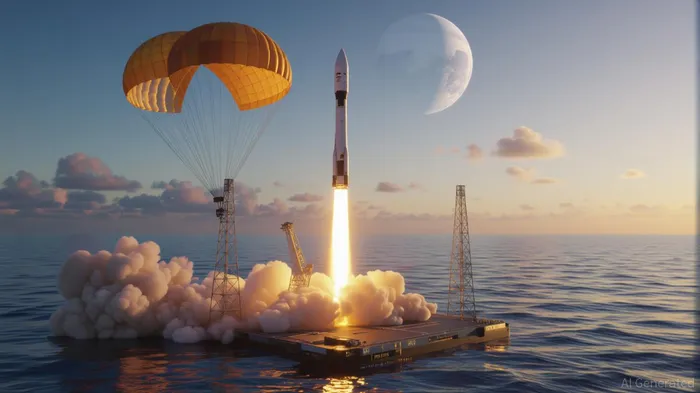
The New Glenn rocket's successful deployment of the ESCAPADE satellites-twin spacecraft named Blue and Gold-highlights the maturation of reusable rocket technology. By landing its first-stage booster in the Atlantic Ocean, Blue Origin has joined the ranks of companies reducing the exorbitant costs of space launches. According to a Bloomberg report, , making previously unfeasible missions economically viable. This cost deflation is already attracting private capital to aerospace startups focused on satellite infrastructure, .
The ESCAPADE mission itself, , underscores the agency's strategic pivot toward commercial partnerships. , where they will study the planet's atmospheric loss and magnetic field interactions with solar winds. This data could inform future human missions and climate studies, but its immediate impact lies in validating the reliability of private-sector-built systems for deep-space exploration.
Investment Trends in Aerospace Startups and Satellite Infrastructure
The commercialization of space is accelerating, with aerospace startups now competing to build next-generation satellite networks, space stations, and in-orbit servicing systems. Blue Origin's collaboration with Rocket LabRKLB-- on the ESCAPADE mission exemplifies this trend. While Rocket Lab designed and built the satellites, the lack of disclosed funding for its role in 2025 highlights a gap in transparency for investors. However, broader industry data suggests robust growth: venture capital firms are increasingly targeting companies developing technologies for lunar and interplanetary infrastructure, .
One key area of investment is satellite communications. Major telecom carriers are partnering with space firms to deploy Direct-to-Cell technology, enabling mobile phone coverage in remote regions. For instance, Viasat's secondary payload on the New Glenn rocket demonstrated in-space relay capabilities, a critical step toward global connectivity. Meanwhile, the U.S. Department of Defense is investing in space-based systems to counter hypersonic missile threats, further diversifying revenue streams for aerospace firms.
The Road Ahead: Profitability and Market Expansion
Despite these advancements, challenges remain. Blue Origin's delayed New Glenn development forced NASA to shift some Mars-bound payloads to other rockets, illustrating the risks of relying on nascent commercial systems. However, the company's recent FAA license for orbital launches and its Blue Ring initiative-focused on on-orbit spacecraft servicing-signal a clear path to profitability. note .
For investors, the focus should be on startups with direct ties to satellite infrastructure and deep-space logistics. Companies like Rocket Lab, which built the ESCAPADE satellites, and those developing modular space stations or in-orbit refueling systems are likely to benefit from NASA's Artemis program and Mars exploration goals. Additionally, the rise of cryptocurrency partnerships-such as Shift4 Payments' recent deal to enable crypto payments for Blue Origin flights-hints at broader financial innovation in the sector.
Conclusion
Blue Origin's Mars mission is more than a technical triumph; it is a catalyst for reshaping the commercial space industry. By proving the viability of reusable rockets and fostering public-private partnerships, the company has lowered barriers to entry for deep-space exploration. As launch costs continue to decline and satellite infrastructure becomes a trillion-dollar market, aerospace startups and investors stand to gain unprecedented opportunities. The next decade will likely see a surge in interplanetary missions, driven not by government budgets alone but by the entrepreneurial spirit of firms like Blue Origin.





Comentarios
Aún no hay comentarios