
Blue Origin's New Glenn Mars Mission: A Catalyst for the Commercialization of Interplanetary Exploration
A New Era of Reusability and Cost Efficiency
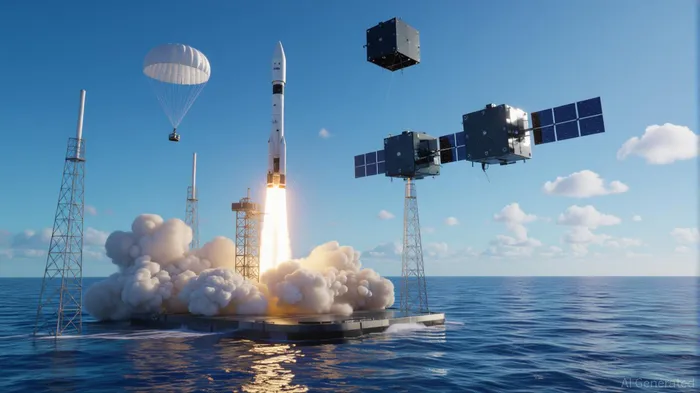
The New Glenn rocket, , successfully demonstrated its reusability by landing its first stage on a drone ship in the Atlantic Ocean. This achievement places Blue Origin in an elite club of companies-alongside SpaceX-that have mastered operational rocket recovery, a critical enabler of cost-effective interplanetary missions. According to a report by , the New Glenn's payload capacity rivals SpaceX's Falcon Heavy, positioning Blue Origin as a formidable competitor in the launch market.
The economic implications are profound. , democratizing access to space for scientific and commercial ventures. For instance, the ESCAPADE mission, which aims to study Mars' magnetosphere and atmospheric loss, was developed under NASA's SIMPLEx program-a model that leverages commercial launch providers to cut costs while accelerating scientific discovery.
NASA's Strategic Shift: Partnerships Over Proprietary Development
NASA's collaboration with Blue Origin reflects a broader strategic pivot toward outsourcing infrastructure and launch capabilities to private firms. The ESCAPADE mission, contracted under NASA's VADR (Venture-class Acquisition of Dedicated and Rideshare) program, exemplifies this approach. By allowing companies like Blue Origin to handle launch logistics, NASA can focus on mission-specific science while reducing overhead.
This model is not without precedent. SpaceX's Commercial Crew Program and Starship development have already proven the viability of public-private partnerships. However, Blue Origin's entry into this arena introduces healthy competition, which could drive further cost reductions and technological advancements. As stated by , the success of the ESCAPADE launch "highlights the growing importance of public-private partnerships in advancing scientific and commercial interests in the space economy."
The Investment Thesis: A $1.8 Trillion Space Economy by 2035
The private aerospace sector is now a cornerstone of the global space economy, . Key drivers include satellite communications, space infrastructure development, and interplanetary exploration. For example, telecom giants are partnering with space companies to deploy Direct-to-Cell technology, expanding coverage to remote regions-a market segment expected to grow alongside advancements in low-Earth orbit (LEO) infrastructure.
Investors should focus on companies with clear commercial pathways and technical execution capabilities. Blue Origin's New Glenn, with its reusable design and NASA-backed missions, fits this profile. Meanwhile, Rocket Lab's role in building the ESCAPADE satellites demonstrates how smaller firms can specialize in niche areas of the value chain, such as spacecraft manufacturing.
Risks remain, however. Blue Origin lags behind SpaceX in operational experience, and geopolitical tensions could disrupt supply chains or regulatory approvals. Yet, the sector's long-term potential-bolstered by lunar missions, asteroid mining, and Mars colonization-suggests that these challenges are surmountable.
Conclusion: A Launchpad for the Future
The ESCAPADE mission is more than a scientific endeavor; it is a harbinger of a new era where commercial space firms and government agencies collaborate to unlock the universe's secrets. For investors, this represents an opportunity to capitalize on a sector transitioning from niche exploration to a mainstream economic force. As reusable rockets and cost-efficient launch models become the norm, the space economy will mirror the trajectory of the internet in the 1990s-transformative, disruptive, and ripe for those who act early.







Comentarios
Aún no hay comentarios