
Blue Origin's New Glenn Launch and Mars Mission Progress: A Catalyst for Space Infrastructure Investment
Reusability and Cost Efficiency: A Game Changer
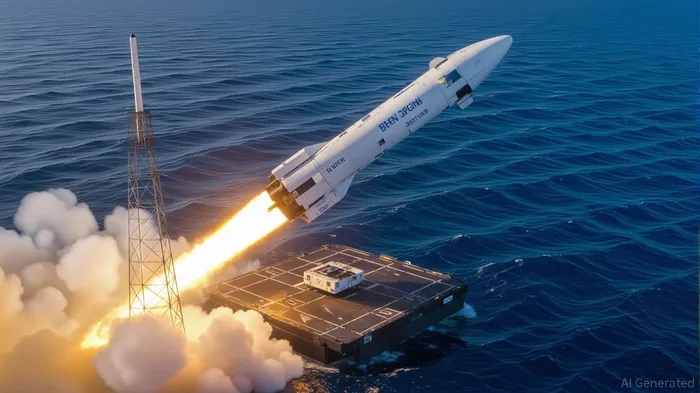
The NG-2 mission's successful booster landing represents a major leap forward for Blue Origin's reusability goals. Unlike its debut flight in January 2025, which failed to recover the first stage, the November launch demonstrated the rocket's ability to reuse its most expensive component, significantly reducing per-launch costs according to Bloomberg. According to a report by Bloomberg, this achievement positions New Glenn to compete directly with SpaceX's Falcon 9, which has long dominated the reusable rocket market according to Bloomberg.
The economic implications are profound. according to Economic Times. , according to USA Today. , driven by reusable technologies and increased launch frequency according to Deloitte.
NASA Collaboration and Strategic Positioning
The NG-2 mission is a testament to Blue Origin's growing partnership with NASA. By carrying the ESCAPADE spacecraft-a pair of satellites designed to study Mars' interaction with solar wind-the rocket has proven its reliability for high-stakes interplanetary missions according to The Wall Street Journal. This collaboration is part of a broader strategy to diversify launch providers, reducing reliance on SpaceX for critical missions. As stated by The Wall Street Journal, the success of this mission could pave the way for future New Glenn launches supporting NASA's Artemis program, including the Blue Moon lunar lander according to Bloomberg.
The rocket's 322-foot height and 7-meter fairing also make it uniquely suited for large payloads, such as AST SpaceMobile's BlueBird satellites, which are designed to deliver cellular broadband from space according to Blue Origin. This versatility strengthens Blue Origin's position in the commercial market, where demand for heavy-lift capabilities is rising.
Space Economy Growth and Investment Opportunities
according to Space Foundation-creates fertile ground for investment. Blue Origin's advancements in reusability and payload capacity are directly tied to this growth. For instance, AST SpaceMobile's partnership with Blue Origin to launch its Block 2 satellites highlights how emerging aerospace firms are leveraging New Glenn's capabilities to build next-generation infrastructure according to Blue Origin.
Investors should also consider the ripple effects of New Glenn's success. Morgan Stanley notes that innovations in satellite broadband, Earth observation, and in-orbit manufacturing will drive the industry's expansion according to Morgan Stanley. Companies like Rocket LabRKLB--, which built the ESCAPADE spacecraft, and Firefly AerospaceFLY--, developing rockets for national security missions, are examples of firms poised to benefit from increased launch activity according to SpaceNews.
Strategic Investment Avenues
Emerging aerospace startups aligned with Blue Origin's ecosystem present compelling opportunities. AST SpaceMobile's BlueBird satellites, for example, require the New Glenn's large fairing to deploy effectively, creating a symbiotic relationship according to Blue Origin. Similarly, firms specializing in space debris remediation and in-orbit servicing-such as Blue Origin's own Blue Ring initiative-are likely to gain traction as launch costs decline according to Bloomberg.
For institutional investors, the key lies in identifying companies that either directly utilize New Glenn's capabilities or address ancillary needs in the space supply chain. according to Bloomberg, the infrastructure supporting these missions-from ground systems to satellite manufacturing-will see heightened demand.
Conclusion
Blue Origin's NG-2 mission is more than a technical achievement; it is a harbinger of a new era in commercial spaceflight. By demonstrating reusability, securing high-profile NASA contracts, and enabling emerging technologies, the New Glenn rocket is reshaping the economics of space access. For investors, the message is clear: the space economy is no longer a speculative frontier but a robust market with tangible growth drivers. As the industry matures, strategic investments in aerospace infrastructure-particularly those aligned with Blue Origin's advancements-will yield significant returns in the coming decade.





Comentarios
Aún no hay comentarios