
Bloom Energy: Powering the AI Revolution Through Clean Energy Infrastructure
The AI revolution is reshaping global industries, but its exponential growth hinges on a critical, often overlooked enabler: clean energy infrastructure. As artificial intelligence (AI) workloads consume an increasingly dominant share of global electricity demand, companies like Bloom Energy are emerging as pivotal players in bridging the gap between digital innovation and sustainable power. With data center electricity consumption projected to quadruple by 2030[1], the need for reliable, low-carbon energy solutions has never been more urgent. Bloom Energy's strategic pivot to AI data centers—coupled with its scalable solid oxide fuel cell (SOFC) technology—positions it as a linchpin in the energy transition, offering investors a compelling case for long-term value creation.
The AI-Driven Energy Crisis: A $720 Billion Problem
The surge in AI adoption has created a perfect storm for energy demand. According to a report by McKinsey, global data center electricity consumption could grow by 50% annually through 2030, with AI workloads alone accounting for over a quarter of this demand by 2027[2]. In the U.S., data centers are expected to consume 11–12% of total power by 2030, surpassing energy-intensive manufacturing sectors like steel and cement[3]. Goldman Sachs estimates that AI data centers will require 165% more electricity by 2030 than they did in 2023[4], driven by the power-hungry nature of large language models (LLMs) and high-performance computing.
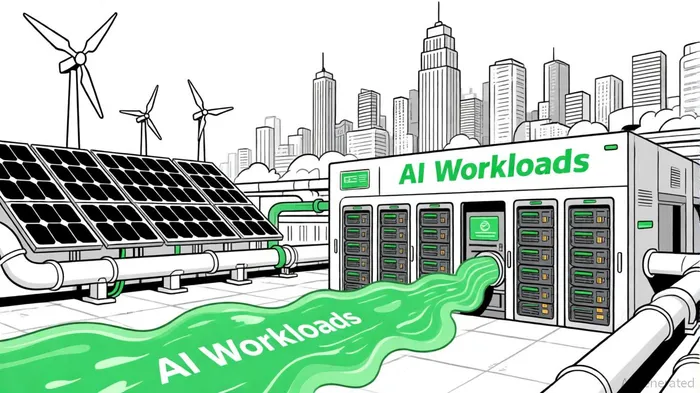
Meeting this demand is no small feat. Grid constraints, long lead times for infrastructure, and strained labor markets are creating bottlenecks[5]. Meanwhile, sustainability commitments are forcing data center operators to adopt hybrid solutions that blend renewables, battery storage, and backup power. This is where Bloom Energy's SOFC technology shines. Unlike traditional grid-dependent solutions, Bloom's EnergyBE-- Servers provide on-site, emissions-free power with the scalability to meet AI's voracious appetite for electricity.
Bloom Energy's Strategic Dominance in AI Data Centers
Bloom Energy has positioned itself as the go-to partner for hyperscalers and cloud providers. In 2025, the company expanded its decade-long collaboration with Equinix, surpassing 100 MW of fuel cell deployments across 19 data centers, with 75 MW already operational and 30 MW under construction[6]. This partnership, which began with a 1 MW pilot in 2015, now represents a 10-year agreement that underscores Bloom's ability to scale rapidly.
Equally significant is Bloom's landmark 90-day deployment agreement with Oracle to power its AI data centers[7]. This deal, announced in Q3 2025, highlights Bloom's agility in a market where speed and reliability are paramount. Oracle's adoption of on-site fuel cells reflects a broader industry shift: hyperscalers are increasingly prioritizing energy resilience to avoid grid outages and reduce carbon footprints.
Bloom's competitive edge lies in its SOFC technology, which outperforms alternatives like Plug Power's proton exchange membrane (PEM) fuel cells. While Plug Power focuses on transportation applications and plans to enter the data center market in late 2025[8], Bloom has already secured major contracts and demonstrated its ability to adapt SOFCs to run on hydrogen. This flexibility positions Bloom to lead the transition to low-carbon power as green hydrogen becomes more viable.
Financial Resilience and Manufacturing Expansion
Bloom Energy's financial performance in 2025 reinforces its credibility as a long-term investment. The company reported Q1 revenue of $326 million, exceeding expectations by 11%, and projects full-year revenue between $1.65 billion and $1.85 billion[9]. With a gross margin of 29%, Bloom has navigated challenges like rising natural gas prices and potential tariffs[10].
To meet surging demand, Bloom is doubling its manufacturing capacity to 2 GW by 2026[11]. This expansion, funded by a $1.2 billion capital raise in early 2025, ensures the company can scale alongside the AI data center boom. By contrast, Plug Power, which faces liquidity challenges, has yet to match Bloom's production scale or contract volume[12].
The Investment Thesis: Clean Energy as a Strategic Bottleneck
The energy transition is not just about renewables—it's about reimagining infrastructure to support AI's digital frontier. Bloom Energy's SOFCs address a critical bottleneck: the need for continuous, high-density power in a world where grid reliability is increasingly uncertain. With data centers projected to require $720 billion in grid upgrades by 2030[13], companies that can deliver decentralized, clean energy solutions will dominate the next decade.
Bloom's partnerships with Equinix and Oracle, combined with its technological and financial advantages, make it a standout in this space. While skeptics may question the scalability of fuel cells, the company's 2 GW manufacturing target and $1.85 billion revenue forecast[14] suggest it's already winning the race. For investors, Bloom EnergyBE-- represents more than a clean energy play—it's a bet on the infrastructure that will power the AI economy.





Comentarios
Aún no hay comentarios