
Bloom Energy vs. Oklo: Which Energy Innovator Is Better Positioned to Power the AI-Driven Future?
The race to power the AI revolution is heating up, with two energy innovators-Bloom Energy and Oklo-emerging as key contenders. While both companies are targeting the surging demand for clean, reliable power in the AI sector, their strategies diverge sharply. Bloom EnergyBE--, a leader in fuel cell technology, is already reaping the rewards of near-term execution and strategic partnerships, while OkloOKLO--, a nuclear microreactor startup, is betting on long-term disruptive innovation. For investors, the question is clear: Should they prioritize Bloom's immediate revenue potential or Oklo's transformative but distant promise?
Bloom Energy: Scaling Now with Proven Partnerships
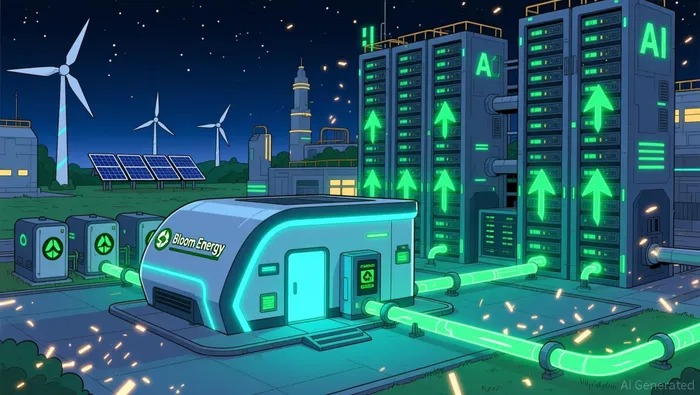
Bloom Energy has demonstrated remarkable execution in 2024 and 2025, with full-year 2024 revenues hitting $1,473.9 million and Q3 2025 revenue surging 57.1% year-over-year to $519.0 million. This growth is driven by its pivot to AI energy solutions, including a landmark $5 billion partnership with Brookfield to deploy fuel cells for AI data centers globally. Additionally, Bloom's collaboration with Oracle to provide rapid on-site power for AI infrastructure has solidified its role in the sector.
The company's ability to secure contracts with major players like CoreWeave, Quanta Computer, and American Electric Power (AEP) underscores its immediate relevance. These partnerships position BloomBE-- as a critical supplier of decentralized, carbon-neutral power for data centers, which are increasingly energy-intensive as AI models grow in complexity. According to a report by Enkiai, Bloom's AI-focused initiatives are projected to drive a $21 billion revenue surge by 2025, reflecting strong market confidence in its near-term scalability.
Oklo: Betting on Nuclear's Long-Term Disruption
Oklo, by contrast, is still in the development phase but has captured attention with its Aurora reactor, a 75-MW advanced nuclear microreactor designed to meet the energy demands of AI data centers according to reports. The company's partnerships with Lightbridge and RPower highlight its focus on long-term supply chain resilience and phased power solutions. For instance, Oklo's collaboration with RPower involves a hybrid model that combines natural gas generators with a future transition to Aurora reactors, ensuring immediate power availability while aligning with sustainability goals.
 Despite reporting net losses in 2024, Oklo's stock price surged 46% during the period, driven by regulatory milestones and strategic alliances. Its Aurora reactor, slated for deployment at the Idaho National Laboratory by late 2027 or early 2028, benefits from streamlined regulatory processes under the ADVANCE Act, which accelerates microreactor commercialization. As noted in a report by MLQ.ai, Oklo's technology could become a cornerstone for AI energy demand, which is expected to triple or quadruple by 2030. However, the company's revenue generation remains contingent on successful deployment and market adoption of its reactors-a timeline that stretches beyond 2025.
Near-Term Execution vs. Long-Term Innovation
Bloom Energy's strength lies in its ability to monetize existing infrastructure and partnerships. Its fuel cell technology is already operational, with a clear path to scaling revenue through contracts with industry giants. For investors seeking immediate returns, Bloom's 60%+ revenue growth in 2024 and its $5 billion Brookfield deal make it a compelling choice.
Oklo, meanwhile, represents a higher-risk, higher-reward proposition. While its Aurora reactor is still in development, the company's strategic positioning in the nuclear energy sector and backing from figures like Sam Altman suggest it could redefine AI energy solutions in the long term according to market analysis. However, its success hinges on navigating regulatory hurdles, securing funding, and proving the commercial viability of microreactors-a process that will take years.
Conclusion: Aligning Investment with Time Horizon
For investors prioritizing near-term execution and revenue visibility, Bloom Energy is the clear favorite. Its track record of scaling partnerships and generating robust financial results positions it as a reliable player in the AI energy market. Conversely, Oklo's disruptive potential is undeniable, but its value will only materialize if it can overcome technical and regulatory challenges to deliver its Aurora reactors by 2028.
Ultimately, the choice between Bloom and Oklo depends on an investor's risk tolerance and time horizon. Those seeking immediate gains should lean on Bloom's momentum, while those willing to bet on the future of nuclear energy may find Oklo's vision more compelling. In an AI-driven world where energy demand is only accelerating, both companies have a role to play-but their paths to success could not be more different.







Comentarios
Aún no hay comentarios