
BlockDAG Technology's Emergence and Its Disruptive Potential in the Blockchain Ecosystem
The Evolution of Blockchain: From Linear Chains to Parallel Processing
Traditional blockchain technology, pioneered by BitcoinBTC-- in 2008, established a decentralized ledger model where transactions are validated sequentially in a linear chain of blocks[1]. This architecture prioritized security and immutability but introduced inherent scalability limitations. Ethereum's 2015 launch of smart contracts expanded blockchain's utility but exacerbated throughput bottlenecks, with Ethereum's average transaction speed hovering around 15–30 TPS[2]. By the mid-2010s, these constraints became a critical barrier to mass adoption, prompting the search for alternative architectures.
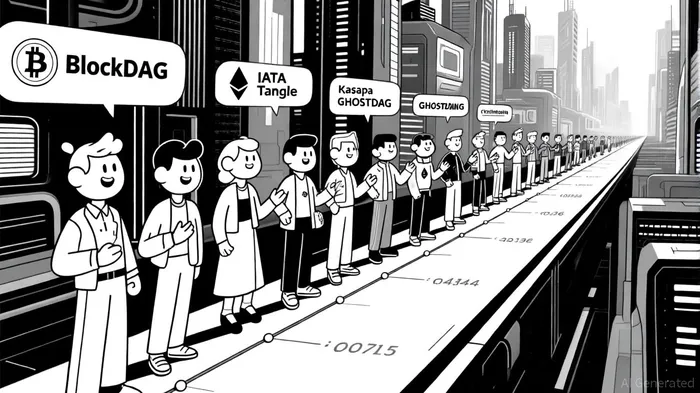
BlockDAG (Directed Acyclic Graph) emerged as a paradigm-shifting solution in the early 2020s. Unlike traditional blockchains, BlockDAG organizes transactions in a multidimensional graph structure, enabling parallel validation. This innovation was first tested in IOTA's Tangle (2015) and later refined in projects like Kaspa (2021), which introduced the GHOSTDAG protocol to achieve 32 blocks per second[3]. By 2025, BlockDAG's scalability had advanced to claims of 15,000 TPS and 70% lower energy consumption compared to traditional chains[4].
Adoption Rates: BlockDAG's Surge vs. Traditional Blockchain's Plateau
From 2020 to 2025, BlockDAG's adoption metrics outpaced traditional blockchains. EthereumETH--, despite its dominance in smart contracts (62% of live contracts in 2025[5]), faced persistent scalability challenges. CardanoADA--, with its peer-reviewed Ouroboros consensus, prioritized long-term stability but struggled to attract developers due to its reliance on Haskell and Plutus[6]. In contrast, BlockDAG's hybrid architecture—combining DAG with blockchain elements—enabled rapid developer onboarding. Over 4,500 developers and 300 projects are already active on its testnet, leveraging tools like Ethereum-compatible smart contract builders[7].
Financial metrics further underscore BlockDAG's momentum. Its presale raised $384 million as of 2025, with a projected listing price of $0.05 implying a 2,660% return for early investors[8]. Traditional blockchains, while foundational, lack comparable growth trajectories. Ethereum's post-Merge energy efficiency (0.0026 TWh/year) is laudable[9], but its transaction throughput remains constrained by linear processing. Cardano's 0.0031 TWh/year energy use[9] is similarly efficient but has not translated into the same developer or user engagement.
Disruptive Potential: Scalability, Usability, and Real-World Applications
BlockDAG's disruptive potential lies in its ability to address three critical pain points: scalability, usability, and real-world integration. By enabling parallel transaction processing, it eliminates the need for sequential block validation, achieving throughput levels suitable for IoT, microtransactions, and global payment systems[10]. Projects like Kaspa's DAGKNIGHT upgrade aim to push this further, targeting 150,000 TPS[11].
Usability is another differentiator. BlockDAG's user-centric tools, such as the X1 Miner App (allowing smartphone mining) and gamified earning platforms like Tap Miner, have cultivated a community of 750,000 miners and 400,000 players[12]. This lowers barriers to entry and fosters mainstream adoption. Traditional blockchains, by contrast, often require technical expertise or expensive hardware.
Real-world partnerships also highlight BlockDAG's traction. Collaborations with entities like Inter Milan and HackerEarth, alongside applications in NFT ticketing and payment systems[13], demonstrate its practical utility. Ethereum and Cardano, while robust in DeFi and smart contracts, lag in tangible use cases outside niche markets.
Conclusion: A New Era in Decentralized Systems
BlockDAG's emergence marks a pivotal shift in blockchain innovation. By addressing scalability through parallel processing and prioritizing usability, it positions itself as a viable alternative to traditional blockchains. For investors, the combination of rapid adoption, developer activity, and real-world partnerships suggests a compelling long-term opportunity. As the global blockchain market expands from $3 billion in 2020 to $39.7 billion by 2025[14], BlockDAG's disruptive potential could redefine the industry's trajectory.






Comentarios
Aún no hay comentarios