
Is BlockDAG the Next Solana-Level Disruptor in Crypto?
The blockchain industry is no stranger to disruptive innovation, but few projects have captured the imagination of investors and developers as profoundly as SolanaSOL--. Now, a new contender-BlockDAG-has emerged, promising to challenge Solana's dominance with a hybrid Layer-1 architecture, institutional-grade security, and a presale that has already raised over $442 million. This article evaluates whether BlockDAG can replicate Solana's trajectory by analyzing its technological innovations, presale momentum, and institutional adoption.
Layer-1 Innovation: DAG-PoW vs. dPoS-PoH
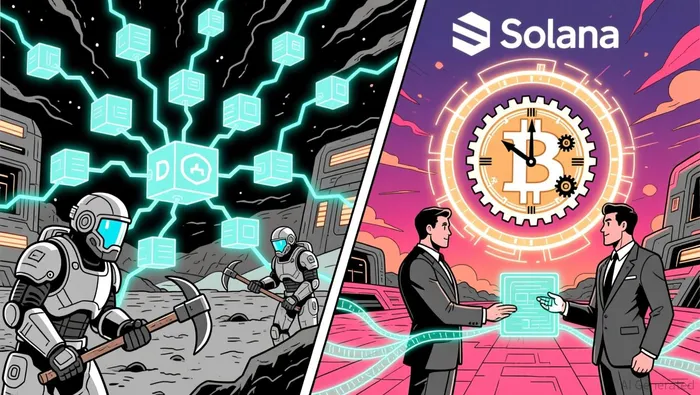
BlockDAG's hybrid Directed Acyclic Graph (DAG) + Proof-of-Work (PoW) architecture represents a radical departure from traditional blockchain designs. By enabling parallel block confirmations, the network claims to process up to 10 blocks per second while maintaining PoW's robust security model. This contrasts with Solana's Delegated Proof of Stake (dPoS) combined with Proof of History (PoH), which leverages a cryptographic clock to achieve 600–1,000 transactions per second under real-world conditions.
BlockDAG's compatibility with the EthereumETH-- Virtual Machine (EVM) further enhances its appeal, allowing seamless migration of Ethereum-based applications without sacrificing scalability or cost efficiency. Meanwhile, Solana's Tower Byzantine Fault Tolerance (BFT) and Turbine protocol optimize block propagation and finality, but its reliance on a centralized validator network (1,800 active nodes) raises concerns about long-term decentralization.
Critically, BlockDAG's testnet has already demonstrated 1,400 TPS, outpacing Solana's theoretical maximum of 65,000 TPS under ideal conditions. However, Solana's institutional-grade infrastructure- bolstered by partnerships with major financial players-has solidified its position as a preferred platform for real-world asset (RWA) tokenization.
Presale Momentum: A $442M Bet on the Future
BlockDAG's presale has become a focal point for investors seeking high-growth opportunities. As of January 2026, the project has raised $442 million, with a presale price of $0.003 per token and a projected launch price of $0.05-implying a potential 16.67x return. This momentum is driven by a combination of grassroots adoption (3 million miners onboarded) and institutional interest, including $86 million in verified investments.
In contrast, Solana's ETF-driven institutional inflows have surpassed $1 billion in net assets, with ETFs maintaining positive flows despite a 6% price drop to $182 in late 2025. While Solana's Total Value Locked (TVL) surged to $35 billion by late 2025, BlockDAG's presale success highlights a shift in investor sentiment toward projects prioritizing decentralization and real-time analytics.
Institutional Adoption: RWAs vs. Community-Driven Growth
Solana's institutional appeal is rooted in its RWA tokenization capabilities. Projects like Homebase (fractional property ownership) and Baxus (tokenized rare spirits) have tokenized $873 million in assets on Solana, with support from Franklin Templeton, Société Générale, and BlackRock. The network's AWS outage resilience in October 2025 further cemented its reliability, attracting $628.98 million in tokenized assets.
BlockDAG, meanwhile, is positioning itself as a community-first alternative. Its hybrid DAG-PoW model has undergone security audits by Halborn and CertiK, while its partnership with the BWT Alpine Formula 1 Team has amplified global visibility. Institutional confidence is also growing, with plans to list on 20 exchanges and rumors of CoinbaseCOIN-- and Kraken listings.
However, Solana's dominance in RWA adoption remains unmatched. Its TVL growth of 1,067% year-over-year and $15 billion in stablecoin supply underscore its role as a bridge between traditional finance and DeFi. BlockDAG's focus on DAG-PoW and community ownership, while innovative, may struggle to replicate Solana's institutional momentum in the short term.
Conclusion: A Tale of Two Paradigms
BlockDAG and Solana represent two distinct paths in the evolution of Layer-1 blockchains. Solana's RWA-centric approach and institutional partnerships have created a robust ecosystem, but its reliance on dPoS and centralized validators may limit long-term scalability. BlockDAG's DAG-PoW architecture and $442 million presale signal a compelling alternative, particularly for investors prioritizing decentralization and real-time transaction speeds.
Yet, Solana's entrenched position in the RWA space and its $35 billion TVL cannot be ignored. For BlockDAG to achieve Solana-level disruption, it must not only maintain its presale momentum but also demonstrate real-world adoption that rivals Solana's tokenized asset ecosystem. As the crypto landscape evolves, both projects will need to adapt to shifting institutional priorities and technological advancements.





Comentarios
Aún no hay comentarios