
BlockDAG's X Series Miners and Their Role in Scaling a $405M Utility-Driven Crypto Network
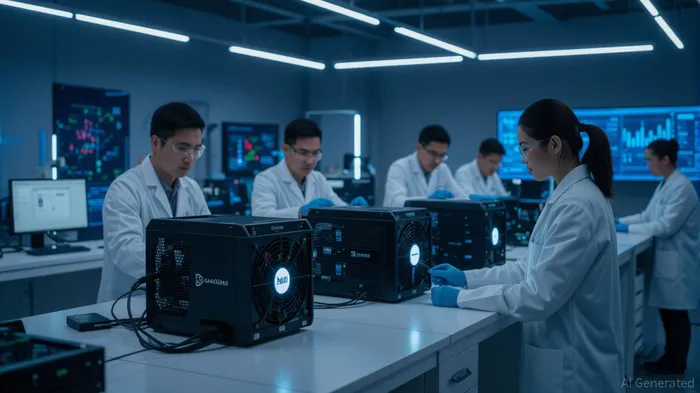
The Next Phase of Blockchain: Mining Infrastructure as a Catalyst for Utility
Blockchain's evolution has long been defined by its ability to solve real-world problems—speeding up transactions, reducing intermediaries, and democratizing access to financial systems. Yet, for these innovations to scale, the underlying infrastructure must adapt. Enter BlockDAG's X Series Miners, a suite of hardware and software solutions designed to accelerate the network's throughput, energy efficiency, and decentralized consensus. With BlockDAG's ecosystem already raising $394 million in its presale as of September 2025 and targeting a $405 million utility-driven network[1], the X Series Miners are not just tools for mining—they are foundational to the project's ambition to redefine blockchain's role in global industries.
Technical Value: Throughput and Scalability in a DAG Framework
BlockDAG's X Series Miners leverage a Directed Acyclic Graph (DAG)-based hybrid protocol, a departure from traditional blockchain architectures. This design allows the network to process over 10,000 transactions per second (TPS)[3], a critical benchmark for real-world applications like cross-border payments and decentralized finance (DeFi). The X100 model, for instance, can mine 2,000 BDAG coins daily[5], while the X1 Miner—designed for accessibility—enables mobile mining via a smartphone app[2]. This tiered approach ensures scalability for both individual miners and large-scale operations.
The DAG architecture's inherent parallelism eliminates the bottleneck of linear block validation, enabling faster finality and reduced latency. According to a report by CoinCheckup, this structure positions BlockDAG to outperform legacy blockchains in throughput while maintaining security[3]. For investors, this means the network is primed to handle enterprise-level workloads, from supply chain tracking to digital identity verification[4].
Energy Efficiency: A Sustainable Mining Paradigm
Energy consumption has long been a sticking point for blockchain adoption. BlockDAG's X Series Miners address this by integrating energy-efficient hardware and a hybrid consensus mechanism that balances Proof-of-Work (PoW) with DAG-based validation[1]. The X30 model, for example, achieves 600 BDAG coins daily while consuming significantly less power than comparable BitcoinBTC-- miners[5].
Third-party audits by Halborn and Certik have validated these claims, confirming the network's ability to maintain high security without excessive energy use[2]. This is a strategic advantage in a regulatory climate increasingly focused on environmental impact. For context, Bitcoin's energy consumption rivals that of small countries, while BlockDAG's approach aligns with global sustainability goals—a factor that could attract institutional investors and ESG-focused capital.
Decentralized Consensus: Security and Community Incentives
A robust consensus mechanism is the bedrock of any blockchain's credibility. BlockDAG's hybrid protocol evolves beyond Kaspa's DAG model by introducing multi-layer validation, ensuring transactions are both fast and tamper-resistant[1]. The network's total supply of 50 billion BDAG tokens is allocated to prioritize community participation: 70% reserved for miners[1], creating a self-sustaining ecosystem where security is incentivized.
This design mitigates centralization risks. Unlike proof-of-stake (PoS) models, where wealth concentration can undermine decentralization, BlockDAG's PoW-DAG hybrid ensures that mining power is distributed across a broad base of participants. As stated by the project's whitepaper, this structure “aligns miner incentives with network security, fostering long-term trust”[5].
Real-World Utility: From DeFi to Global Partnerships
BlockDAG's value proposition extends beyond technical metrics. The network is already deploying utility-driven applications in sectors like DeFi, where its high TPS and low fees enable seamless lending and trading platforms[4]. In supply chain management, the DAG's immutable ledger can track goods in real time, reducing fraud and inefficiencies.
Strategic partnerships are accelerating adoption. The project has confirmed listings on multiple Tier 1 and US-based exchanges[5], a move that will drive liquidity and visibility. Additionally, BlockDAG's mobile mining app democratizes participation, allowing users to mine from their smartphones—a feature that could onboard millions of new participants in emerging markets[2].
Investment Thesis: A Scalable, Long-Term Play
For investors, BlockDAG's X Series Miners represent more than a hardware play—they are a gateway to a blockchain network designed for mass adoption. The presale's $394 million raise[1] signals strong market confidence, while the six-month mainnet launch timeline underscores the team's execution capability. With 70% of tokens allocated to the community, the network's growth is intrinsically tied to miner participation, creating a flywheel effect as more users join.
The $405 million utility target is not just a financial milestone—it's a validation of BlockDAG's ability to deliver tangible value. As the network scales, its energy-efficient infrastructure and DAG-based architecture will position it as a go-to solution for enterprises and developers seeking scalable, secure blockchain tools.
Conclusion
BlockDAG's X Series Miners are a masterstroke in blockchain infrastructure. By combining DAG's scalability with energy-efficient hardware and a decentralized consensus model, the network is poised to bridge the gap between crypto's speculative past and its utility-driven future. For investors, this is a rare opportunity to back a project that's not just building a better blockchain but actively deploying it in industries hungry for innovation. As the $405 million utility target looms, one question remains: Will the market recognize BlockDAG as the next phase of blockchain, or will it dismiss it as another hype cycle? The answer may lie in the miners themselves.






Comentarios
Aún no hay comentarios