
BlockDAG: Redefining Blockchain Performance in 2025 – A Comparative Analysis with Cardano and Binance Smart Chain
In 2025, the blockchain landscape is defined by a race to solve scalability, energy efficiency, and developer accessibility. Three platforms-BlockDAG, CardanoADA-- (ADA), and Binance Smart Chain (BSC)-represent divergent strategies. While Cardano emphasizes academic rigor and Binance prioritizes institutional utility, BlockDAG emerges as a disruptive force, leveraging a hybrid Directed Acyclic Graph (DAG) architecture to outperform both in speed, scalability, and community-driven growth.
BlockDAG's Technical Edge: Speed, Scalability, and Accessibility
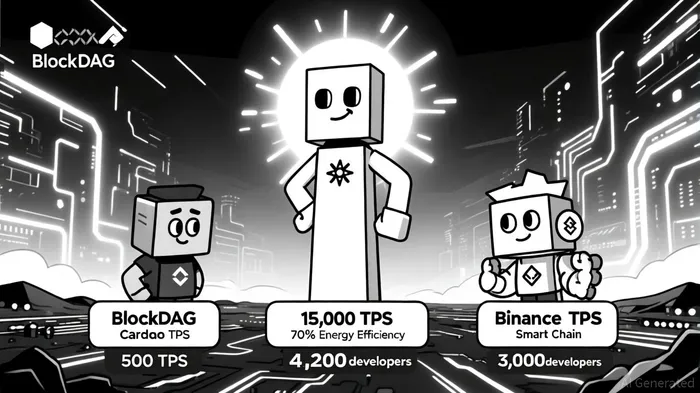
BlockDAG's hybrid DAG and Proof of Work (PoW) design enables parallel block creation, achieving 2,000–15,000 transactions per second (TPS), according to Analytics Insight. This dwarfs Cardano's 250–500 TPS, as noted in TheCoinrise analysis, and Binance Smart Chain's 2,181 TPS, according to ChainSpect, positioning BlockDAG as a viable Layer 1 solution for high-throughput applications. Its energy efficiency-70% by design-combines next-gen PoW with Proof of Engagement (PoE) via the X1 Mobile Miner, allowing users to mine from smartphones while maintaining security, according to Crypto-Economy.
The platform's ecosystem growth is equally compelling. Over 4,500 developers are building 300+ active projects, spanning DeFi, AI, and digital payments, according to TheCoinrise analysis. This developer density, coupled with EVM compatibility and low-code tools, lowers barriers for entry, attracting both traditional and crypto-native builders. BlockDAG's referral-based growth model further accelerates adoption, with a presale already raising $351 million and projecting 2,660% returns for early investors, according to Crypto-Economy.
Cardano's Academic Rigor: Stability Over Speed
Cardano's Ouroboros Proof of Stake (PoS) protocol prioritizes energy efficiency (95%) and formal verification, making it a favorite among institutions seeking long-term stability, as covered by Analytics Insight. However, its TPS of 250–500 lags behind BlockDAG and Binance Smart Chain, per TheCoinrise analysis, and its research-driven roadmap-while methodical-has delayed practical scalability solutions. This cautious approach appeals to risk-averse investors but leaves Cardano vulnerable to faster-moving competitors.
Binance Smart Chain's Institutional Dominance
Binance Smart Chain (BSC) remains a dominant force, leveraging Binance's ecosystem to process 145.9 TPS with block times of 0.75 seconds, according to ChainSpect. Its low fees ($0.01 per transaction) and quarterly token burns have driven BNB's TVL to $6 billion, according to an Analytics Insight roundup https://www.analyticsinsight.net/cryptocurrency-analytics-insight/experts-pick-these-4-top-high-roi-cryptos-for-2025-gains-blockdag-bnb-solana-cardano. Yet, BSC's centralized governance model-a point of contention in the crypto community-limits its appeal to those prioritizing decentralization, a critique echoed by Crypto-Economy. While Binance plans to increase gas limits and introduce privacy features, its reliance on Binance's institutional credibility makes it a less agile competitor to BlockDAG's community-driven model.
Investment Considerations: ROI, Risk, and Market Positioning
For investors, the choice hinges on priorities. BlockDAG's aggressive ROI projections (2,660% for presale participants) and rapid ecosystem growth make it a high-risk, high-reward bet, as noted by Crypto-Economy. Cardano offers stability and academic credibility, ideal for long-term hodlers. Binance Smart Chain, meanwhile, remains a safe harbor for those prioritizing utility within Binance's ecosystem.
However, BlockDAG's unique value proposition-combining DAG scalability, mobile mining, and a thriving developer community-positions it as a next-gen platform poised to redefine Layer 1 adoption. As the crypto market shifts toward speed and accessibility, BlockDAG's hybrid architecture and referral-driven growth model could outpace both Cardano's academic caution and Binance's institutional dominance.
Conclusion
The 2025 blockchain race is not just about technology but about adaptability. BlockDAG's ability to merge DAG scalability with PoW security, while democratizing access through mobile mining and a vibrant ecosystem, sets it apart. While Cardano and Binance Smart Chain remain relevant, their approaches-whether overly cautious or centralized-may struggle to keep pace with the decentralized, high-performance demands of tomorrow's crypto landscape. For investors seeking to capitalize on next-gen innovation, BlockDAG's trajectory is one to watch.






Comentarios
Aún no hay comentarios