
BlockDAG's Rapid Rise: Is It the New Benchmark for Blockchain Scalability and Investment Potential?
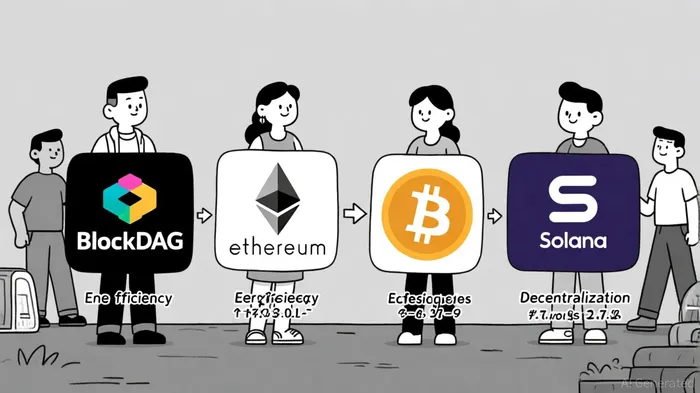
The Blockchain Trilemma and BlockDAG's Disruptive Approach
The blockchain industry has long grappled with the "trilemma" of scalability, security, and decentralization. Traditional blockchains like BitcoinBTC-- and EthereumETH-- have struggled to balance these pillars, often sacrificing one for the sake of another. BlockDAG, however, claims to resolve this conundrum through its hybrid Directed Acyclic Graph (DAG) and Proof-of-Work (PoW) architecture. By enabling parallel transaction validation, BlockDAG processes up to 15,000 transactions per second (TPS) while maintaining robust security and decentralization[1]. This contrasts sharply with Ethereum's 15–45 TPS bottleneck and Bitcoin's paltry 7 TPS[2], positioning BlockDAG as a potential scalability benchmark.
Scalability Metrics: TPS, Latency, and Energy Efficiency
BlockDAG's DAG structure eliminates the sequential block limitations of traditional blockchains, allowing for exponential scalability. For instance, while SolanaSOL-- boasts 65,000 TPS using its Proof-of-History (PoH) consensus, it has faced frequent outages and reliability issues[3]. In contrast, BlockDAG's hybrid model ensures stability without compromising throughput. Latency metrics further underscore its advantage: BlockDAG's parallel processing reduces confirmation times to near-instantaneous levels, outperforming Ethereum's 12-second latency and Bitcoin's 10-minute block time[4].
Energy efficiency is another critical differentiator. Bitcoin's PoW mechanism consumes approximately 700 kWh per transaction[5], while Ethereum's post-merge PoS model still lags behind DAG-based systems like BlockDAG, which claims energy consumption of just 0.01 kWh per transaction[1]. Solana's PoH architecture is efficient but has drawn criticism for validator centralization, undermining its decentralization claims[3].
Market Dynamics and Investor Sentiment
BlockDAG's rapid rise is not just technical but also financial. As of September 2025, its presale has raised over $410 million, with 25.4 billion tokens sold at a fixed price of $0.0013[6]. Early investors in Batch 1 have already seen 2,900% returns, and projections suggest a post-launch price of $0.05—implying a potential 3,632% ROI[6]. This surge is driven by a robust ecosystem: 2.5 million mobile miners via the X1 app, 19,350 ASIC units sold, and partnerships with high-profile sports teams like Inter Milan[6].
In contrast, Ethereum and Solana, while dominant, face distinct challenges. Ethereum's reliance on Layer 2 solutions to address scalability limitations highlights its ongoing bottlenecks[1], while Solana's recent outages have eroded user trust[3]. Bitcoin, though a stable long-term asset, remains constrained by its 21 million supply cap and energy inefficiency[5].
Real-World Adoption and Ecosystem Growth
BlockDAG's ecosystem is expanding rapidly, with 4,500 developers building 300+ decentralized applications (dApps) on its EVM-compatible platform[6]. This growth is supported by 20 planned exchange listings and a focus on real-world use cases, such as mobile mining and low-cost transactions. Meanwhile, Ethereum's developer activity remains strong but is increasingly fragmented across Layer 2 networks[1]. Solana's DeFi ecosystem is vibrant but has yet to overcome its reliability issues[3].
Investment Potential: A 2025 Outlook
For investors, BlockDAG presents a compelling case. Its hybrid DAG-PoW model addresses the blockchain trilemma, while its presale traction and ecosystem growth signal strong adoption potential. With a projected post-launch price of $0.05 and aggressive ROI targets, BlockDAG could outperform Ethereum and Solana in the short to medium term[6]. However, risks remain, including regulatory scrutiny and competition from established players.
Conclusion
BlockDAG's rapid rise is reshaping the blockchain landscape, offering a scalable, energy-efficient, and decentralized alternative to traditional blockchains. While Ethereum and Solana maintain their market dominance, BlockDAG's technological innovation and financial traction position it as a formidable contender. For investors seeking high-growth opportunities in 2025, BlockDAG's hybrid architecture and ecosystem momentum make it a compelling candidate—provided its execution matches its ambitious claims.






Comentarios
Aún no hay comentarios