
Why BlockDAG Outperforms Ethena and Hedera as a Sustainable Crypto Investment in 2026: Structural Fundamentals vs. Media-Driven Volatility
In 2026, the crypto landscape is defined by a tension between projects with robust structural fundamentals and those driven by media hype. BlockDAG, EthenaENA--, and HederaHBAR-- each represent distinct approaches to blockchain innovation, but only one-BlockDAG-combines technical superiority with a sustainable, less volatile investment thesis. This analysis dissects their strengths and weaknesses through the lens of structural fundamentals and media-driven volatility, arguing why BlockDAG emerges as the superior long-term bet.
Structural Fundamentals: The Bedrock of Long-Term Value
BlockDAG's Hybrid Architecture and Scalability
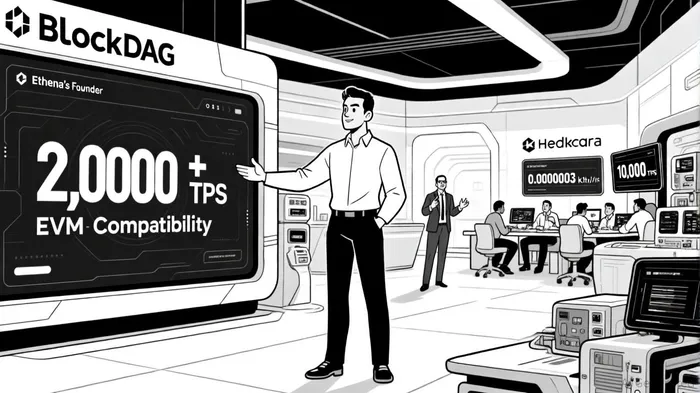
BlockDAG's hybrid Proof-of-Work (PoW) and Directed Acyclic Graph (DAG) architecture enables it to process over 2,000 transactions per second (TPS) while maintaining EVM compatibility, a critical factor for Ethereum-based dApp migration, according to a Coinrise analysis. This scalability is further amplified by strategic partnerships, such as its collaboration with the BWT Alpine Formula 1® Team, which not only boosts brand credibility but also integrates blockchain into real-world ecosystems.
Ethena's Institutional Adoption vs. Technical Gaps
Ethena's Terminal Finance DEX has attracted $280 million in TVL, as reported by a Yahoo Finance report. However, the project lacks transparency in transaction throughput and energy efficiency metrics, relying instead on institutional adoption and fee revenue ($578 million in 2026) noted in the earlier Coinrise coverage. While its governance model is token-based, it remains untested under extreme market conditions.
Hedera's Hashgraph Consensus and Energy Efficiency
Hedera's Hashgraph consensus mechanism theoretically supports 10,000 TPS and consumes just 0.000003 kWh per transaction-making it the most energy-efficient public network, per Hedera Hashgraph statistics. However, its governance model is heavily enterprise-focused, with recent initiatives like EQTY Lab's AI governance framework targeting public-sector use cases rather than decentralized community control, as detailed in EQTY Lab's launch. This creates a gap in user-driven governance compared to EVM-compatible platforms like BlockDAG.
Media-Driven Volatility: The Double-Edged Sword of Hype
BlockDAG's Presale-Driven Stability
BlockDAG's $435 million presale, with a fixed price of $0.005 per token and a hard cap of 50 billion tokens, has insulated it from typical media-driven volatility, as noted in a Coindoo article. Unlike Ethena and Hedera, which rely on market sentiment and external events, BlockDAG's growth is fueled by tangible capital commitments from 10,000+ wallets, including large-scale "whale" accumulations, as reported by a Digital Journal piece. This scarcity-driven model creates a floor for long-term value.
Ethena's Fragile Price Recovery
Ethena's price rebound in late 2025 was fragile, driven by macroeconomic trends and a $20 million insider purchase by its co-founder (reported by Digital Journal). However, its USDeUSDe-- stablecoin briefly depegged to $0.98 in October 2025, exposing vulnerabilities in its cash-and-carry model, according to a MEXC blog post. Analysts warn that without structural improvements, Ethena's reliance on media-driven narratives could lead to sharp corrections.
Hedera's ETF Hype and Uncertain Momentum
Hedera's 25% price surge in 2026 followed the launch of the first HBARHBAR-- ETF by Canary Capital Group, noted in a Crypto.news analysis. While the ETF attracted $44 million in inflows, technical indicators suggest a continuation of the downtrend unless HBAR breaks above key resistance levels, as the same Crypto.news analysis suggests. This highlights the risks of projects dependent on institutional hype without a clear path to ecosystem growth.
The Sustainable Investment Thesis: Why BlockDAG Wins
BlockDAG's hybrid architecture, EVM compatibility, and presale-driven capitalization create a flywheel effect: technical robustness attracts developers, while fixed-price scarcity deters speculative volatility. In contrast, Ethena's institutional focus and Hedera's enterprise-centric governance leave them exposed to market sentiment and regulatory shifts.
Moreover, BlockDAG's strategic partnerships and whale activity signal a governance model that balances community engagement with real-world impact. As the crypto market matures, projects with structural integrity-rather than media-driven hype-will dominate.






Comentarios
Aún no hay comentarios