
Why BlockDAG's Live Awakening Testnet Positions It as the Next Big Thing in Cryptocurrency
The cryptocurrency landscape is at a crossroads. For years, scalability has been the holy grail of blockchain innovation, with BitcoinBTC-- and EthereumETH-- struggling to balance security, decentralization, and performance. Enter BlockDAG, a project that has quietly but decisively disrupted this narrative with its Live Awakening Testnet-a live proof-of-concept demonstrating 15,000 transactions per second (TPS) and a suite of enterprise-grade features. As the crypto market grapples with stagnation and fragmentation, BlockDAG's technical breakthroughs and strategic timing position it as a prime candidate for the next major bull run.
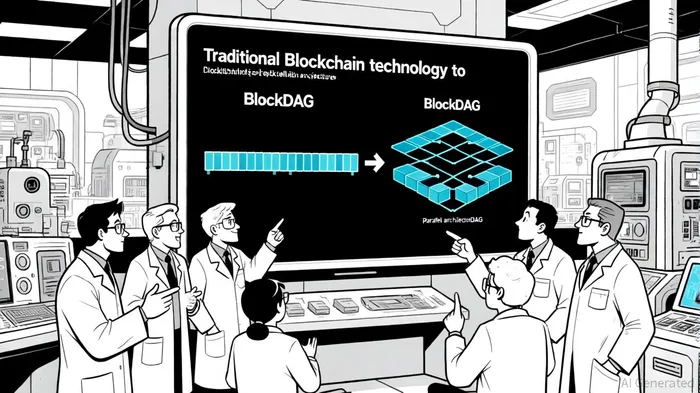
The Scalability Arms Race: BlockDAG vs. Legacy Chains
Traditional blockchains like Bitcoin and Ethereum are fundamentally constrained by their linear architecture. Bitcoin processes ~7 TPS with 10-minute confirmations[2], while Ethereum, despite layer-2 solutions, maxes out at ~30 TPS[3]. These limitations stem from sequential block validation, where each block must reference a single predecessor. BlockDAG, however, leverages a Directed Acyclic Graph (DAG) structure, enabling parallel block processing. This allows thousands of transactions to be validated simultaneously, slashing congestion and gas fees[1].
Data from BlockDAG's Live Awakening Testnet, which went live in September 2025, is staggering. By October 2025, throughput doubled from 800 TPS to 1,400 TPS in the testnet, with real-world dApps and smart contracts already operational[1]. While this is below the 15,000 TPS benchmark achieved in controlled tests[1], it underscores the network's trajectory. In contrast, competitors like Bitcoin HyperHYPER-- (HYPER) and Lyno AI (LYNO) remain in early-stage development, lacking live infrastructure to validate their claims.
Ecosystem Readiness: Beyond TPS
Scalability alone isn't enough to define a project's potential. BlockDAG's testnet has also prioritized developer experience and real-world utility. The network transitioned from a UTXO model to an account-based model, aligning with Ethereum Virtual Machine (EVM) standards and simplifying smart contract deployment[1]. Features like gas sponsorships, batching, and EIP-4337 social recovery further lower barriers for adoption[1].
The project's ecosystem is equally compelling. A full IDE, NFT Explorer, and live dApps are now available, signaling a mature development environment[1]. Meanwhile, a public dashboard tracks TPS and gas metrics in real time, fostering transparency[1]. These tools aren't just technical checkboxes-they're foundational for attracting enterprise clients and DeFi innovators.
Investment Timing: The Perfect Storm
The timing of BlockDAG's launch couldn't be better. As of October 2025, the project has raised $420 million in its presale, with over 26.5 billion BDAG coins sold and 312,000 holders[1]. This level of capitalization and community participation is rare for a project in its testnet phase, suggesting strong institutional and retail interest.
Compare this to Ethereum's ongoing struggles with upgrades and scaling costs[2], or BNB's recent loss of steam[1]. BlockDAG isn't just solving a problem-it's doing so at a moment when the market is starved for scalable solutions. The project's hybrid DAG + Proof-of-Work framework also offers a more energy-efficient alternative to Bitcoin's PoW and Ethereum's high-validator-entry PoS[3], aligning with global sustainability trends.
Risks and Realism
No investment is without risk. BlockDAG's DAG model, while theoretically robust, is untested at mainnet scale. Regulatory scrutiny of high-TPS blockchains could also pose challenges. However, the project's live testnet and growing ecosystem mitigate these risks. Unlike speculative projects that rely on hype, BlockDAG has delivered tangible results.
Conclusion: A New Paradigm
BlockDAG's Live Awakening Testnet isn't just a technical milestone-it's a paradigm shift. By solving scalability without compromising security or decentralization, the project addresses the core limitations that have plagued crypto for a decade. With a $420 million presale, EVM compatibility, and a roadmap that includes enterprise IoT and DeFi use cases[3], BlockDAG is uniquely positioned to capture market share in 2026.
For investors, the question isn't whether BlockDAG can scale-it's whether they can afford to ignore a project that already has.






Comentarios
Aún no hay comentarios