
Is BlockDAG a Legitimate Layer-1 Contender in 2025? A Deep Dive into Verifiability, Execution, and Institutional Credibility
1. Verifiability: Leadership, Governance, and Transparency
BlockDAG's leadership team, led by Antony Turner, has faced scrutiny due to allegations from crypto sleuth ZachXBT, who claims the project is controlled by Gurhan Kiziloz, a controversial figure in fintech, as reported in a Cryptopolitan report. However, Turner has publicly addressed these claims with verifiable actions. As CEO, Turner has a documented background in blockchain, including his role as COO of Spirit Blockchain and founder of SwissOne Capital, as detailed in a Blockchain Reporter profile. He has also provided detailed, time-bound updates on the presale, including a confirmed closure date of February 10, 2026, and a $86 million institutional allocation, according to a FinanceFeeds article.
The project's governance model is transitioning from centralized stewardship to community-driven decision-making. While Turner currently oversees strategic direction, BlockDAG's roadmap outlines a shift toward on-chain governance, where token holders will vote on protocol upgrades and treasury allocations, as outlined in a 2UrbanGirls analysis. This hybrid model balances early-stage efficiency with long-term decentralization, a critical factor for institutional trust.
2. Execution: Technical Milestones and Scalability
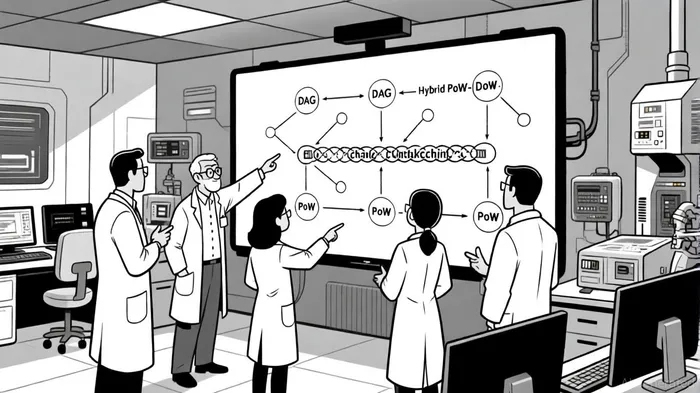
BlockDAG's technical execution is anchored in its hybrid Proof-of-Work (PoW) + Directed Acyclic Graph (DAG) architecture, enabling up to 15,000 transactions per second (TPS) and EVM compatibility, as reported in a TheCoinRise report. The Awakening Testnet, already processing 1,400 TPS, serves as a proof of concept for its scalability claims according to a TimesTabloid report. Additionally, the project has deployed a robust mining ecosystem, including 20,000 X-Series miners and 3.5 million users via the X1 mobile app, as covered in a ZYCrypto profile.
A critical differentiator is BlockDAG's EVM compatibility, which allows seamless migration of Ethereum-based dApps without code rewrites. This positions it as a viable alternative for DeFi and GameFi developers seeking lower costs and faster speeds (as TheCoinRise noted earlier). Independent audits by CertiK and Halborn further validate its security framework, addressing a common pain point for Layer-1 projects (the ZYCrypto profile discussed these audits).
3. Institutional Credibility: Partnerships and Exchange Listings
BlockDAG's institutional credibility is bolstered by its partnerships with Coinbase and Kraken, two of the most regulated exchanges in the crypto space. A leaked Memorandum of Understanding (MOU) with Coinbase outlines compliance measures, USD/USDT trading pair preparations, and joint promotional activities (reported earlier by ZYCrypto). Similarly, the Kraken Cooperation Agreement includes $300,000 in liquidity, $200,000 in marketing funds, and a 30-day liquidity freeze to stabilize post-listing volatility (the ZYCrypto profile covered these terms). These agreements, signed by authorized executives like Coinbase's Zach Segal, are legally binding and publicly verifiable, according to a CryptoTimes article.
The project's presale success-$435 million raised across 31 batches-also signals strong retail and institutional demand. With a projected listing price of $0.05 (a 3,233% return for early investors, as TheCoinRise reported), BlockDAG's valuation trajectory aligns with its technical and operational milestones.
4. Addressing Controversies: Leadership Disputes and Governance Risks
While BlockDAG's execution and institutional backing are compelling, leadership disputes remain a red flag. ZachXBT's allegations that Turner is a "frontman" for Kiziloz, a figure linked to past regulatory issues, have not been fully resolved (as reported by Cryptopolitan). However, Turner's public accountability-via AMAs, video updates, and transparent presale documentation-contrasts with the anonymity often seen in crypto projects (as documented in the FinanceFeeds piece).
The governance model's transition to community-driven decision-making also mitigates long-term centralization risks. By 2026, token holders will gain voting rights on critical protocol upgrades, reducing reliance on the core team (the 2UrbanGirls analysis outlines this timeline). This structured decentralization aligns with Web3 principles and addresses concerns about leadership concentration.
Conclusion: A Legitimate Layer-1 Contender?
BlockDAG's combination of $435M+ presale transparency, audits by CertiK and Halborn, EVM-compatible scalability, and institutional partnerships positions it as a credible Layer-1 project. While leadership controversies require ongoing scrutiny, the project's verifiable execution-testnets, mining infrastructure, and exchange agreements-demonstrates tangible progress. For investors, the key question is whether the team can deliver on its 2025 roadmap, including the November 26, 2025, Genesis Day launch, as reported by LiveBitcoinNews. If successful, BlockDAG could emerge as a top-tier Layer-1 solution, bridging the gap between high throughput and institutional adoption.







Comentarios
Aún no hay comentarios