
BlockDAG's Imminent Presale Close and ROI Potential: A Strategic Alternative to Ethereum and Avalanche in Early 2026
The cryptocurrency market in early 2026 is at a crossroads. While EthereumETH-- and AvalancheAVAX-- continue to grapple with stagnation and evolving challenges, a new contender-BlockDAG-is generating significant momentum through its presale. With a scheduled close date of January 26, 2026, BlockDAG's presale offers a potential 16.6x return for investors purchasing at $0.003 per token before the launch price of $0.05 according to market analysis. This article examines why BlockDAG's presale-driven growth model presents a compelling alternative to the traditional Layer-1 dynamics of Ethereum and Avalanche, particularly as both face structural headwinds in 2026.
Ethereum's Stagnation: Layer-2 Dominance and Fee Erosion
Ethereum's 2026 trajectory is shaped by its ongoing shift to Layer-2 solutions. While upgrades like EIP 4844 and proto-danksharding aim to reduce transaction costs and improve scalability, this transition has led to a decline in direct fee revenue for the Ethereum mainnet. According to a report by Grayscale, Ethereum's average daily transaction volume in early 2026 exceeded 2.2 million transactions, but much of this activity is now routed through Layer-2 networks like ArbitrumARB-- and Optimism. This shift has diluted Ethereum's ability to capture value from on-chain activity, even as institutional adoption of tokenized real-world assets and custodial staking grows.
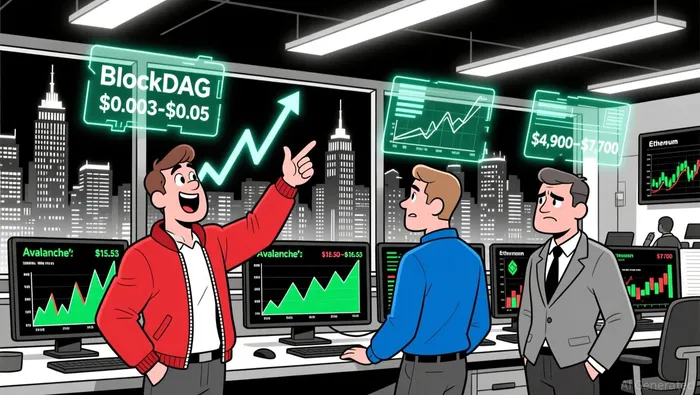
Price-wise, Ethereum's performance in 2026 has been mixed. Despite ETF inflows increasing ETH holdings from 3.5 million to 11.8 million coins, the price of ETH traded at $3,100.34 in January 2026, well below its 2025 all-time high. Analysts project a moderate growth range of $4,900–$7,700 for 2026, contingent on successful implementation of scalability upgrades. However, the broader market remains skeptical about Ethereum's ability to maintain its first-mover advantage as Layer-2 networks absorb more transaction volume.
Avalanche's Struggle: Subnets and Price Volatility
Avalanche (AVAX) has carved a niche with its subnet architecture, enabling enterprises to launch custom blockchains while leveraging shared security. This flexibility has attracted financial institutions experimenting with RWA platforms, yet AVAX's price performance in early 2026 has been lackluster. As of January 2026, AVAXAVAX-- traded around $14 per coin, with daily price ranges fluctuating between $13.9 and $14.6. Despite a 24-hour decline of -0.77% by mid-January, analysts predict a bullish range of $15.50–$16.50 for AVAX in early 2026 according to price analysis.
Transaction volume on Avalanche remains robust, with daily DEX volume clearing $100 million and over $1.27 billion in DeFi TVL. However, Avalanche's price lags behind larger Layer-1 competitors, and its subnet model has yet to achieve widespread institutional adoption. While Avalanche's architecture positions it as a viable alternative for customized blockchain solutions, its 2026 performance underscores the challenges of competing with Ethereum's entrenched ecosystem.
BlockDAG's Strategic Advantage: Presale Momentum and ROI Potential
BlockDAG's presale, which has already raised over $441 million, represents a fundamentally different value proposition. Unlike Ethereum and Avalanche, which rely on organic adoption and speculative price action, BlockDAG's presale model creates immediate liquidity and investor alignment. With 3.5 billion tokens remaining as of the latest batch, the network is prioritizing market infrastructure, governance frameworks, and liquidity plans before its Mainnet launch according to project documentation.
The ROI potential is stark. At $0.003 per token, investors who purchase before the January 26 deadline could see a 16.6x return if the token reaches its confirmed launch price of $0.05. This contrasts sharply with Ethereum's projected 57–148% growth range and Avalanche's modest 11–15% increase. BlockDAG's presale also benefits from a deflationary supply model, as the remaining token allocation is being distributed to early buyers, creating scarcity and demand.
Conclusion: A Time-Sensitive Opportunity
As Ethereum and Avalanche navigate structural challenges in 2026, BlockDAG's presale offers a high-conviction alternative. The project's imminent close date and substantial ROI potential position it as a strategic play for investors seeking exposure to a next-generation blockchain with a clear roadmap and liquidity-driven incentives. While Ethereum's institutional adoption and Avalanche's subnet innovation remain relevant, the presale-driven momentum of BlockDAG underscores a shift in investor priorities toward projects with immediate value capture and clear exit liquidity. For those who act before January 26, BlockDAG's presale represents not just a speculative bet, but a calculated advantage in a market increasingly defined by urgency and ROI.






Comentarios
Aún no hay comentarios