
BlockDAG: A High-Conviction Play in a Fragmented Crypto Market
A Weak Environment: ARBARB-- and LINKLINK-- as Cautionary Tales
The recent underperformance of ARB and LINK underscores the fragility of even well-established layer-2 and oracle ecosystems in a risk-off market. According to a report by FXStreet, ARB has plummeted to $0.22 as of November 19, 2025, a 65% decline from its August 2024 peak of $0.62. This selloff reflects broader macroeconomic pressures and a lack of immediate utility-driven demand, despite Arbitrum's ongoing "Arbitrum Everywhere" infrastructure upgrades. Technical indicators further validate the bearish sentiment: ARB's price remains below critical moving averages, and its MACD has signaled a sell bias since mid-week.
Chainlink (LINK), meanwhile, has mirrored this trend, with its price failing to break above $5.50 for months. Institutional sentiment toward both tokens has soured, as evidenced by reduced on-chain activity and declining staking yields. This weak environment creates a vacuum for projects that can demonstrate both technical differentiation and capital efficiency-qualities BlockDAG appears to possess.
Strategic Timing: Capitalizing on Market Dislocation
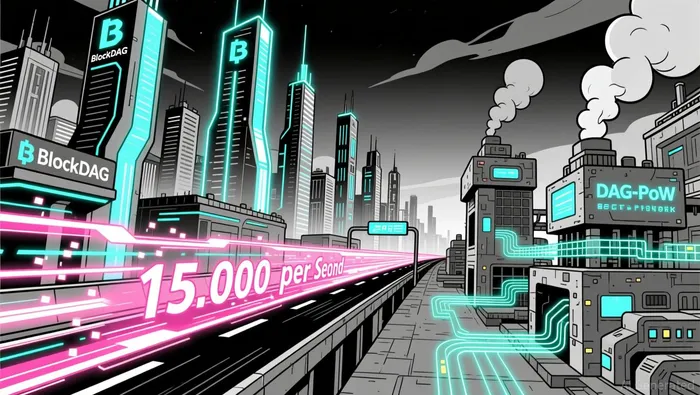
BlockDAG's pre-sale success-raising $435 million as of November 2025-positions it as a counterpoint to the stagnation of ARB and LINK according to Bitget. The project's timing is deliberate: it entered a market saturated with overhyped but under-delivered layer-2 solutions, offering a hybrid DAG-PoW architecture capable of processing 15,000 transactions per second (TPS). This throughput dwarfs the 4,000 TPS of Ethereum's layer-2s and the 1,000 TPS of Solana's current capacity, addressing a critical pain point for institutional adopters.
Moreover, BlockDAG's community-driven model-distributing 27.2 billion tokens across 312,000 wallets-creates a decentralized ownership structure that mitigates the risk of whale-driven volatility. This contrasts sharply with ARB's concentration of tokens among a few large holders, which has historically exacerbated price swings. By aligning incentives between retail and institutional investors, BlockDAG reduces the friction that has plagued other high-profile projects.
Structural Upgrades: A Foundation for Scalability
BlockDAG's hybrid DAG-PoW architecture is not merely a technical novelty but a strategic response to the limitations of existing blockchain frameworks. Unlike traditional blockchains, which rely on linear block validation, BlockDAG's directed acyclic graph (DAG) allows parallel transaction processing, reducing latency and energy consumption. This design is particularly appealing to institutional investors seeking compliance-friendly solutions, as it inherently supports modular governance and regulatory oversight.
The project's roadmap also includes rumored dual listings on Coinbase and Kraken, with the latter committing $300,000 in liquidity incentives and $200,000 for marketing. These partnerships signal a commitment to mainstream adoption, as major exchanges act as gatekeepers for institutional capital. By securing early access to these platforms, BlockDAG is positioning itself to capture market share from projects like Near ProtocolNEAR-- (NEAR) and Pudgy PenguinsPENGU-- (PENGU), which face bearish trends due to their lack of structural innovation.
Institutional Credibility: Bridging Web3 and Traditional Finance
Perhaps the most compelling aspect of BlockDAG's thesis is its institutional credibility. According to Bitget, the project has attracted $86 million in institutional investment, a figure that dwarfs the funding rounds of most altcoins in 2025. This backing is not merely financial but strategic: BlockDAG's emphasis on regulatory compliance and transparency aligns with the risk-averse priorities of traditional finance. For example, its decentralized wealth-sharing model-distributing tokens across a broad base of retail investors-mirrors the democratization of access that institutional investors increasingly demand.
This credibility is further reinforced by its rumored exchange partnerships. Kraken's liquidity incentives, in particular, suggest a level of institutional confidence rarely seen in the altcoin space. By securing these relationships early, BlockDAG is creating a flywheel effect: institutional capital attracts retail demand, which in turn drives network effects and utility.
Conclusion: A High-Conviction Play in a Fragmented Market
In a crypto market defined by fragmentation and uncertainty, BlockDAG's combination of strategic timing, structural innovation, and institutional credibility makes it a standout candidate for 2025. While ARB and LINK grapple with bearish fundamentals and technical headwinds, BlockDAG is building a foundation for scalable, institutional-grade adoption. For investors seeking exposure to the next phase of blockchain innovation, the project represents a high-conviction opportunity-one that leverages the weaknesses of its competitors to position itself as a leader in the post-2024 landscape.







Comentarios
Aún no hay comentarios