
BlockDAG's Global Expansion and Its Implications for the Layer-1 Ecosystem
In 2025, the blockchain landscape is witnessing a seismic shift as Layer 1 networks compete to solve the scalability trilemma. Among the contenders, BlockDAG has emerged as a disruptive force, combining strategic partnerships with a novel hybrid architecture to challenge EthereumETH-- and SolanaSOL--. With over $420 million raised in its presale and a user base spanning 130 countries, BlockDAG's global expansion is not just a marketing play-it's a calculated move to redefine the boundaries of blockchain scalability and adoption.
Strategic Positioning: From Sports to Mainstream
BlockDAG's playbook is rooted in cultural relevance. By aligning with high-profile entities like the BWT Alpine Formula 1® Team and Inter Milan, the project has embedded itself into the DNA of global entertainment and sports. These partnerships are more than logos on jerseys; they're about creating real-world utility for its blockchain. For instance, the F1 collaboration integrates fan engagement tools and digital activations during races, turning passive viewers into active participants in a decentralized ecosystem, according to a Timestabloid report.
The UFC partnership further amplifies this strategy. With 800,000 app users and counting, BlockDAG is leveraging the UFC's global audience to onboard millions of new users to its X1 Miner and TG Tap Miner platforms, according to a Crypto-Reporter report. These tools, which allow one-tap mining and staking, are critical for lowering the barrier to entry-a stark contrast to the technical complexity of traditional blockchain participation.
But BlockDAG's ambitions extend beyond user growth. The launch of the BlockDAG Academy in Q3 2025 signals a long-term commitment to developer education, ensuring that the ecosystem can sustain rapid innovation. With 4,500 developers already building decentralized applications, the project is fostering a community-driven approach to scaling Web3, according to an Analytics Insight article.
Technological Edge: Hybrid Architecture for Scalability
At the heart of BlockDAG's disruption is its hybrid architecture, which merges Proof of Work (PoW) with Directed Acyclic Graph (DAG) technology. This design allows the network to process multiple blocks in parallel, eliminating the sequential bottlenecks that plague traditional blockchains. According to a Gate report, BlockDAG supports up to 15,000 transactions per second (TPS), outpacing Ethereum 3.0's 10,000–15,000 TPS and rivaling Solana's 65,000+ TPS.
The implications are profound. While Solana's Proof of History (PoH) excels in speed, its centralized validator model raises concerns about security and decentralization. BlockDAG's hybrid approach, by contrast, maintains PoW's security guarantees while achieving DAG's scalability. This balance is critical for applications like DeFi and real-time gaming, where both speed and trustlessness are non-negotiable, as noted in a 36Crypto article.
Moreover, BlockDAG's upcoming Mainnet launch-set for Q1 2026 after a successful Beta Testnet in March 2025-will validate its claims of low gas fees ($0.0015 presale price) and sub-second finality. Early benchmarks suggest the network can handle 15,000 TPS with block times optimized to under 1 second, a feat that would position it as a serious competitor to Solana's current dominance, according to an Analytics Insight article.
Scalability Showdown: BlockDAG vs. Ethereum vs. Solana
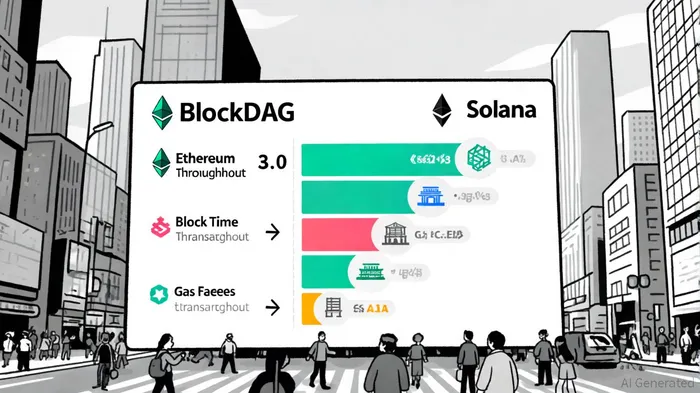
To understand BlockDAG's potential, it's essential to compare its metrics with its rivals. Solana's 65,000+ TPS and $0.00025 gas fees make it the gold standard for speed and cost efficiency, but its reliance on a small validator set introduces centralization risks. Ethereum 3.0, post-danksharding, has improved to 10,000–15,000 TPS with 90% lower fees, but its 6–12-second block times remain a bottleneck for real-time applications, according to a Markaicode comparison.
BlockDAG sits in the middle, offering a compelling compromise. Its hybrid architecture claims to deliver 10,000–15,000 TPS with block times under 1 second and gas fees in the $0.001–$0.01 range. While these numbers lag behind Solana's peak performance, they outperform Ethereum's latency and offer a more decentralized alternative-a sweet spot in a market increasingly demanding both, as a BTCC analysis notes.
Implications for the Layer-1 Ecosystem
BlockDAG's rise signals a broader shift in the Layer-1 landscape. As Ethereum 3.0 prioritizes security and Solana doubles down on speed, BlockDAG is carving out a niche for scalable decentralization. Its partnerships with mainstream brands and focus on user-friendly tools are bridging the gap between Web2 and Web3, a critical step for mass adoption.
For investors, the project's $420 million presale and 312,000 token holders indicate strong early traction. With plans to list on ten major exchanges and a roadmap that includes EVM compatibility and WASM integration, BlockDAG is positioning itself as a versatile platform for both developers and enterprises, according to Blockchain Reporter.
However, challenges remain. The lack of publicly available TPS data from some sources raises questions about transparency, and competition from established chains is fierce. Yet, BlockDAG's dual strategy-combining cultural relevance with technical innovation-suggests it's more than a flash in the pan.
Conclusion: A New Contender in the Layer-1 Race
BlockDAG's global expansion is a masterclass in strategic positioning. By aligning with sports giants, democratizing blockchain access, and innovating with a hybrid architecture, it's challenging the status quo in the Layer-1 ecosystem. While Solana and Ethereum 3.0 remain formidable, BlockDAG's focus on scalability without sacrificing decentralization makes it a project to watch in 2025 and beyond.
For investors, the key question isn't whether BlockDAG can scale-it's whether it can sustain its momentum in a market where innovation is the only constant.






Comentarios
Aún no hay comentarios