
BlockDAG and the Future of Low-Cost Tokens: A Scalability-Driven Paradigm Shift
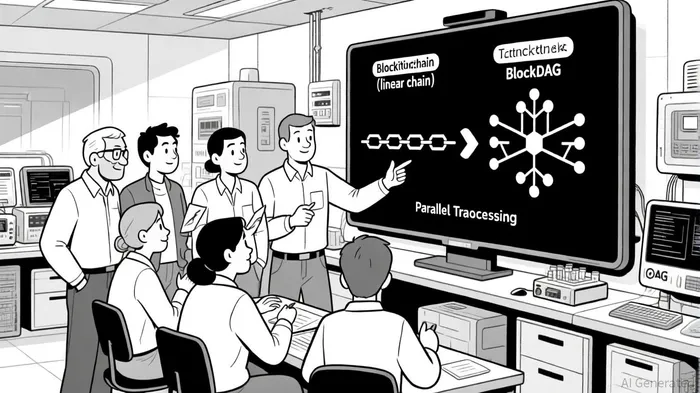
Blockchain scalability has long been a thorny problem, with traditional architectures like BitcoinBTC-- and EthereumETH-- constrained by linear block processing and network congestion[1]. Enter BlockDAG, a Directed Acyclic Graph-based framework that reimagines blockchain throughput by enabling parallel block validation. This innovation isn't just theoretical—it's already reshaping token economics and user behavior, with implications for low-cost tokens like Shiba InuSHIB-- (SHIB) and SolanaSOL-- (SOL).
The BlockDAG Scalability Edge
BlockDAG's architecture allows multiple blocks to be processed simultaneously, bypassing the sequential limitations of conventional blockchains[2]. Projects like Kaspa (KAS) and Taraxa (TARA) have demonstrated transaction finality in under a second, achieving throughput levels that dwarf legacy systems[2]. For context, Ethereum's current capacity hovers around 30 transactions per second (TPS), while BlockDAG-based networks can scale to thousands of TPS[2]. This isn't just faster—it's a structural shift toward real-time, global applications.
The economic implications are profound. By reducing latency and fees, BlockDAG lowers the barrier to entry for retail users and developers alike. Consider the X1 App, a mobile mining platform built on BlockDAG: it has attracted 3 million users by gamifying participation, offering BDAG tokens via a “tap-to-earn” model[1]. This mass adoption isn't accidental—it's a byproduct of accessibility. Users no longer need technical expertise or expensive hardware to engage with blockchain, a democratization that could ripple across the ecosystem.
Token Economics: From Speculation to Utility
Low-cost tokens like SHIBSHIB-- and SOL have thrived on speculative demand, but their long-term value hinges on utility. BlockDAG's scalability could catalyze this transition. For instance, SHIB's ecosystem has struggled to justify its 1 quadrillion supply, yet a scalable infrastructure could enable microtransactions or decentralized applications (dApps) that give SHIB real-world use cases. Similarly, SOL's high-performance network is already a benchmark for DeFi, but BlockDAG's hybrid consensus—combining Proof-of-Work with DAG—offers a blueprint for even greater decentralization without sacrificing speed[3].
The BlockDAG Network's token model provides a case study. By rewarding early adopters with a 150% bonus and incentivizing referrals, it has created a self-sustaining growth loop[3]. This mirrors strategies seen in SHIB's airdrops and liquidity programs but with a critical difference: BlockDAG's architecture ensures the network can handle the volume generated by such incentives. If tokens like SHIB and SOL adopt similar models, their value dynamics could shift from speculative hype to sustainable, usage-driven growth.
Market Implications for 2025 and Beyond
While direct data on BlockDAG's 2025 impact on SHIB and SOL is scarce, the underlying trends are clear. Scalability isn't just a technical fix—it's a catalyst for network effects. The BlockDAG Network's $381 million presale and 300 dApps in development[4] suggest institutional confidence in this model. For low-cost tokens, the lesson is twofold:
1. Adoption-Driven Value: Tokens that integrate scalable infrastructure (like BlockDAG) can transition from speculative assets to utility-driven platforms.
2. Competition as a Force for Innovation: Projects like Xelis ($XEL) and Taraxa ($TARA) are already leveraging BlockDAG to build IoT and smart contract ecosystems[2]. This competition pressures incumbents like SOL to innovate or risk obsolescence.
Conclusion: A New Era for Token Economics
BlockDAG isn't just solving scalability—it's redefining the relationship between network performance and token value. For low-cost tokens, the path forward lies in adopting architectures that prioritize real-world utility over speculative momentum. SHIB and SOL may yet evolve into this new paradigm, but the clock is ticking: in 2025, scalability isn't optional—it's existential.






Comentarios
Aún no hay comentarios