
BlockDAG: The Next Frontier in Blockchain Innovation
The blockchain landscape in 2025 is witnessing a seismic shift as emerging consensus models challenge the dominance of traditional Proof-of-Work (PoW) and Proof-of-Stake (PoS) architectures. Among these innovators, BlockDAG has emerged as a formidable contender, leveraging its Directed Acyclic Graph (DAG) structure to deliver unprecedented scalability, security, and energy efficiency. This article examines BlockDAG's potential to disrupt established networks like SolanaSOL-- (SOL), BNBBNB-- Chain, and TronTRX-- (TRX), drawing on market trends, technical benchmarks, and adoption metrics.
Technical Superiority: DAG Architecture Redefines Scalability
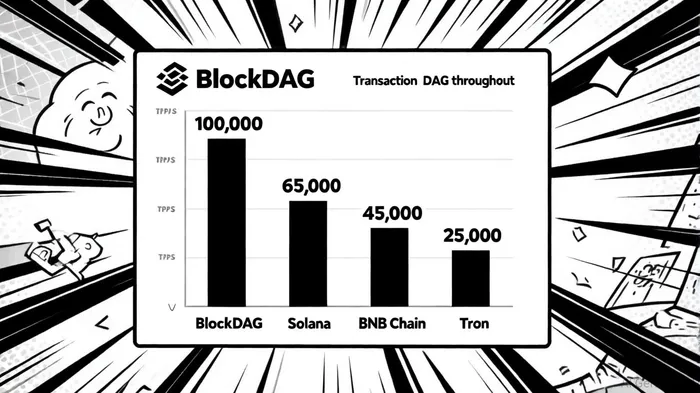
BlockDAG's hybrid DAG + PoW model enables parallel transaction processing, allowing the network to handle 100,000 transactions per second (TPS)-far outpacing Solana's 65,000 TPS and BNB's 45,000 TPS, according to a CryptoUpdates article. Unlike traditional blockchains, which rely on sequential block validation, BlockDAG's DAG structure allows multiple blocks to be confirmed simultaneously, eliminating bottlenecks and reducing latency to sub-second levels, as an Analytics Insight piece explains. This is achieved through protocols like SPECTRE (for fast partial ordering) and PHANTOM (for total ordering), ensuring robust transaction finality without compromising speed, as the BlockDAG docs describe.
Energy efficiency is another critical advantage. While PoW blockchains like BitcoinBTC-- consume exorbitant energy (169.7 TWh annually, per a ResearchGate study), and PoS models like EthereumETH-- post-Merge save 99.95% energy according to CoinLaw statistics, BlockDAG's hybrid approach balances decentralization with sustainability. By integrating Proof-of-Engagement (PoE)-which allows users to mine via mobile apps-and energy-efficient ASIC hardware, BlockDAG minimizes computational overhead while maintaining security, according to a CoinCentral review. This contrasts sharply with Solana's reliance on high-performance hardware, which has exposed vulnerabilities during peak demand, as a Hackernoon analysis argues.
Market Momentum: Presale Success and Real-World Adoption
BlockDAG's presale has raised $400 million as of September 2025, according to Blockchain Reporter, with 25.9 billion tokens sold across 30 batches. Early investors are projected to see returns of up to 3,025% if the token lists at $0.05, compared to its presale price of $0.0016, per a TradeZoneCrypto forecast. This momentum is driven by real-world adoption: the X1 mobile miner app has attracted 3 million users, and 19,600 ASIC miners have been sold, signaling robust infrastructure development, according to an Analytics Insight report.
In contrast, Solana's price has stabilized around $184, supported by DeFi and NFT activity, but faces scalability concerns due to past network outages, according to a BitcoinEthereumNews analysis. BNB, trading at $684, benefits from its deep integration with the Binance ecosystem but remains tethered to exchange performance, according to a Crypto-Economy article. Tron, at $0.275, maintains a stablecoin-centric ecosystem but lacks the infrastructure innovation of BlockDAG (per CryptoUpdates).
Comparative Analysis: BlockDAG vs. Traditional Blockchains
| Metric | BlockDAG | Solana (SOL) | BNB Chain | Tron (TRX) |
|---|---|---|---|---|
| TPS | 100,000 (per CryptoUpdates) | 65,000 (per CryptoUpdates) | 45,000 (per CryptoUpdates) | 25,000 (per CryptoUpdates) |
| Consensus Model | Hybrid DAG + PoW (per Analytics Insight) | PoS + PoH (per Hackernoon) | PoS (per Crypto-Economy) | Delegated PoS (per CryptoUpdates) |
| Energy Efficiency | High (PoE + ASICs) (per CoinCentral) | Moderate (PoH hardware) (per Hackernoon) | Low (PoS) (per CoinLaw) | Low (Delegated PoS) (per CryptoUpdates) |
| Adoption | 3M users, 19.6k ASICs (per Analytics Insight) | 2M+ DeFi users (per BitcoinEthereumNews) | 100M+ exchange users (per Crypto-Economy) | 40B+ Tether transactions (per CryptoUpdates) |
BlockDAG's unique value proposition lies in its ability to combine scalability, security, and user accessibility. While Solana and BNB prioritize developer ecosystems, and Tron focuses on stablecoin infrastructure, BlockDAG's DAG architecture and hybrid consensus model address the trilemma of scalability, security, and decentralization, as an arXiv paper on high-throughput DAG consensus suggests.
Investment Outlook: A Disruptive Force in 2025
For investors, BlockDAG represents a high-growth opportunity in a competitive market. Its presale success, coupled with institutional interest and a growing developer community (4,500+ EVM-compatible developers, per a Bitget report), positions it to challenge legacy networks. However, risks remain, including regulatory scrutiny and execution uncertainty post-IEO delay (noted in a CoinSpeaker guide).
In contrast, Solana's technical upgrades (e.g., NFT compression) and BNB's ecosystem dominance offer more predictable returns, albeit with lower growth potential. Tron's stability makes it a defensive play but lacks the innovation to disrupt the status quo.
Conclusion
BlockDAG's hybrid DAG architecture and aggressive adoption metrics signal a paradigm shift in blockchain technology. By outperforming traditional blockchains in TPS, energy efficiency, and real-world utility, it is well-positioned to redefine the Layer 1 landscape. For investors seeking exposure to next-generation infrastructure, BlockDAG's $400 million presale and 3,025% ROI projections, reported by TradeZoneCrypto, make it a compelling long-term bet-provided the project executes on its ambitious roadmap.






Comentarios
Aún no hay comentarios