
BlockDAG's Explosive Presale Growth and Developer-Driven Momentum: A Deep Dive into Next-Gen Blockchain Infrastructure and Tokenomics
The Rise of BlockDAG: A New Era in Blockchain Scalability
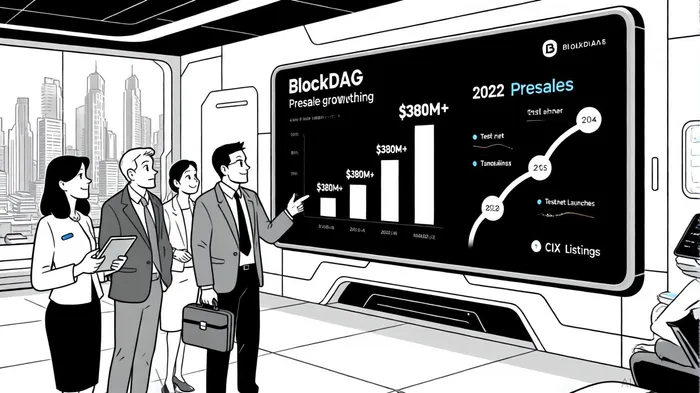
BlockDAG has captured the crypto world's attention in 2025 with a presale that has raised over $380 million and sold 25.4 billion tokens, positioning it as one of the most capital-efficient projects in the space, according to a Coindoo review. At a confirmed listing price of $0.05, early participants stand to see a potential return on investment (ROI) exceeding 3,000% if the token reaches its long-term price targets, according to a CoinCentral review. But beyond the numbers lies a compelling narrative: BlockDAG's hybrid architecture, which merges the scalability of a Directed Acyclic Graph (DAG) with the security of Proof-of-Work (PoW) and EthereumETH-- Virtual Machine (EVM) compatibility, is redefining what's possible for Layer 1 blockchains, as Kanalcoin reports.
Structural Innovations: The BlockDAG Advantage
Traditional blockchains like BitcoinBTC-- and Ethereum face inherent trade-offs between scalability, security, and decentralization. BlockDAG's solution is a hybrid DAG-PoW-EVM model that the Coindoo review says can process 10 blocks per second in testnet environments and scale linearly to 15,000 transactions per second (TPS) in production. This is achieved by structuring the network as a DAG, where transactions are validated in parallel rather than sequentially, eliminating bottlenecks. Meanwhile, PoW ensures robust security, while EVM compatibility allows developers to migrate Ethereum-based dApps with minimal friction, a point detailed in Analytics Insight's AMA.
The project's testnet, Awakening, already processes 1,400 TPS and supports real-world use cases, including decentralized finance (DeFi) and non-fungible tokens (NFTs), as reported by Kanalcoin. This is a stark contrast to Ethereum's current 30–45 TPS and Solana's 50,000 TPS but with a centralized validator model. BlockDAG's approach appears to strike a balance, offering both speed and decentralization.
Tokenomics: A Model Designed for Long-Term Stability
BlockDAG's tokenomics are structured to align incentives across miners, presale participants, and the broader ecosystem. With a total supply of 150 billion BDAG tokens, the distribution is as follows:
- 50% (75B) to miners, ensuring network security and accessibility, according to the Coindoo review.
- 33.3% (50B) to presale participants, with 40% unlocked at mainnet launch and 20% released monthly for three months, as reported by Kanalcoin.
- 12.7% (19B) reserved for community and ecosystem development, including grants for developers and partnerships, noted in the Coindoo review.
This vesting schedule is a strategic move to prevent liquidity shocks. For instance, bonus tokens from giveaways or rewards are locked for 12 months and vest linearly, ensuring that early investors remain committed to the project's long-term success, according to Kanalcoin. Such design contrasts with speculative projects that often see token dumping after rapid unlocks.
Developer Ecosystem and Real-World Utility
BlockDAG's developer-driven momentum is another key differentiator. Over 4,500 developers are already building on the platform, with 300 decentralized applications (dApps) in development, as described in the Coindoo review. EVM compatibility has been a major draw, enabling Ethereum developers to leverage existing tooling while benefiting from BlockDAG's scalability.
Partnerships with sports teams like Inter Milan and Seattle-based franchises have further amplified brand visibility, noted in the CoinCentral review. Meanwhile, the project is preparing for 10 centralized exchange (CEX) listings, which could significantly boost liquidity and attract institutional interest, details of which were discussed in the project's AMA coverage.
Mining Accessibility and Decentralization
Decentralization remains a core focus. The X1 mobile miner app has attracted 2.5 million users, while 19,000 X10 hardware miners have been sold, creating a diverse mining community, per the Coindoo review. To prevent centralization, BlockDAG has partnered with Bitmain, a leader in crypto mining, to develop exclusive hardware tailored for its DAG architecture, a partnership highlighted in the AMA coverage. A global beta testing program involving 100 miners is currently evaluating performance, energy efficiency, and decentralization metrics, as discussed in the AMA.
Challenges and Cautionary Notes
Despite its momentum, BlockDAG faces hurdles. Analysts caution that presale success does notNOT-- guarantee long-term adoption, according to an Intellectia analysis. The project must deliver on its promises of scalability, stability, and real-world utility to compete with Ethereum and SolanaSOL--. Post-listing liquidity management will also be critical, as a flood of tokens into exchanges could pressure the price.
Moreover, while some forecasts suggest a long-term price target of $1–$10, achieving this would require consistent development progress and strong ecosystem growth, the Coindoo review notes. The project's roadmap includes launching 20,000 X-Series miners globally and finalizing hardware refinements before the mainnet launch in August 2025, as covered by Kanalcoin.
Conclusion: A High-Potential Bet in a Competitive Landscape
BlockDAG's explosive presale growth and developer-driven momentum position it as a standout project in 2025. Its hybrid DAG-PoW-EVM architecture addresses critical blockchain limitations, while its tokenomics and vesting schedules prioritize long-term stability. However, investors must remain vigilant-execution will be key. If BlockDAG can maintain its pace of innovation and deliver on its roadmap, it could redefine the next generation of blockchain infrastructure.






Comentarios
Aún no hay comentarios