
BlockDAG's Explosive Growth: How Dual Consensus Mechanisms Are Redefining Blockchain's Future
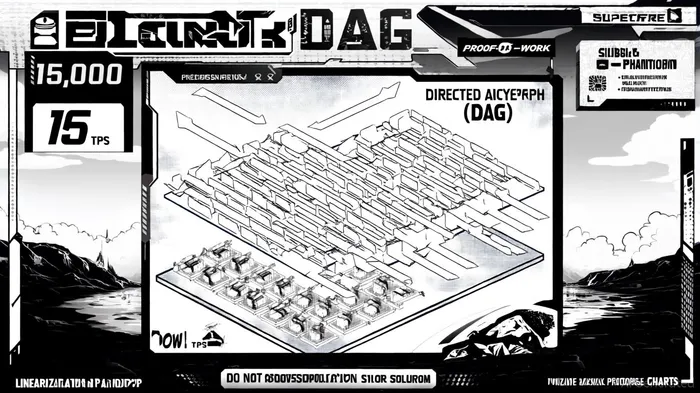
In the ever-evolving blockchain landscape, innovation often hinges on solving the “trilemma” of scalability, security, and decentralization. BlockDAG (BDAG) has emerged as a standout project by redefining consensus mechanisms through a hybrid model that combines Proof-of-Work (PoW) with Directed Acyclic Graph (DAG) technology. This dual approach has notNOT-- only positioned BlockDAG as a technical marvel but also fueled its explosive fundraising success, raising over $380 million in presales as of 2025 [1]. For investors, the question is no longer if this project matters, but how its architecture is reshaping the future of decentralized networks.
The Dual Consensus Revolution: SPECTRE, PHANTOM, and PoW
BlockDAG's hybrid consensus mechanism is a masterclass in balancing speed and security. At its core, the network employs SPECTRE (Serial Inclusion of Transactions with Consensus Through Recursive Enhancement) and PHANTOM (Proof of High Availability and Total Ordering Mechanism) protocols to achieve parallel transaction validation and total ordering [2]. SPECTRE enables incremental consensus by recursively validating blocks in a DAG structure, while PHANTOM refines this partial order into a linear main chain by analyzing block scores and propagation times. This dual-layer system eliminates orphaned blocks and reduces latency, allowing the network to process 2,000–15,000 transactions per second (TPS)—a stark contrast to traditional blockchains like BitcoinBTC-- (7 TPS) or even high-performance chains like SolanaSOL-- (5,000–65,000 TPS under ideal conditions) [3].
The integration of Proof-of-Work further bolsters security. Miners validate cryptographic solutions against network difficulty, ensuring decentralization and resistance to attacks. Notably, BlockDAG's dual-mining model democratizes participation: hardware miners like the X10 and X100 cater to institutional players, while the X1 Mobile App allows everyday users to mine via smartphone engagement [4]. This inclusivity has driven over 2.5 million mobile miners into the ecosystem, creating a robust, decentralized network [5].
Fundraising Success: Community-Driven Capital and ROI
BlockDAG's technical prowess has directly translated into financial success. As of Batch 29, the project has raised $377 million in its presale, with a token price of $0.0276 [6]. This figure dwarfs historical presales like FilecoinFIL-- ($255M) and CardanoADA-- ($62M), and early investors have seen a staggering 2,380% return on investment [7]. The project's community-driven fundraising model—eschewing traditional venture capital—has fostered a grassroots movement, with over 3 million miners contributing to its growth [8].
The dual consensus mechanism is a key driver here. By solving scalability bottlenecks, BlockDAG has attracted both retail and institutional attention. For example, strategic partnerships with entities like Inter Milan and the Seattle Orcas have amplified brand visibility, while EVM compatibility and early dApp development (300+ decentralized applications in the pipeline) have reduced adoption barriers [9]. Analysts project a post-launch price target of $0.05, with long-term potential reaching $1–$5 by 2030 if the network achieves its full diluted valuation (FDV) of $2.55 billion [10].
Market Validation and Future Projections
BlockDAG's technical roadmap is equally ambitious. The network's Testnet has already demonstrated scalability and ease of use, with developers praising its 10-block-per-second throughput [11]. The upcoming Mainnet launch in early 2025 is expected to unlock full interoperability, smart contract functionality, and account abstraction, positioning BlockDAG as a versatile platform for decentralized applications [12].
Market sentiment remains cautiously optimistic. While critics highlight risks like regulatory uncertainties and real-world performance validation, the project's transparent communication—via weekly updates, developer diaries, and AMAs—has built trust among early adopters [13]. Moreover, the hybrid model's ability to handle high-frequency transactions makes it a compelling option for industries like gaming, DeFi, and cross-border payments.
Challenges and the Path Forward
No project is without risks. The dual consensus mechanism, while innovative, faces challenges in synchronization and throughput under real-world conditions [14]. Additionally, the token's FDV of $2.55 billion raises questions about its utility beyond speculative demand. However, BlockDAG's focus on ecosystem development—through hardware sales, mobile mining, and strategic partnerships—suggests a long-term vision beyond short-term hype.
For investors, the key takeaway is clear: BlockDAG's hybrid architecture is not just a technical novelty but a foundational shift in how blockchains scale and secure value. As the network transitions to Mainnet, its ability to deliver on promises of 15,000 TPS and institutional adoption will determine whether it becomes a Layer-1 titan or a cautionary tale of presale frenzy.






Comentarios
Aún no hay comentarios