
BlockDAG Emerges as a Disruptive Force in 2025: A Comparative Analysis with AVAX and ADA
The Rise of BlockDAG: A New Paradigm in Layer 1 Adoption
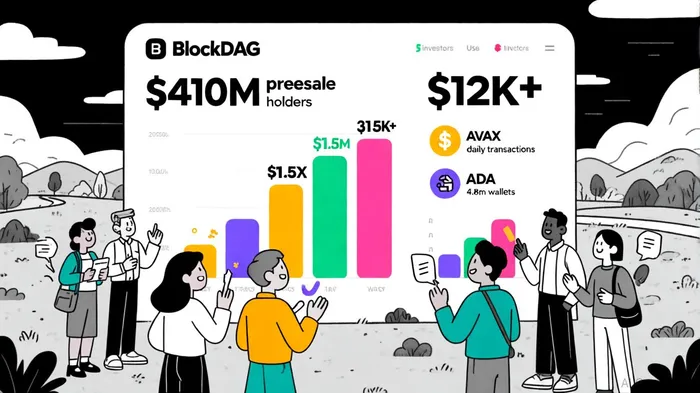
In 2025, the cryptocurrency landscape is witnessing a seismic shift as investors and developers pivot toward projects that prioritize tangible utility and decentralized infrastructure. BlockDAG, a next-generation blockchain protocol, has emerged as a standout contender, raising over $410 million in its presale and attracting 312,000+ unique holders across 130+ countries[1]. This growth is not driven by speculative hype but by a combination of real-world adoption, hardware innovation, and a community-driven approach.
BlockDAG's Adoption Metrics: A Case for Scalability
BlockDAG's presale success is underpinned by its ability to deliver measurable value. The project has sold 26.2 billion tokens, with early buyers locking in a presale price of $0.0013—a price that remains fixed until October 1, 2025[2]. Meanwhile, the current Batch 30 price of $0.03 represents a 2,900% return for early adopters, signaling strong investor confidence.
The project's infrastructure further solidifies its appeal. Over 3 million users now mine via the X1 mobile app, while 19,900 physical mining units have been shipped globally[3]. These metrics highlight a decentralized network that prioritizes accessibility, as evidenced by the absence of influencer-driven marketing or centralized control.
AVAX and ADA: Struggling to Match BlockDAG's Momentum
Avalanche (AVAX) and CardanoADA-- (ADA), two of 2025's most established Layer 1s, face challenges in maintaining investor interest. AVAXAVAX--, trading around $34, has seen 1.5 million daily transactions and a 57% month-over-month increase in active addresses[4]. However, its holder distribution remains highly concentrated, with the top 100 addresses controlling 65% of the supply[5]. This centralization raises questions about long-term adoption and resilience.
Cardano (ADA), meanwhile, boasts 4.8 million unique wallets and a 67% staking rate, with 1.25 million active stakers[6]. Despite these metrics, ADA's price has remained range-bound between $0.60–$0.82, and its ecosystem growth has been outpaced by newer projects like BlockDAG.
Investor Migration: Why BlockDAG Outpaces AVAX and ADA
The 2025 investor migration trends reveal a clear preference for projects with high ROI potential and decentralized infrastructure. BlockDAG's presale offers a projected 3,025% return if its launch price reaches $0.05, dwarfing ADA's anticipated $1.80 target and AVAX's $45–$50 price ceiling[7]. This ROI is amplified by BlockDAG's $0.0013 entry point, which remains locked until October 1, creating a rare liquidity event for early buyers.
In contrast, AVAX and ADAADA-- rely on speculative narratives. AVAX's subnet model and RWA integrations are promising, but its whale-driven price action (380% surge in May 2025) suggests volatility[8]. ADA's focus on smart contract upgrades and institutional partnerships has yet to translate into sustained price appreciation, with bears dominating the short-term outlook[9].
Security and Credibility: BlockDAG's Competitive Edge
BlockDAG's credibility is further bolstered by independent audits from CertiK and Halborn, which validated its code integrity and security protocols[10]. These audits, combined with the delivery of physical mining hardware and a transparent roadmap, position BlockDAG as a project with long-term viability. AVAX and ADA, while established, lack the same level of tangible infrastructure, relying instead on technical upgrades and market speculation.
Conclusion: BlockDAG as the 2025 Altcoin to Watch
The data paints a compelling picture: BlockDAG's $410M presale, 312K+ holders, and 15,000 TPS outpace AVAX and ADA in both adoption and ROI potential. As investors seek projects with real-world utility and decentralized governance, BlockDAG's combination of hardware innovation, global reach, and security audits makes it a standout choice. While AVAX and ADA remain relevant, their centralized holder distributions and speculative price action highlight the need for alternatives. For 2025, BlockDAG is not just a contender—it's a paradigm shift.






Comentarios
Aún no hay comentarios