
BlockDAG's Ecosystem as a Disruptive Force in Global Banking: A Comparative Analysis of Blockchain Utility and Investment Potential
The global banking sector stands at a crossroads, with blockchain technology reshaping financial infrastructure. While traditional blockchains like BitcoinBTC-- and EthereumETH-- have laid the groundwork for decentralized finance, their scalability limitations-rooted in linear transaction processing-have created bottlenecks for institutions demanding real-time efficiency. Enter BlockDAG, a hybrid Directed Acyclic Graph (DAG) and blockchain protocol, which is emerging as a disruptive force in 2025. By enabling parallel transaction validation and eliminating sequential constraints, BlockDAG offers a compelling alternative for banks and fintech startups seeking to future-proof their operations.
BlockDAG's Technological Edge: Scalability and Security
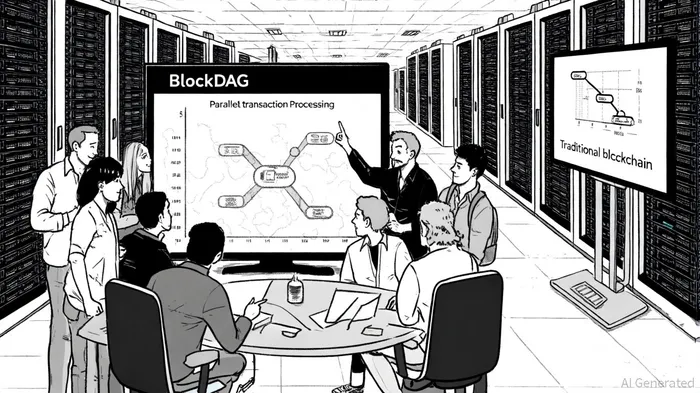
BlockDAG's architecture fundamentally redefines transaction throughput. Unlike traditional blockchains, which process transactions in a linear chain, BlockDAG allows multiple blocks to be validated simultaneously within a graph-like structure. This design achieves transaction speeds ranging from 2,000 to 15,000 transactions per second (TPS), outpacing Bitcoin's 7 TPS and Ethereum's 30 TPS, according to a comparative analysis. For context, JPMorgan Chase's blockchain-based Onyx platform executed a $1 billion repo trade in 2023, but such operations remain constrained by Ethereum's gasGAS-- fees and confirmation times, according to 2025 industry statistics. BlockDAG's hybrid model-combining DAG's parallelism with Proof-of-Work (PoW) security-also mitigates risks like 51% attacks and chain reorganizations, making it a robust solution for high-stakes financial applications, as a technical deep dive explains.
Adoption Metrics: Market Demand and Developer Ecosystem
BlockDAG's adoption is not merely theoretical. The protocol has already sold 25.6 billion BDAG coins in its presale, raising $389 million and attracting over 2 million users across 150 countries, according to presale figures. This demand is driven by its fee-less transactions, which are critical for micropayments and cross-border settlements. Meanwhile, 4,500 developers are building 300 decentralized applications (dApps) on the platform, developer metrics show. In contrast, traditional blockchain projects often rely on venture capital funding, creating centralization risks. BlockDAG's community-driven presale model, which bypasses hedge fund allocations, ensures broader retail investor participation, as a CoinEdition analysis notes.
Comparative Analysis: BlockDAG vs. Traditional Blockchain in Banking
Traditional blockchain adoption in banking has been steady but limited. By 2023, 81% of global financial institutions were exploring blockchain solutions, with the market projected to reach $22.46 billion by 2026, according to an industry report. However, these systems struggle with scalability. For instance, Ethereum's gas fees spiked to $50 during peak DeFi activity in 2021, deterring institutional use. BlockDAG's ability to handle 15,000 TPS at near-zero cost positions it as a viable replacement for legacy systems. Projects like Kaspa ($KAS) already demonstrate this potential, achieving one-second confirmations for real-time financial applications, as the Kaspa example shows.
Investment Potential: A New Paradigm for Fintech
BlockDAG's ecosystem is particularly attractive for fintech startups and SMEs. Its human-centered design, including a real-time Explorer UI and gamified community engagement, lowers the barrier to entry for non-technical users, as covered on 36crypto. This contrasts with traditional blockchains, which often prioritize technical performance over accessibility. Furthermore, BlockDAG's mobile mining app, X1 Miner, democratizes participation by allowing smartphone users to contribute to network security, fostering a decentralized user base. For investors, this translates to a project with both technological innovation and sustainable growth metrics.
Conclusion: The Future of Banking is Parallel
As global banking grapples with the need for speed, security, and scalability, BlockDAG's hybrid architecture offers a blueprint for the next generation of financial infrastructure. While traditional blockchains remain foundational, their limitations in transaction throughput and cost efficiency make them ill-suited for the high-volume demands of modern banking. BlockDAG's ability to process transactions in parallel, coupled with its community-driven governance and developer ecosystem, positions it as a disruptive force. For investors, the combination of presale success, institutional-grade security, and real-world adoption metrics makes BlockDAG a compelling long-term opportunity in 2025 and beyond.





Comentarios
Aún no hay comentarios