
BlockDAG's Disruptive Potential in Blockchain Scalability: A 2025 Comparative Analysis with Ethereum and Hyperliquid
In 2025, the blockchain landscape is witnessing a seismic shift in scalability paradigms, with BlockDAG, EthereumETH--, and Hyperliquid each vying for dominance through distinct architectural innovations. This analysis evaluates their throughput, efficiency, and adoption trajectories, offering investors a framework to assess their disruptive potential.
BlockDAG: A Hybrid Architecture for Scalability
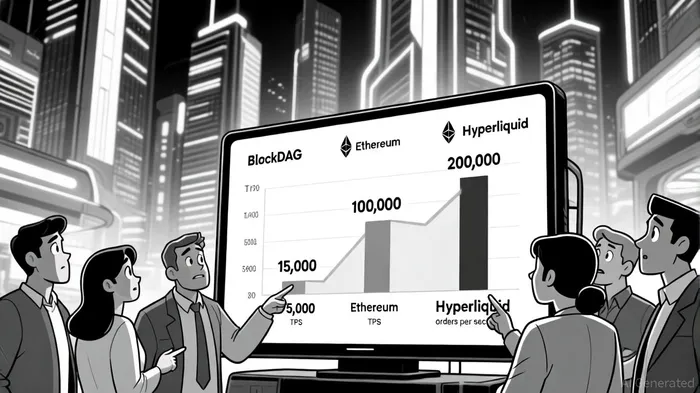
BlockDAG's hybrid Directed Acyclic Graph (DAG) + Proof-of-Work (PoW) model has emerged as a formidable contender, achieving 15,000 transactions per second (TPS), according to a Coindoo comparison. This performance outpaces Ethereum's current Layer-2 (L2) solutions, which, despite the Dencun upgrade, remain constrained by rollup-centric limitations, according to a CryptoDaily piece. BlockDAG's EVM compatibility further amplifies its appeal, enabling seamless migration of Ethereum-based applications without re-coding, as noted by Coindoo.
Financial metrics underscore its disruptive potential: BlockDAG's presale raised $385 million, with 25.5 billion coins sold and a projected 2,660% return on investment (ROI) for early investors, according to an OKX Learn analysis. Its X1 mobile mining app has attracted 2.5 million users, while 19,300 ASIC miners sold highlight robust community engagement, per CryptoDaily. These figures suggest a strong alignment between technical innovation and market adoption.
Ethereum: Iterative Upgrades and the Path to 100,000 TPS
Ethereum's 2025 roadmap, anchored by the Fusaka hard fork, aims to address scalability through PeerDAS (Peer Data Availability Sampling) and increased blob capacity, as explained in a Cointelegraph explainer. PeerDAS reduces node storage requirements by enabling data sampling, allowing the network to process 10x more rollup data per block. Coupled with a gas limit increase to 150 million units per block, these upgrades are expected to reduce congestion and lower fees by up to 90%.
However, Ethereum's economic model has shifted from deflationary to inflationary, sparking debates about tokenomics (CryptoDaily). Despite this, institutional adoption remains robust, with $550 million in ETF inflows in late 2025 (CryptoDaily). Vitalik Buterin's vision of 100,000 TPS via rollups remains aspirational, contingent on L2 execution efficiency and cross-chain interoperability.
Hyperliquid: High-Frequency Trading and Liquidity Depth
Hyperliquid's focus on decentralized perpetual trading has positioned it as a leader in the DeFi space. Its HyperBFT consensus and HyperEVM layer enable sub-second finality and support 200,000 orders per second, outpacing traditional exchanges, according to Coindoo. In Q3 2025, the platform recorded $320 billion in perpetuals trading volume and $86.6 million in protocol revenue, capturing a 35% market share in on-chain revenue (Coindoo).
Hyperliquid's deflationary token model, which allocates 97% of trading fees to HYPE buybacks, has created a flywheel effect, with $1.3 billion in token value locked through buybacks (Coindoo). Its $3.5 billion TVL and 73% market share in decentralized perpetual trading reflect strong liquidity depth and user trust (Coindoo).
Comparative Analysis: Throughput, Efficiency, and Adoption
| Metric | BlockDAG | Ethereum | Hyperliquid |
|---|---|---|---|
| TPS/Orders per Second | 15,000 TPS | 100,000 TPS (target) | 200,000 orders/sec |
| Gas Fees | N/A (DAG-based) | -90% post-Dencun | $0.01–$0.05 avg |
| TVL/Revenue | $385M presale | $550M ETF inflows | $3.5B TVL, $86.6M revenue |
| Adoption | 2.5M users, 19k ASICs | 250M+ dApp users | 73% market share |
BlockDAG's hybrid architecture and ROI projections make it a high-growth asset, while Ethereum's institutional backing and iterative upgrades ensure long-term relevance. Hyperliquid's dominance in decentralized trading, however, highlights the importance of niche specialization in DeFi.
Conclusion: Strategic Implications for Investors
For investors prioritizing scalability and ROI, BlockDAG's 15,000 TPS and 2,660% ROI present compelling short-to-medium-term opportunities, as reported by Coindoo and CryptoDaily. Ethereum's Fusaka upgrade and 2026 roadmap offer a safer bet for those betting on institutional adoption, per Cointelegraph. Meanwhile, Hyperliquid's liquidity-driven model appeals to traders seeking exposure to decentralized finance's growth (Coindoo).
The 2025 blockchain landscape is defined by specialization: BlockDAG for scalability, Ethereum for institutional trust, and Hyperliquid for trading efficiency. Diversification across these platforms may mitigate risks while capitalizing on their unique strengths.






Comentarios
Aún no hay comentarios