
Can BlockDAG Disrupt the Altcoin Hierarchy by 2026? A Scalability-Driven Analysis
The cryptocurrency market in 2025 is a battlefield of scalability. Ethereum's dominance is under siege from faster, cheaper alternatives like SolanaSOL-- and emerging contenders like BlockDAG. As the demand for decentralized applications (dApps) and real-world use cases grows, the ability to process transactions at scale without compromising security or decentralization has become the defining metric of success. Enter BlockDAG (BDAG), a hybrid Directed Acyclic Graph (DAG) + Proof-of-Work (PoW) blockchain that claims to bridge this gap. With a presale raising over $420 million and a testnet achieving 15,000 transactions per second (TPS), BlockDAG is positioning itself as a potential disruptor. But can it truly unseat EthereumETH-- and Solana in the altcoin hierarchy by 2026?
The Scalability Arms Race: BlockDAG's Technical Edge
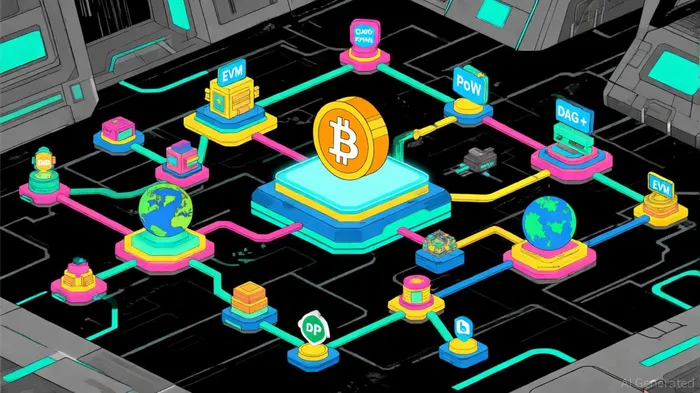
Scalability has long been the holy grail of blockchain innovation. Ethereum, despite its first-mover advantage and robust ecosystem, struggles with throughput limitations. Even with Layer 2 solutions and the Pectra upgrade, Ethereum processes roughly 30–45 TPS on-chain, according to a Crypto Reporter comparison. Solana, by contrast, boasts 65,000 TPS but has faced reliability issues, as noted in a WorldForexCrypto report. BlockDAG's hybrid architecture-combining DAG's parallel processing with PoW's security-claims to deliver 15,000 TPS in live testnets, with room to scale further, per a Phemex report.
This performance is not just theoretical. BlockDAG's Awakening Testnet has already demonstrated 1,400 TPS with EVM compatibility, enabling developers to deploy dApps and mint NFTs, according to a Dapp.Expert report. The project's roadmap includes parallel block processing and miner synchronization, which could push throughput to 15,000 TPS by 2026, as Analytics Insight noted. Such metrics position BlockDAG as a viable alternative for high-volume use cases like DeFi, gaming, and cross-border payments.
Market Positioning: From Presale Momentum to Ecosystem Growth
BlockDAG's rise isn't just about numbers-it's about execution. The project has raised over $425 million in its presale, selling 27 billion tokens, a figure that dwarfs many altcoins' total market caps, per Crypto Reporter coverage. This capital has fueled infrastructure development, including 3 million daily mobile miners via the X1 app and partnerships with global sports franchises like Inter Milan and the BWT Alpine Formula 1 Team, according to another Crypto Reporter article. These partnerships aren't just PR stunts; they signal real-world adoption and brand visibility.
Ethereum and Solana, meanwhile, face their own challenges. Ethereum's $3,800 price tag and energy-efficient PoS model have kept it relevant, but its scalability limitations persist. Solana's $210 price and 65,000 TPS are impressive, but network instability and a lack of major protocol upgrades in 2025 have eroded some of its luster, as outlined in a Blockonomi guide. BlockDAG's hybrid model, with its balance of speed, security, and decentralization, could appeal to developers and users seeking a middle ground.
Value Creation: dApps, Partnerships, and Tokenomics
For BlockDAG to disrupt the hierarchy, it must create tangible value. The project's roadmap includes hosting 1,000 dApps by 2026, spanning DeFi, gaming, health, and identity, highlighted in a Crypto Reporter keynote. Developer incentives like grants, hackathons, and an Ambassador Program aim to accelerate this growth. Early signs are promising: the testnet has already processed 362,599 transactions and 285,058 blocks, per the BlockDAG dev release.
Tokenomics also play a role. BlockDAG's Smart Account roadmap and EIP-4337 compatibility are designed to control coin velocity and boost staking activity, according to a CoinCentral projection. With 312,000 holders and a projected 3,000% ROI if the token lists at $0.05, the token's utility and scarcity could drive demand, per a Crypto-Economy report. However, price predictions vary widely, from $0.002 by 2025 to speculative $0.06 by 2030, reflecting the market's volatility in CryptoNews predictions.
Challenges and the Path to Disruption
No project is without risks. BlockDAG's success hinges on timely execution of its roadmap, including the October 1, 2025, deployment of miner sync and blockchain explorer tools, as TechBullion noted. Delays or technical setbacks could erode investor confidence. Additionally, the altcoin market is crowded, with competitors like BittensorTAO-- and EthenaENA-- vying for developer attention, according to a CoinInsight piece.
Yet, BlockDAG's hybrid model offers a unique value proposition. Unlike pure DAG networks (e.g., IOTA) or PoW chains (e.g., Bitcoin), it combines scalability with decentralization and security. Its EVM and WASM compatibility further lower the barrier for developers, enabling cross-chain migration from Ethereum and PolkadotDOT--, as covered in a CoinCentral comparison.
Conclusion: A Contender for the Top 15
By 2026, BlockDAG has the technical and financial foundations to challenge Ethereum and Solana. Its hybrid architecture addresses scalability without sacrificing security, while its ecosystem growth and real-world partnerships validate its potential. If it achieves 15,000 TPS in production and attracts 1,000 dApps, BlockDAG could secure a spot in the top 15 cryptocurrencies-a feat that would redefine the altcoin hierarchy.
However, disruption is never guaranteed. Market dynamics, regulatory shifts, and technological breakthroughs could alter the landscape. For now, BlockDAG's combination of scalability-driven innovation and measurable adoption makes it a project to watch.






Comentarios
Aún no hay comentarios