
BlockDAG's Breakthrough and Implications for the Cryptocurrency Market
The cryptocurrency market in 2025 is witnessing a paradigm shift driven by next-generation blockchain projects that prioritize scalability, real-world utility, and user engagement. Among these, BlockDAG has emerged as a standout contender, leveraging a hybrid Directed Acyclic Graph (DAG) and Proof-of-Work (PoW) architecture to achieve unprecedented transaction throughput. With testnet performance exceeding 2,000 transactions per second (TPS) and a roadmap targeting 15,000 TPS, BlockDAG is redefining the benchmarks for Layer 1 blockchains. This analysis evaluates how its technical innovations and strategic execution position it to disrupt traditional blockchain models and drive mass adoption.
Technological Breakthrough: Hybrid Architecture and Scalability
BlockDAG's core innovation lies in its fusion of DAG's parallel processing with PoW's security. Unlike linear blockchains, which process transactions sequentially, BlockDAG allows multiple blocks to be validated simultaneously, eliminating throughput bottlenecks. According to an Analytics Insight report, the network's testnet has already achieved 2,000 TPS, with the potential to scale to 15,000 TPS through further optimization. This dwarfs the performance of established chains like EthereumETH-- (15–45 TPS, according to Analytics Insight beta coverage) and CardanoADA-- (257 TPS, per a Coinotag report), which struggle to balance scalability with decentralization.
The hybrid model also introduces Proof of Engagement (PoE), enabling mobile users to mine via the X1 app by simply staying active on the platform. This dual-mining approach-combining hardware and mobile participation-ensures broad accessibility while maintaining energy efficiency. As stated by Crypto Reporter, BlockDAG's EVM compatibility further accelerates developer adoption, allowing seamless deployment of 300+ decentralized applications (dApps) across DeFi, NFTs, and Web3 infrastructure.
Real-World Adoption: Partnerships and User Growth
BlockDAG's scalability is matched by its aggressive real-world integration. Strategic partnerships with global sports teams, including Inter Milan and the Seattle Orcas, have amplified its brand visibility and attracted mainstream audiences. The X1 app, with 2.5 million users, has become a gateway for mass participation, simulating mining on smartphones and rewarding engagement, according to Analytics Insight coverage. This user base, combined with 19,000+ ASIC miners sold, underscores a hybrid ecosystem that bridges institutional and retail stakeholders.
The project's testnet has already processed 362,599 transactions, demonstrating tangible utility beyond theoretical metrics, as noted in a CoinCentral review. A demo trading platform and blockchain explorer further enhance transparency, enabling users to practice trading and developers to experiment with smart contracts. These features align with the growing demand for user-friendly, production-ready blockchain solutions.
Market Positioning: Presale Success and Competitive Edge
BlockDAG's presale, which raised over $380 million by August 2025, ranks among the largest in crypto history. This capital influx has funded hardware deployment, developer incentives, and global marketing campaigns. Analysts note that the project's focus on execution-unlike academically driven roadmaps of competitors like Cardano-has translated into rapid progress, including a live testnet and EVM compatibility.
The network's ability to sustain high TPS without compromising security or decentralization positions it as a viable alternative for enterprises and developers. For instance, its parallel block confirmation reduces latency, making it suitable for real-time payments and supply chain applications. As Blockchain Times highlights, BlockDAG's hybrid model addresses the "trilemma" of scalability, security, and decentralization, a persistent challenge for legacy blockchains.
Challenges and Considerations
While BlockDAG's metrics are compelling, its long-term success hinges on post-launch execution. The project must maintain user engagement beyond the presale hype and ensure seamless mainnet deployment. Critics argue that DAG-based models face complexity in consensus mechanisms, requiring rigorous stress-testing. Additionally, competition from Ethereum's upgrades and emerging Layer 1s like SolanaSOL-- remains intense.
However, BlockDAG's active developer community (4,500+ contributors) and strategic partnerships provide a buffer against these risks. The planned listing on ten major exchanges is expected to enhance liquidity and attract institutional investors.
Conclusion: A Catalyst for Next-Gen Blockchain Adoption
BlockDAG's breakthrough in scalability and real-world utility underscores a critical trend in the crypto market: the shift toward high-performance, user-centric blockchains. By combining DAG's throughput with PoW's security and mobile accessibility, it addresses the limitations of traditional models while fostering mass adoption. For investors, the project's presale success, ecosystem growth, and technical execution present a compelling case for long-term value creation. As the 2025 crypto cycle unfolds, BlockDAG's ability to deliver on its roadmap will likely determine its role in shaping the future of decentralized finance and Web3. 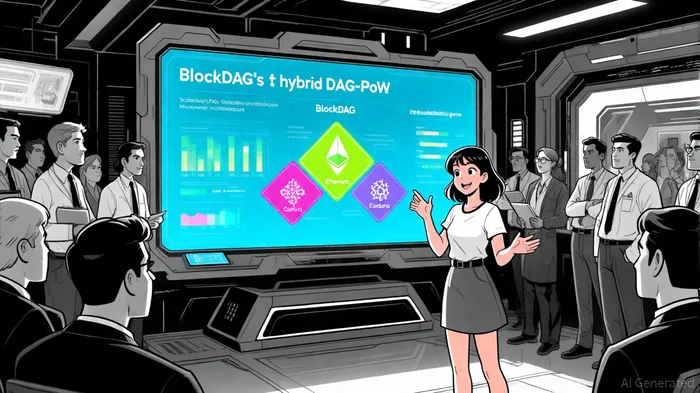






Comentarios
Aún no hay comentarios