
Why BlockDAG, Arbitrum, Hedera, and Stellar Are the 2025 Bull Run Powerhouses
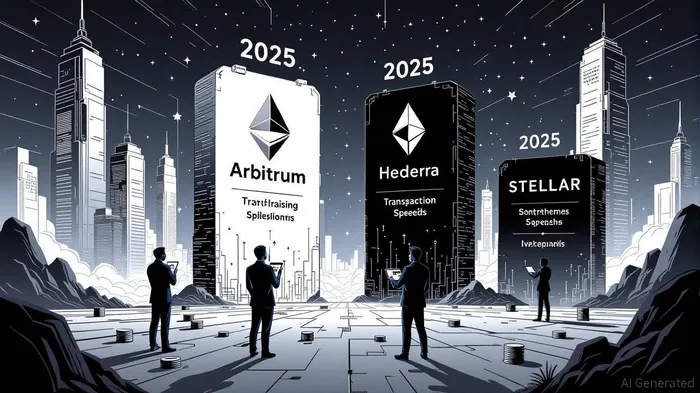
The 2025 crypto bull run is being driven by a seismic shift in blockchain infrastructure and enterprise adoption. Four projects—BlockDAG, Arbitrum, HederaHBAR--, and Stellar—are emerging as powerhouses, each leveraging unique technological innovations, institutional backing, and real-world utility to redefine the industry. This analysis breaks down why these projects are poised for explosive growth and long-term value appreciation.
BlockDAG: Retail-Driven Growth Meets Institutional Credibility
BlockDAG (BDAG) has shattered fundraising records in 2025, raising $386 million in its presale across 30 batches, outpacing early-stage totals of Layer-1 giants like AvalancheAVAX-- ($230M) and Aptos ($350M) [2]. With 25.5 billion tokens sold and a $600M target in sight, the project’s retail-first model has attracted 3 million mobile miners via the X1 app and 19,000+ X-series miners sold [1]. Whale investments totaling $10 million and confirmed listings on MEXC and BitMart further validate its institutional appeal [2].
BlockDAG’s hybrid DAG + Proof-of-Work (PoW) architecture enables 10,000–15,000 transactions per second (TPS), outperforming competitors [3]. Its ecosystem includes 4,500 developers building 300+ dApps, while partnerships with global sports teams like Inter Milan and Borussia Dortmund amplify mainstream visibility [3]. Analysts project a listing price of $0.05 by 2025, with long-term targets reaching $10 if it breaks into the top 10 cryptos by market cap [1].
Arbitrum: Ethereum’s Layer-2 Dominance and Institutional Integration
Arbitrum (ARB) has solidified its role as Ethereum’s leading Layer-2 scaling solution, processing $17.14 billion in TVL and surpassing Ethereum’s mainnet in transaction volume [4]. Its Optimistic Rollups reduce costs while maintaining security, making it a hub for DeFi protocols like UniswapUNI-- and AaveAAVE-- [4]. Institutional adoption is accelerating: the U.S. Department of Commerce now publishes quarterly GDP data on Arbitrum, validating its infrastructure for institutional use [4].
Robinhood’s integration of Arbitrum in Europe and BlackRock’s tokenization of U.S. government securities via the BUIDL fund highlight its real-world utility [4]. Cold Wallet’s institutional custody solutions and 50+ Orbit chains in the roadmap underscore Arbitrum’s scalability and developer flexibility [4]. With ArbOS 40 and Stylus upgrades enhancing interoperability, Arbitrum is positioned to dominate the institutional-grade blockchain space.
Hedera: Enterprise-Grade Consensus and Tokenization Momentum
Hedera (HBAR) is redefining enterprise blockchain with its hashgraph consensus mechanism, achieving 10,000 TPS and predictable low fees [5]. Institutional partnerships are surging: UK banks like LloydsLYG-- and abrdn are using Hedera for $10 billion asset settlements, while Nasdaq filed for a spot HBARHBAR-- ETF in August 2025 [5]. The platform’s collaboration with Isle Finance enables instant stablecoin payments for B2B transactions, reducing settlement delays to near-zero [5].
HBAR’s real-world utility is expanding through tokenized assets and compliance tools. AUDD Digital’s APAC-focused stablecoin and SWIFT’s cross-border settlement testing highlight Hedera’s institutional readiness [5]. Analysts project HBAR could reach $0.30 in Q3 2025 and $0.50 by early 2026 if adoption continues [5].
Stellar: Cross-Border Payments and Protocol 23 Upgrades
Stellar (XLM) is gaining traction with Protocol 23, which boosts scalability to 5,000 TPS and introduces compliance tools for automated KYC/AML enforcement [6]. PayPal’s integration of PYUSD and Visa’s inclusion of StellarXLM-- in its stablecoin settlement platform underscore its role in enterprise-grade cross-border payments [6]. The Stellar Disbursement Platform (SDP) has already transformed payroll delivery in conflict zones like Syria, automating wallet creation for recipients [6].
With $120 million in DeFi TVL post-Protocol 23 and partnerships with UNICEF and MoneyGram, Stellar’s real-world utility is undeniable [6]. Its focus on low-cost, high-speed transactions positions it as a key player in the 2025 bull run.
The 2025 Bull Run: Infrastructure and Enterprise Adoption as Catalysts
The 2025 bull run is being fueled by projects that bridge blockchain’s scalability limitations with real-world enterprise needs. BlockDAG’s retail-driven growth and DAG-PoW hybrid, Arbitrum’s EthereumETH-- Layer-2 dominance, Hedera’s institutional-grade consensus, and Stellar’s cross-border payment innovations collectively represent a $100+ billion market opportunity.
Conclusion: Positioning for Long-Term Value Appreciation
For investors, the 2025 bull run offers a rare opportunity to capitalize on blockchain’s next wave of innovation. BlockDAG’s explosive presale and retail adoption, Arbitrum’s institutional integration, Hedera’s enterprise-grade infrastructure, and Stellar’s cross-border utility all point to a future where blockchain becomes the backbone of global finance. Early adoption of these projects—backed by robust fundamentals and real-world use cases—could yield outsized returns as the bull run unfolds.
Source:
[1] BlockDAG Presale Surpasses Avalanche & Aptos With ..., [https://cryptobrowser.io/news/200000-holders-3m-miners-heres-why-blockdags-retail-first-growth-leaves-aptos-and-avalanche-behind/]
[2] BlockDAG Presale Hits $386M on the Road to $600M, [https://www.mexc.com/en-GB/news/blockdag-presale-hits-386m-on-the-road-to-600m-why-investors-call-it-the-best-crypto-presale/77193]
[3] BlockDAG Rivals Top Cryptos with Real-World Mining and ..., [https://www.bitget.com/news/detail/12560604950518]
[4] Latest Arbitrum (ARB) News Update, [https://coinmarketcap.com/cmc-ai/arbitrum/latest-updates/]
[5] Hedera Network in July 2025: Tokenization Momentum, [https://genfinity.io/2025/08/04/hedera-network-july-2025-updates/]
[6] Stellar Network's Protocol 23 Upgrade: A Strategic Catalyst, [https://www.bitget.com/news/detail/12560604946871]






Comentarios
Aún no hay comentarios