
BlockDAG’s $400M Presale and 3M Miners vs. TRX’s Growth Trajectory: A Deep Dive into Next-Gen Blockchain Scalability and Sustainable Adoption
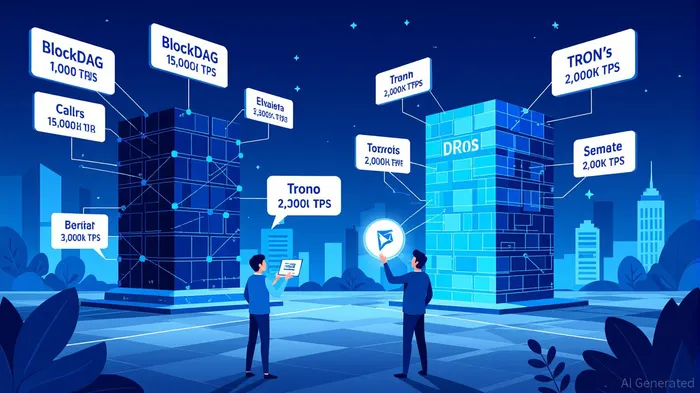
The Scalability Arms Race: BlockDAG’s Hybrid Innovation vs. TRON’s Proven Infrastructure
Blockchain scalability has long been a holy grail for developers and investors. In 2025, two projects—BlockDAG and TRONTRON-- (TRX)—stand out for their contrasting approaches to solving this challenge. BlockDAG, with its $400 million presale and 3 million mobile miners, is betting on a hybrid Directed Acyclic Graph (DAG) + Proof-of-Work (PoW) model to achieve unprecedented transaction speeds. TRON, meanwhile, has solidified its position as a stablecoin and DeFi powerhouse, leveraging its Delegated Proof-of-Stake (DPoS) architecture to process 2,000 transactions per second (TPS) while maintaining low fees and high throughput.
BlockDAG: A New Paradigm in Scalability and Community-Driven Growth
BlockDAG’s presale has raised nearly $400 million, with over 25.9 billion tokens sold at $0.0013, positioning it as one of the most capital-rich projects of 2025 [1]. Its hybrid DAG + PoW model enables parallel transaction validation, achieving a theoretical 15,000 TPS—far outpacing Solana’s 1,133 TPS and Ethereum’s 15–45 TPS [2]. This scalability is critical for real-world adoption, particularly in sectors like gaming, finance, and global paymentsGPN--, where high throughput and low latency are non-negotiable.
The project’s miner network further underscores its decentralized ethos. Over 3 million users are already mining via the X1 Mobile Miner app, while 19,000 ASIC units have been shipped globally [1]. This grassroots distribution model not only democratizes participation but also ensures network security through a diverse miner base. Whale activity, including purchases exceeding $4.4 million, has added credibility to BlockDAG’s long-term potential [1].
However, BlockDAG’s launch has faced delays, with the Deployment Event now scheduled for September 30, 2025 [6]. Despite this, its ecosystem is already active: 4,500+ developers have built 300+ decentralized applications (DApps), and partnerships with global sports teams like Inter Milan and Borussia Dortmund are driving real-world utility [2].
TRON (TRX): Proven Scalability and Ecosystem Maturity
TRON’s DPoS consensus model, with 27 Super Representatives, has enabled it to process 10 billion transactions in Q2 2025 alone, a 19% year-over-year increase [2]. Its theoretical 2,000 TPS and 60% transaction fee reduction have made it a go-to platform for stablecoin settlements, with $23.5 billion in daily USDTUSDC-- transfers [6]. This dominance in stablecoin activity—accounting for 89.3% of transactions—has cemented TRON’s role in global finance [2].
TRON’s Total Value Locked (TVL) reached $9.3 billion by mid-2025, driven by DeFi protocols like JustLend and SunSwap [2]. The platform’s sidechain, "The Sun Network," further enhances scalability by offloading transactions to parallel chains. With 276 million total wallet addresses and 2.5–3 million daily active addresses, TRON’s user base is concentrated in the Asia-Pacific region, where low fees and developer incentives have fueled adoption [2].
Critically, TRON’s energy efficiency stems from its DPoS model, which consumes significantly less power than PoW-based networks [4]. This aligns with global sustainability goals and positions TRON as a scalable, eco-friendly alternative to energy-intensive blockchains.
Comparative Analysis: Scalability, Adoption, and Sustainability
Scalability:
BlockDAG’s DAG + PoW model offers a quantum leap in transaction speed (15,000 TPS vs. TRON’s 2,000 TPS), making it ideal for high-volume use cases. However, TRON’s DPoS architecture, combined with sidechains, ensures consistent throughput and real-world reliability.
Adoption:
BlockDAG’s presale and miner network reflect a community-driven approach, with 3 million mobile miners and 19,000 ASIC units creating a decentralized security layer. TRON, by contrast, has prioritized ecosystem maturity, with 1,900 active DApps and a $33 billion market cap [2].
Sustainability:
Both projects emphasize energy efficiency. BlockDAG’s hybrid model balances decentralization with low energy consumption, while TRON’s DPoS inherently reduces power usage. However, TRON’s existing infrastructure and stablecoin dominance give it a head start in real-world utility.
The Road Ahead: Which Project Holds More Promise?
BlockDAG’s potential ROI is staggering: a Deployment Event price of $1 would represent a 76,815% return on its presale price of $0.0013 [1]. Yet, its delayed launch and unproven DAG + PoW model introduce risks. TRON, while less speculative, offers a track record of growth, with analysts predicting a price target of $0.45–$0.50 [2].
For investors, the choice hinges on risk tolerance. BlockDAG appeals to those seeking high-growth, next-gen infrastructure, while TRON suits those prioritizing established scalability and stablecoin dominance. Both, however, underscore the industry’s shift toward energy-efficient, high-throughput solutions—a trend that will define blockchain’s next decade.
Source:
[1] Most Popular Cryptocurrencies to Watch in 2025 [https://coincentral.com/most-popular-cryptocurrencies-to-watch-in-2025-why-blockdag-is-stealing-the-spotlight]
[2] TRON Statistics 2025: Users, DeFi, Stablecoins & More [https://coinlaw.io/tron-statistics/]
[6] BlockDAG (BDAG) Price Prediction 2025, 2026, 2030 [https://cryptonews.com/price-predictions/blockdag-price-prediction/]





Comentarios
Aún no hay comentarios