
BlockDAG's 2025 Surge: A Structural and Economic Powerhouse Outpacing Shiba Inu and Hedera
In 2025, the cryptocurrency landscape is witnessing a seismic shift as projects with robust infrastructure and sustainable economic models outpace speculative narratives. BlockDAG, a hybrid Directed Acyclic Graph (DAG) and Proof-of-Work (PoW) blockchain, has emerged as a standout contender, surpassing Shiba InuSHIB-- (SHIB) and HederaHBAR-- (HBAR) in both technical innovation and market momentum. This analysis delves into the structural and economic advantages that position BlockDAG as a top-tier investment opportunity in a competitive market.
Structural Superiority: Scalability and Security
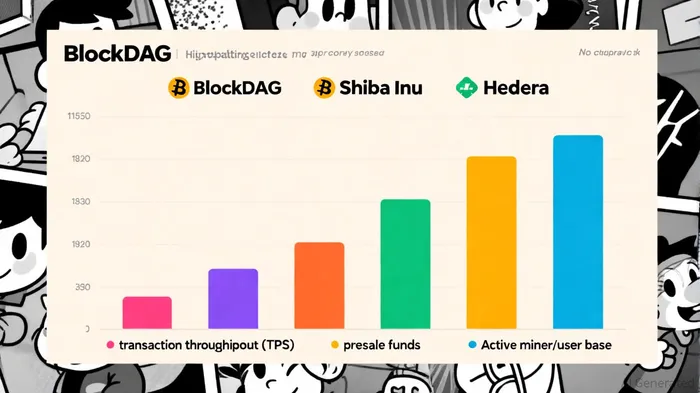
BlockDAG's hybrid architecture combines the scalability of a DAG with the security of PoW, enabling it to process up to 15,000 transactions per second (TPS) in live conditions, according to an Analytics Insight article. This dwarfs Shiba Inu's reliance on Ethereum-based smart contracts, which struggle with congestion and high gas fees, and Hedera's hashgraph consensus, which, while efficient, lacks the decentralized security of PoW, as noted in a Coingabbar forecast. The DAG component allows parallel block validation, while the PoW layer mitigates spam and Sybil attacks, making BlockDAG more attractive to institutional players (the Analytics Insight piece elaborates on these points).
In contrast, Shiba Inu's token burns and Shibarium's Layer 2 solution, while improving gas efficiency, fail to address fundamental scalability limitations, according to an Analytics Insight SHIB forecast. Hedera's focus on stablecoin use cases and enterprise partnerships is commendable, but its 5,000 TPS ceiling and energy-efficient consensus model cannot match BlockDAG's throughput or miner-driven security, as shown in a Coinbird comparison.
Economic Model: Liquidity and Tokenomics
BlockDAG's presale has raised over $425 million, with 312,000+ holders and a growing user base of 3.5 million active miners via the X1 mobile app, according to the Analytics Insight coverage. This liquidity-driven model contrasts sharply with Shiba Inu's speculative momentum, where token burns-though aggressive-have yet to translate into meaningful price appreciation, as discussed in a Watcher Guru analysis. Hedera's 50 billion token supply, while advantageous for scarcity, cannot offset its reliance on compliance-driven narratives and short-term volatility (the Coinbird comparison outlines these trade-offs).
BlockDAG's tokenomics are structured to incentivize long-term participation: 50% of the 150 billion total supply is allocated to miners, with early emissions creating temporary selling pressure that analysts project will be offset by sustained demand (the Coingabbar forecast examines these projections). Early presale participants have already seen 2,660% paper gains, and post-launch projections range from $0.05 to $0.10, with long-term forecasts reaching $1–$30 by 2030 (Coingabbar's analysis provides detailed scenarios). Shiba Inu's $0.000013 price point and 589 trillion supply, meanwhile, make its $1 target implausible without radical supply adjustments (the Analytics Insight SHIBSHIB-- forecast addresses this).
Ecosystem Growth: Real-World Adoption
BlockDAG's ecosystem is expanding rapidly, with 4,500 developers and 300 decentralized applications in development, supported by EVM and WASM compatibility (the Analytics Insight article summarizes developer and dApp metrics). Partnerships with sports teams like Inter Milan and the Seattle Seawolves have amplified its brand visibility, while enterprise solutions in cross-border payments and supply chain management underscore its utility (Coingabbar's coverage highlights enterprise use cases). Hedera's Wyoming FRNT stablecoin initiative and partnerships with Google and IBM are notable, but BlockDAG's 20,000+ hardware miners and 2.5 million X1 app users indicate a more decentralized and engaged community, as reported by Analytics Insight.
Shiba Inu's metaverse and DeFi initiatives remain underutilized, with adoption plateauing despite token burns and Shibarium's launch (the Watcher Guru analysis reviews SHIB's adoption challenges). Its market cap of $7.43 billion, while impressive, is increasingly outpaced by BlockDAG's $425 million presale valuation and projected post-launch growth (the Analytics Insight coverage provides comparative valuations).
Market Position and Projections
As of 2025, BlockDAG's market capitalization is projected to surpass Shiba Inu and Hedera by 2026, driven by its roadmap milestones, including listings on Gemini and CoinbaseCOIN-- (Coingabbar's forecast outlines listing scenarios). Technical analysts highlight a golden cross for HBARHBAR-- and a bullish breakout for SHIB, but both face structural headwinds: SHIB's 7.49 trillion token outflows and HBAR's reliance on regulatory alignment (the Analytics Insight SHIB forecast and Coinbird comparison discuss these risks).
BlockDAG's $0.05–$0.10 listing target and $1–$30 2030 forecasts (Coingabbar's forecast) suggest a trajectory that aligns with its infrastructure-driven growth.
Conclusion
BlockDAG's hybrid DAG-PoW architecture, liquidity-rich presale, and real-world adoption strategies position it as a superior investment compared to Shiba Inu's speculative model and Hedera's compliance-centric approach. While all three projects aim to capture institutional and retail markets, BlockDAG's technical robustness and economic incentives create a flywheel effect that is difficult to replicate. For investors seeking long-term value in a fragmented crypto landscape, BlockDAG's 2025 momentum is notNOT-- just a trend-it's a structural redefinition of what a Layer-1 blockchain can achieve.





Comentarios
Aún no hay comentarios