
Blockchain Beyond Speed: User Activity as the True Growth Indicator
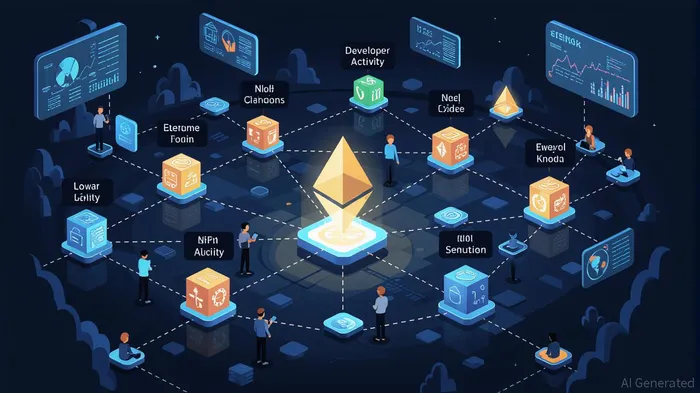
Blockchain ecosystems have long been evaluated through narrow metrics like transaction speed, gas fees, and consensus mechanisms. Yet, as the industry matures, a clearer picture emerges: user activity—not technical benchmarks—drives long-term value creation. Ethereum’s evolution in 2023–2025 exemplifies this shift, with its ecosystem thriving on sustained user engagement, developer innovation, and real-world utility. This article argues that investors should prioritize metrics like daily active wallets (DAU), developer activity, and dApp adoption to identify blockchain projects with sustainable growth potential.
The Myth of Speed: Why Transaction Throughput Fails as a Benchmark
Speed-centric metrics, such as transactions per second (TPS), often dominate early-stage blockchain hype cycles. However, these metrics fail to capture the complexity of user behavior or the value of decentralized applications. For instance, while newer blockchains like Base and TON tout high TPS, Ethereum’s Layer-2 rollups processed 2.4 billion transactions in 2024, driven by user demand rather than technical superiority [3]. This underscores a critical insight: scalability is a function of user activity, not just infrastructure.
Ethereum’s Pectra upgrade in May 2025—a hard fork focused on staking mechanics and user experience—further illustrates this. By improving scalability and reducing friction, the upgrade solidified Ethereum’s DAU between 380,000 and 420,000 in H1 2025, a stable base reflecting a mature user base [2]. This consistency, compared to the volatile growth of 2017–2022, signals a shift from speculative adoption to institutional and enterprise-grade usage [5].
Developer Engagement: The Engine of Ecosystem Resilience
Ethereum’s dominance in developer activity is a cornerstone of its long-term value. In 2025, over 3,200 monthly active developers contribute to its ecosystem, dwarfing competitors like CardanoADA-- (720 developers) [1]. The EthereumETH-- Foundation’s $45 million in grants and the Devcon 2025 conference—drawing 8,500 attendees—further cement its role as the go-to platform for innovation [1].
This developer density translates to tangible outcomes. Over 170,000 GitHub commits in the past year and 660+ Ethereum Improvement Proposals (EIPs) highlight a vibrant, iterative development cycle [1]. Projects like AaveAAVE-- and Lido, with combined TVL of $61.396 billion, demonstrate how developer-driven innovation sustains user trust and capital [1]. Even as dApp activity in sectors like gaming declines (a 17% QoQ drop in Q2 2025), Ethereum’s foundational role in DeFi and NFTs remains unshaken [4].
Real-World DApp Adoption: Beyond the Hype Cycle
While metrics like daily unique active wallets (dUAW) for dApps dipped by 3% in Q1 2025, Ethereum’s real-world use cases reveal a different story. For example:
- DeFi: A 291% QoQ surge in user activity in Q1 2024, driven by liquid staking and lending protocols [1].
- Payroll solutions: Ethereum-based smart contracts are transforming cross-border salary payments in Asia, leveraging low fees and scalability [2].
- NFTs: Utility NFTs for ticketing and identity are reviving the sector, with Ethereum’s market share growing despite competition from cheaper blockchains [1].
These applications highlight a critical trend: blockchain’s value lies in solving real-world problems, not just enabling speculative trading. While Ethereum faces competition from Layer 2s and newer chains, its EVM compatibility ensures seamless integration, fostering a flywheel effect where developer tools and user bases reinforce each other [5].
Why User-Driven Investment Strategies Outperform
Investors who prioritize user activity metrics over speed-centric benchmarks are better positioned to capture long-term value. Consider Ethereum’s DAU growth: from 300K–450K in 2023–2024 to a stabilized 380K–420K in H1 2025 [2]. This maturity, driven by the Pectra upgrade and institutional adoption, contrasts with the boom-and-bust cycles of earlier years. Similarly, Ethereum’s $11.8 billion daily transaction volume in 2025—powered by DeFi and Layer-2 solutions—reflects a user base that values reliability over novelty [6].
In contrast, blockchains that prioritize speed often struggle with user retention. For instance, while Ronin and Polygon saw dUAW growth in Q2 2025, their success is tied to niche use cases (e.g., gaming) rather than broad ecosystem adoption [4]. This fragility makes them less attractive for long-term investment.
Conclusion: Reimagining Value in Web3
The blockchain industry is at a crossroads. As user activity metrics like DAU, developer engagement, and real-world dApp adoption become more sophisticated, they offer a clearer lens for evaluating long-term value. Ethereum’s 2023–2025 trajectory—marked by stable user growth, robust developer activity, and practical use cases—demonstrates that sustainable growth in Web3 is user-driven, not speed-driven.
For investors, the lesson is clear: prioritize ecosystems where user behavior, not technical jargon, defines success. In a world where blockchain’s promise is increasingly realized through tangible applications, the true growth indicators lie in the wallets, developers, and dApps that power them.
Source:
[1] Ethereum vs. Cardano Statistics 2025: DeFi, NFTs, etcETC--. [https://coinlaw.io/ethereum-vs-cardano-statistics/]
[2] How is Ethereum Transforming Payroll Solutions in 2025? [https://www.onesafe.io/blog/ethereum-transforming-payroll-solutions-2025]
[3] The State of Web3 Industry- Industry Report [https://www.slideshare.net/slideshow/the-state-of-web3-industry-industry-report/280419362]
[4] 10 Blockchains Leading in User Adoption in 2025 [https://www.ccn.com/education/crypto/10-fastest-growing-blockchains-to-watch/]
[5] ETHEREUM (ETH) STAKING INSIGHTS & PROTOCOL ... [https://everstake.one/crypto-reports/ethereum-staking-insights-and-analysis-first-half-of-2025]
[6] Binance Smart Chain vs. Ethereum Statistics 2025 [https://coinlaw.io/binance-smart-chain-vs-ethereum-statistics/]






Comentarios
Aún no hay comentarios