
Blockchain Sovereignty and Asset Control: Navigating Centralized Risks and Decentralized Rewards in 2025
Centralized Mechanisms: Security at the Cost of Autonomy
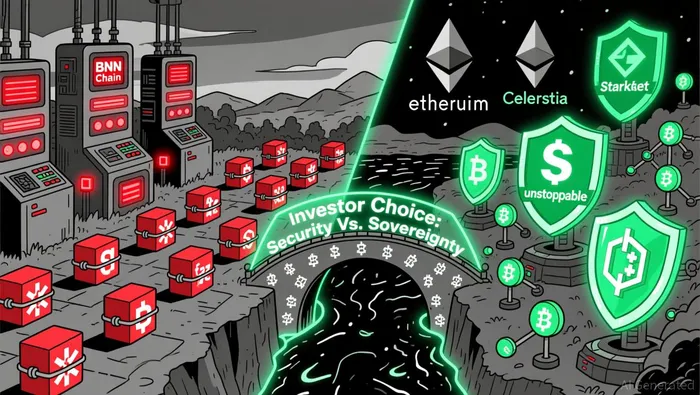
Bybit's analysis identifies three primary methods for fund freezing: hardcoded functions, config-based blacklists, and smart contract controls, as Coinotag notes. For instance, BNB Chain, VeChainVET--, and XinFin's XDC Network embed freezing capabilities directly into their source code, allowing administrators to act unilaterally. Meanwhile, blockchains like SuiSUI-- and Aptos rely on editable configuration files managed by validators or developers, enabling rapid but centralized interventions. These tools have proven useful in crisis scenarios: Sui froze $162 million in stolen assets after the CetusCETUS-- hack, and BNB Chain responded to a $570 million bridge exploit using hardcoded blacklists, according to Lampros.
However, such power inherently undermines the foundational principle of blockchain-user autonomy. If a network's administrators can override user intent, it introduces a single point of failure and opens the door to censorship or regulatory pressure. The report also notes that 19 additional blockchains, including Cosmos-based networks, could adopt similar capabilities with minimal protocol adjustments, as Liberty Street Economics notes. For investors, this signals a systemic risk: even blockchains marketed as decentralized may harbor hidden centralization.
Decentralized Alternatives: The Rise of Censorship-Resistant Protocols
In response to these risks, 2025 has seen a strategic shift toward truly censorship-resistant protocols. EthereumETH--, for example, anchors its security through a decentralized validator base of over 1 million participants, with $90 billion in staked ETH under its Proof-of-Stake model, as LinkedIn reports. Protocols like EigenLayer and Karak Network further enhance this by enabling shared security markets, where validator capital is reused across ecosystems. Meanwhile, Celestia addresses data availability-a critical component of censorship resistance-by offering modular, verifiable data sampling for rollups, as Lampros notes.
Zero-knowledge (zk) protocols such as Starknet and Polygon zkEVM also play a pivotal role. By cryptographically verifying computational correctness, they ensure that no entity can alter or suppress data without detection. These systems are designed to withstand external pressures, whether from regulators or malicious actors. For instance, during the Tornado Cash sanctions, Ethereum's decentralized validator dispersion mitigated coordinated censorship efforts, as some proposers excluded sanctioned transactions while others did not, as Lampros notes.
Investment Implications: Balancing Risk and Resilience
The BitcoinBTC-- World report underscores a key investment dilemma: centralized networks offer short-term security but long-term vulnerability, while decentralized protocols prioritize resilience at the cost of complexity. For risk-averse investors, blockchains with freezing capabilities may provide a safety net in crises, as demonstrated by Bybit's own $1.5 billion cold wallet breach, as Bitcoin World notes. However, these networks expose portfolios to governance risks, where administrators could prioritize compliance over user rights.
Conversely, censorship-resistant protocols like Ethereum and CelestiaTIA-- appeal to those prioritizing long-term sovereignty. Their adoption is accelerating: the U.S. decentralized social network market, valued at $13.83 billion in 2025, is projected to grow at an 8.78% CAGR through 2033, as LinkedIn reports. Yet, challenges remain-technical scalability, regulatory uncertainty, and user education barriers could slow adoption.
Strategic Recommendations for Investors
- Diversify Across Governance Models: Allocate capital to both centralized and decentralized networks, balancing immediate security needs with long-term resilience. For example, pair BNB Chain's rapid response capabilities with Ethereum's validator dispersion, as Coinotag notes.
- Prioritize Protocols with Transparent Governance: Favor blockchains with open-source codebases and decentralized validator bases, such as Ethereum or Celestia, to minimize hidden centralization risks, as LinkedIn notes.
- Monitor Regulatory Developments: As governments increasingly target crypto infrastructure, protocols with modular designs (e.g., Cosmos) may adapt more swiftly to compliance demands without sacrificing decentralization, as Liberty Street Economics notes.
Conclusion
The Bitcoin World analysis serves as a wake-up call: even the most prominent blockchains may harbor centralized vulnerabilities. For investors, the path forward lies in understanding the trade-offs between control and autonomy. While centralized networks offer tactical advantages, the long-term health of crypto portfolios depends on embracing censorship-resistant protocols. As the industry evolves, those who prioritize sovereignty-without sacrificing security-will be best positioned to navigate the uncertainties of 2025 and beyond.






Comentarios
Aún no hay comentarios